Calligonum polygonoides
L.
Red lantern
(c) Radha Veach, some rights reserved (CC BY-NC)
(c) Radha Veach, some rights reserved (CC BY-NC)
(c) Radha Veach, some rights reserved (CC BY-NC)
What to Eat
Edible parts: Leaves, Flowers, Fruit
The fruit are eaten raw, the leaves are eaten as a green vegetable, and the flowers are made into bread. The flowers also serve as a famine food.
Where to Find It
It grows in Mediterranean climate plants. It grows on sand dunes and undulating sand plains. It can grow in arid places.
Afghanistan, Africa, Armenia, Asia, Azerbaijan, Bahrain, Caucasus, Egypt, Europe, India, Iran, Iraq, Israel, Jordan, Kuwait, Mediterranean, Middle East, North Africa, Oman, Pakistan, Palestine, Russia, Syria, Turkey, Türkiye, Yemen,
How to Identify
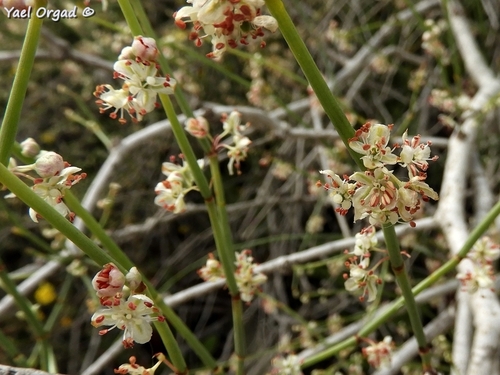
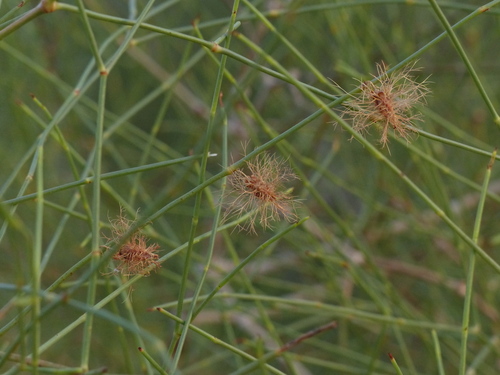
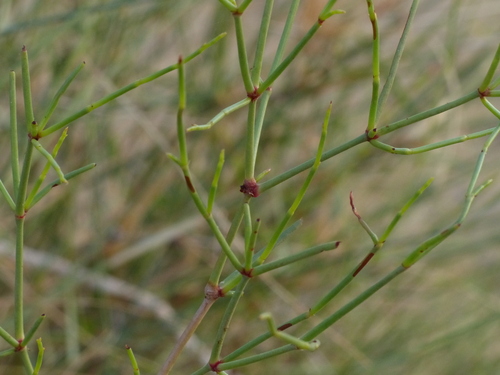
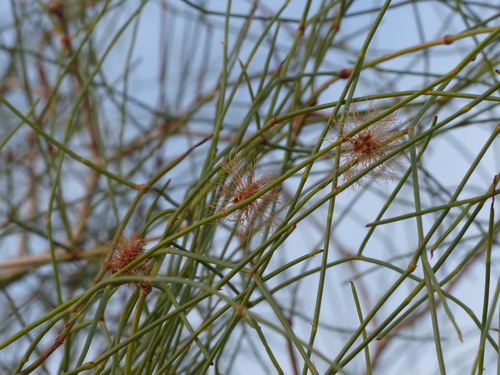
A shrub. It grows 0.2-1 m high. It has jointed segments. It has long roots. The leaves are very narrow and grow out of the joints. The leaves fall and the green stems convert sunlight. The flowers are delicate and have 5 white sepals. The stamen are yellowish-pink. The fruit are red and showy. They are bristly.
Wikipedia
Source ↗Calligonum polygonoides, locally known as phog (Rajasthani: फोग), is a small shrub found in Thar Desert areas, usually 4 feet to 6 feet high but occasionally may reach even 10 feet in height with a girth of 1 to 2 ft. This plant is referred to as orta in old Arabic poetry. It commonly grows on dry sandy soils and on sand dunes. It is very hardy and being capable of growing under adverse conditions of soil and moisture. It is frost hardy. It produces root suckers and is easily propagated by cutting and layering.
Production
The flowers fall and are swept up.
Other Information
The flowers are a famine food.
Notes
There are about 80 Calligonum species. Chemical composition (after Hooper): Albumenoids = 12.03% (dry). Ash = 11.10% (dry). Nitrogen = 1.92% (dry). Phosphoric acid = .38% (dry). Silicates = .38% (dry).
Names & Synonyms
Abal, Arta, Artee, Balanja, Berwaja, Lassan, Phog, Phogalli, Phogla, Phok, Tatuke, Tirni
References (14)
- Ambasta S.P. (Ed.), 2000, The Useful Plants of India. CSIR India. p 96
- Bircher, A. G. & Bircher, W. H., 2000, Encyclopedia of Fruit Trees and Edible Flowering Plants in Egypt and the Subtropics. AUC Press. p 74
- BHANDARI,
- Dobriyal, M. J. R. & Dobriyal, R., 2014, Non Wood Forest Produce an Option for Ethnic Food and Nutritional Security in India. Int. J. of Usuf. Mngt. 15(1):17-37
- Flora of Pakistan. www.eFloras.org
- Hedrick, U.P., 1919, (Ed.), Sturtevant's edible plants of the world. p 143
- HOOPER,
- Macmillan, H.F. (Revised Barlow, H.S., et al), 1991, Tropical Planting and Gardening. Sixth edition. Malayan Nature Society. Kuala Lumpur. p 355
- Martin, F.W. & Ruberte, R.M., 1979, Edible Leaves of the Tropics. Antillian College Press, Mayaguez, Puerto Rico. p 186
- Phillips, D.C., 1988, Wild Flowers of Bahrain. A Field Guide to Herbs, Shrubs, and Trees. Privately published. p 82
- Royal Botanic Gardens, Kew (1999). Survey of Economic Plants for Arid and Semi-Arid Lands (SEPASAL) database. Published on the Internet; http://www.rbgkew.org.uk/ceb/sepasal/internet [Accessed 4th June 2011]
- SAXENA,
- SHANKARNARAYAN & SAXENA,
- World Checklist of Useful Plant Species 2020. Royal Botanic Gardens, Kew