Callipteris prolifera
(Lam.) Bory
Kumugras, fern

(c) Isaac Aguilar, some rights reserved (CC BY-NC)

(c) Isaac Aguilar, some rights reserved (CC BY-NC)

(c) Isaac Aguilar, some rights reserved (CC BY-NC)
What to Eat
Edible parts: Leaves, Fronds
The fronds are edible and traditionally used in Papua New Guinea.
Where to Find It
A tropical plant. It occurs in the tropical lowlands. It likes hot humid places. It occurs in East and West New Britain and Manus in Papua New Guinea. It often grows along creeks. It grows in rainforest. The fronds are brittle and easily damaged by the wind. It can grow in shady places.
Africa, Australia, Malaysia, Pacific, Papua New Guinea, PNG, Samoa, SE Asia,
How to Identify
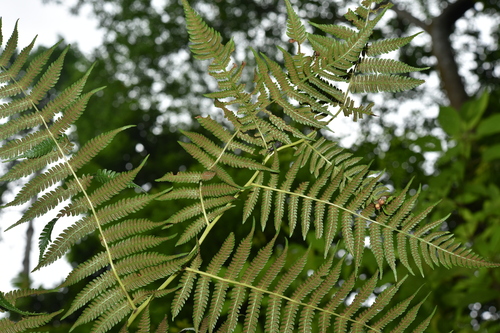
A fern with a tufted, woody, black rhizome covered with black scales. The trunk is short. The plant forms rounded clumps. The stem of the fronds is triangular in cross section. It is spiny. The fronds are erect and up to 2 m long. They arch over. They are fleshy and pale green. The leaflets are in one row with the base ending abruptly. These leaflets are curved and with a scalloped edge. The top end has a tail. The spore or fruit spots are brown in double rows between the ribs. The spore groups are arranged in long V shaped pairs under the fronds. Small plantlets often grow along the fronds on the upper half.
How to Grow
It can be grown from the small plantlets on the fronds. It is best to grow it in soil, in gardens. It can be grown from spores.
Other Information
A commonly used fern in New Britain and Manus in Papua New Guinea.
Notes
There are 3 Callipteris species. Also put in the family Aspleniaceae.
Names & Synonyms
Ubuga
References (10)
- Andrews, S.B., 1990, Ferns of Queensland. A handbook to the ferns and fern allies. Queensland DPI p 72
- Borrell, O.W., 1989, An Annotated Checklist of the Flora of Kairiru Island, New Guinea. Marcellin College, Victoria Australia. p 1
- Chaffey, C.H., 1999, Australian Ferns. Growing them successfully. Kangaroo Press. p 11, 115
- Cronin, L., 1989, The Concise Australian Flora. Reed. p 271
- Elliot, W.R., & Jones, D.L., 1982, Encyclopedia of Australian Plants suitable for cultivation. Vol 2. Lothian. p 410
- Flavelle, A. J., 1991, A Traditional Agroforestry Landscape on Fergusson Island, Papua New Guinea. M. Sc. Univ. of British Columia. p 168
- French, B.R., 1986, Food Plants of Papua New Guinea, A Compendium. Asia Pacific Science Foundation p 77
- Goudey, C.J., 1988, A Handbook of Ferns for Australia and New Zealand. Lothian. p 74
- Jones D, L, 1986, Ornamental Rainforest Plants in Australia, Reed Books, p 307
- Peekel, P.G., 1984, (Translation E.E.Henty), Flora of the Bismarck Archipelago for Naturalists, Division of Botany, Lae, PNG. p 13, 15