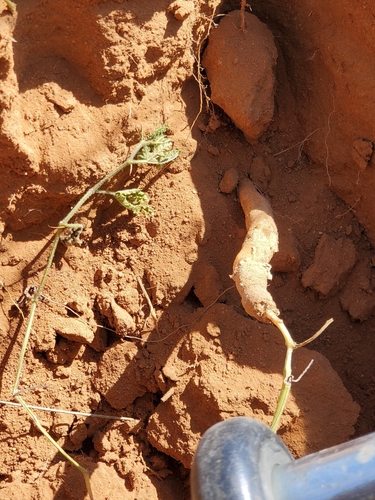
Corallocarpus epigaeus
(Rottl.) C. B. Clarke
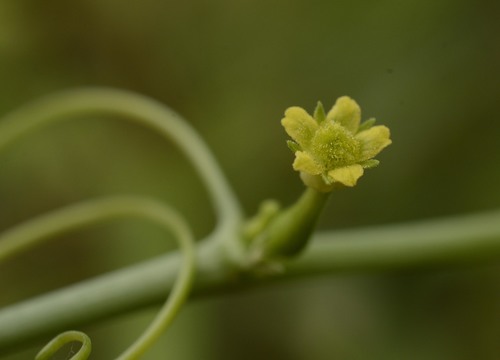
(c) Siddarth Machado, some rights reserved (CC BY), uploaded by Siddarth Machado
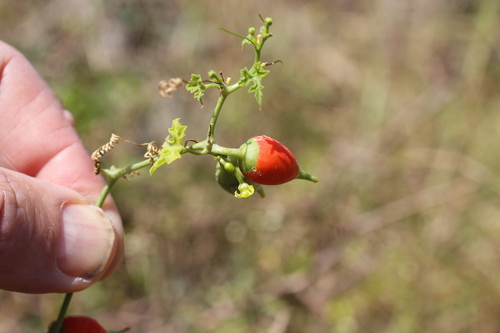
(c) Massugue, some rights reserved (CC BY-NC)
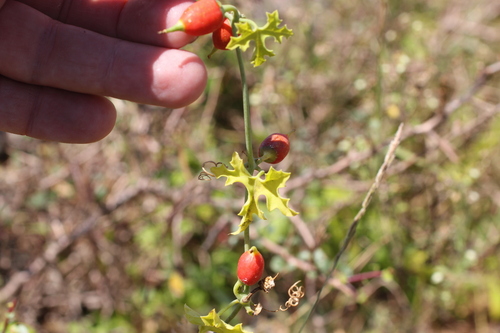
(c) Massugue, some rights reserved (CC BY-NC)
What to Eat
Edible parts: Fruit
The fruit is edible.
Where to Find It
It is a tropical plant. It grows in forest and woodland. It can grow in arid places.
Africa, Burkina Faso, East Africa, Ethiopia, India, Iran, Kenya, Middle East, Nigeria, Oman, Pakistan, Rwanda, Somalia, Sri Lanka, Sudan, Tanzania, West Africa,
How to Identify
A herb. It lies along the ground or can be a climber. It keeps growing from year to year. It grows 4 m long. It has a tuberous root. The stems are angular and can be finely hairy. It has simple tendrils. The leaves are 2-6 cm long. The leaves are divided into 3-5 lobes. The lobes are broadly sword shaped and can have 1-3 lobes. The flowers are yellow. The fruit are oval and 1-2 cm long. The seeds are an unequal pear shaped. There are about 8 seeds.
Medicinal Uses
The rhizomes are used in traditional medicine.
Notes
The rhizomes are used in medicine.
Names & Synonyms
Akasgaddah, Akasha garudan, Azanulfi, Garajphal, Garudan kizhangu, Kadvinam, Kilimukkankizhangu, Murdonda, Nagadonda
References (3)
- Royal Botanic Gardens, Kew (1999). Survey of Economic Plants for Arid and Semi-Arid Lands (SEPASAL) database. Published on the Internet; http://www.rbgkew.org.uk/ceb/sepasal/internet [Accessed 15th April 2011]
- Samydurai, P., et al, 2012, Wild habits of Kolli Hills being staple food of inhabitant tribes of eastern Ghats, Tamil Nadu, India. Indian Journal of Natural Products and Resources. 3(3) September 2012 pp 432-437
- World Checklist of Useful Plant Species 2020. Royal Botanic Gardens, Kew