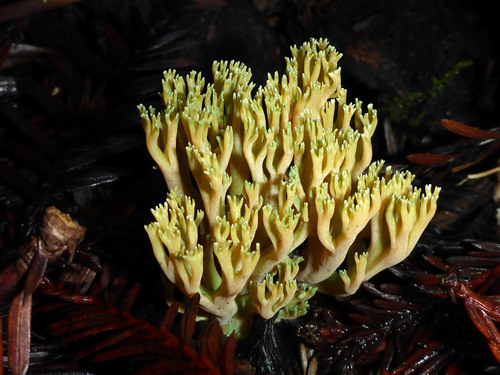
Ramaria holorubella

(Atk.) Corner

RamariaceaeMushroomsPotential hazards — see below
Caution — Parts of this plant may be toxic or require specific preparation. Verify with multiple sources before consuming.
Ramaria holorubella
gbif · cc-by-sa
Pat Grey

What to Eat

Edible parts: Mushroom, Fungus

Known Hazards

Ramaria botrytis is an edible species, and some rate it as choice. Its taste is "slight", or "fruity", and has been likened to sauerkraut, green peanuts (fresh harvested peanuts that have not been dehydrated), or pea pods. Older fruit bodies develop an acidic flavor. It is sold in food markets in Japan as Nedzumi-take, and harvested from the wild in Korea and Nepal. The thick base and main branches require longer cooking than the smaller branchlets. In the Garfagnana region of central Italy, the mushroom is stewed, or pickled in oil. Fruit bodies can be preserved by slicing thinly and drying. One field guide rates the edibility as "questionable", warning of the possible danger of confusing specimens with the poisonous Ramaria formosa. Other authors warn that some individuals may experience laxative effects from consuming the mushroom. Caution is advised when collecting fruit bodies near polluted areas, as the species is known to bioaccumulate toxic arsenic. Chemical analysis shows R. botrytis to have a food energy value of 154 kilojoules per 100 grams of fresh fruit bodies, which is comparable to the 120–150 kJ range reported for commercially grown edible mushrooms. As a percentage of dry matter, the fruit bodies contain 39.0% crude protein, 1.4% lipids, 50.8% carbohydrates, and 8.8% ash. The majority of the lipid content comprises oleic (43.9%), linoleic (38.3%), and palmitic (9.9%) fatty acids.

Where to Find It

It is a subtropical plant.

Mexico, North America,

Countries: Antigua & Barbuda, Barbados, Bahamas, Belize, Canada, Costa Rica, Cuba, Dominica, Dominican Republic, Grenada, Guatemala, Honduras, Haiti, Jamaica, St Kitts & Nevis, St Lucia, Mexico, Nicaragua, Panama, Puerto Rico, El Salvador, Trinidad & Tobago, United States, St Vincent

How to Identify

A mushroom in the Ramariaceae family found in subtropical regions and sold in local markets.

Other Information

It is sold in local markets.

Names & Synonyms
Clavaria holorubella Atk.Clavaria rufescens sensu CokerClavaria botrytis sensu Kauffm.Clavaria australiana Clel.
References (3)
  • Perez-Moreno, J. et al, 2008, Wild Mushroom Markets in Central Mexico and a Case Study at Ozumba. Economic Botany, 62(3), 2008, pp. 425–436
  • Perez-Moreno, J., et al, 2009, Social and Biotechnological Studies of Wild Edible Mushrooms in Mexico. Acta Botanica Yunnanica Suppl. XV1: 55-61
  • www.plantnames.unimelb.edu.au

More from Ramariaceae