Castanopsis armata
(Roxb.) Spach
FagaceaeSeeds/Nuts

gbif · cc0
Royal Botanic Garden Edinburgh
Royal Botanic Garden Edinburgh

gbif · cc-by-nc-sa
MBG
MBG

gbif · cc0
Royal Botanic Garden Edinburgh
Royal Botanic Garden Edinburgh
What to Eat
Edible parts: Nuts
Where to Find It
It is a tropical plant. It grows in the forest between 1,000-1,300 m above sea level.
Asia, Cambodia, Indochina, Laos, Myanmar, SE Asia, Thailand, Vietnam,
Countries: United Arab Emirates, Afghanistan, Armenia, Azerbaijan, Bangladesh, Bahrain, Brunei, Bhutan, China, Georgia, Indonesia, Israel, India, Iraq, Iran, Jordan, Japan, Kyrgyzstan, Cambodia, North Korea, South Korea, Kuwait, Kazakhstan, Laos, Lebanon, Sri Lanka, Myanmar, Mongolia, Maldives, Malaysia, Nepal, Oman, Philippines, Pakistan, Qatar, Saudi Arabia, Singapore, Syria, Thailand, Tajikistan, Timor-Leste, Turkmenistan, Turkey, Taiwan, Uzbekistan, Vietnam, Yemen
How to Identify
A tree. It grows 15-30 m tall. The bark is brown and cracked. The leaves are narrowly oval and 8-22 cm long by 408 cm wide. The fruit are oval and 1-2.5 cm long. They are in a capsule covered with spines.
Names & Synonyms
Thit-e
Castanea armata (Roxb.) F. M. WilliamsCastanea falconeri HanceCastanea sphaerocarpa Lindl.Castanopsis falconeri HanceCastanopsis sphaerocarpa (Lindl.) LIndl.Castanopsis tribuloides var. armata (Roxb.) KurzQuercus armata Roxb.Quercus catungea Buch.Ham. ex D. Don
References (2)
- Anderson, E. F., 1993, Plants and people of the Golden Triangle. Dioscorides Press. p 205
- Castillo, C., 2013, The Archaeobotany of Khao Sam Kaeo and Phu Khao Thong: The Agriculture of Late Prehistoric Southern Thailand. Ph. D. thesis University College, London p 378
More from Fagaceae

Castanea alnifolia
Bush chinkapin, Florida chinkapin, Trailing chinkapin, Downy chinquapin

Castanea crenata
Japanese chestnut

Castanea dentata
American chestnut, American sweet chestnut

Castanea henryi
Zhui li, Conic chestnut
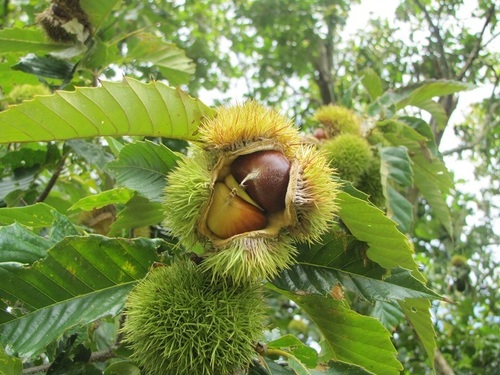
Castanea mollissima
Chinese chestnut

Castanea ozarkensis
Ozark chinkapin, Ozark chestnut