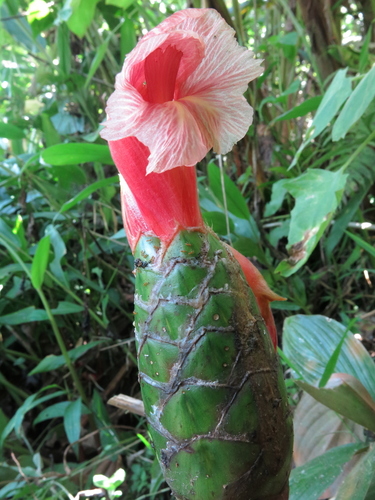
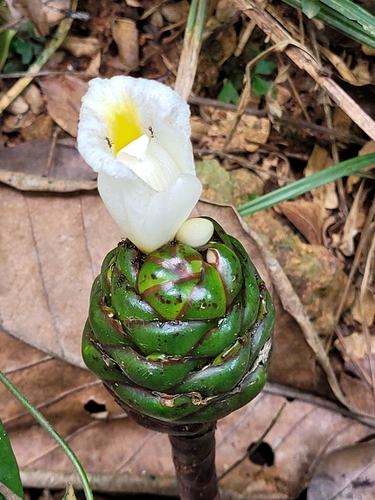
Costus afer
Ker-Gawl.
Ginger lily, White spiral costus

(c) Marco Schmidt, some rights reserved (CC BY-NC-SA), uploaded by Marco Schmidt
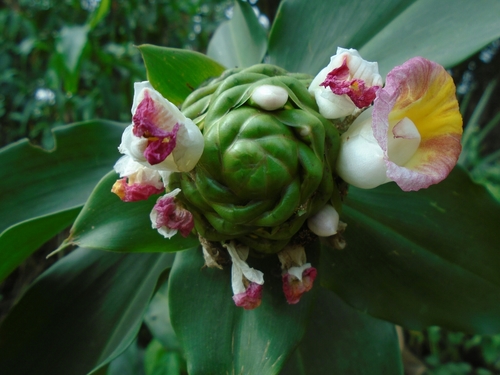
(c) Maxwell C. Obiakara, some rights reserved (CC BY-NC), uploaded by Maxwell C. Obiakara
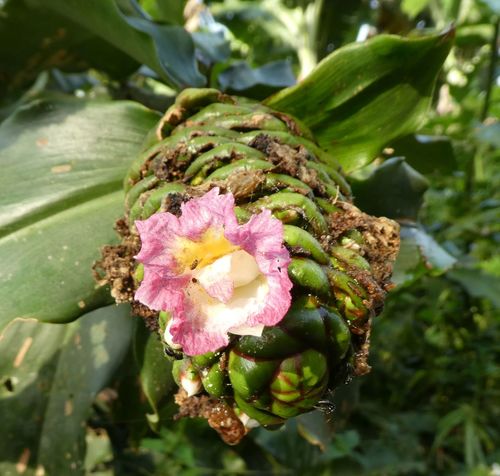
(c) Carel Jongkind, some rights reserved (CC BY-NC)
What to Eat
Edible parts: Leaves, Vegetable, Rhizome - spice, Root, Pith, Stem
The leaves have an acid flavour, and the rhizome is occasionally used as a spice or flavouring.
Where to Find It
It is a tropical plant. It grows in woodland, savannah woodland and palm groves. It needs to be in a sunny position. It grows up to 1,200 m above sea level. Cairns BG.
Africa*, Angola, Asia, Australia, Burkina Faso, Cameroon, Central Africa, Central African Republic, CAR, Congo DR, East Africa, Guinea, Guinée, Guinea-Bissau, Indonesia, Kenya, Mozambique, Sao Tome and Principe, SE Asia, Senegal, Tanzania, West Africa,
How to Identify
A herb. It keeps growing from year to year. It grows 3 m tall. It has rhizomes. The stems are erect and slightly woody at the base. They are twisted in a spiral. The leaves are oblong to sword shaped and 25 cm long by 7 cm wide. The base is rounded and they taper to the tip. The leaves are based in spirals. They are smooth above and pale and hairy underneath. The flowers are in a round head up to 7 cm long. The flowers are tube shaped and 5 cm across. The fruit is a round capsule. There are many black shiny seeds.
How to Grow
Prefers a very fertile, moist but well-drained acid soil and a position in some shade. Plants also succeed in full sun. Spiral ginger is a very vigorous grower. It flowers and fruits throughout the year, depending on the humidity of the soil.
Propagation: Seed is best sown fresh and germinates best at 20°C. For division, rhizomes are cut into 2.5cm pieces and planted in a sand and peat moss mixture. Stem cuttings are also taken as 2.5cm sections and planted in the same medium. Some species produce bulbils in the enlarged fruit head; these can be potted up and grown into new plants.
Medicinal Uses
Spiral ginger is widely used as a medicinal plant across tropical Africa, and modern research has validated many of its traditional applications. The stem, seeds, and rhizome contain several steroidal sapogenins, the most important being diosgenin, which the rhizome yields at 0.5%. Diosgenin is a key raw material used as a precursor in synthesising corticosteroids, sex hormones, oral contraceptives, and anabolic agents. The rhizomes also contain the saponins aferosides A and C, dioscin, paryphyllin C, and the flavonoid glycoside kaempferol 3-O-a-L-rhamnopyranoside, the last of which has shown an ability to potentiate in vitro cisplatin cytotoxicity in a human colon cancer cell line. A papaverine-like alkaloid in the rhizome relaxes smooth muscle, acting as an anti-spasmodic, diuretic, and central nervous system depressant. Methanol extract of the rhizome showed significant topical anti-inflammatory activity. The saponin fraction from the rhizomes and the methanolic leaf extract both showed significant abortifacient activity. Sesquiterpenoids are the most abundant volatile compounds in the leaf essential oil, which showed no antimicrobial activity. Aqueous extracts of the leaves and stems showed significant antibacterial and amoebicidal activity in vitro. The methanolic leaf extract showed significant cytotoxicity and moderate local anaesthetic activity, and demonstrated antihyperglycaemic activity — small doses decreased blood glucose levels, while higher doses increased them. A decoction of the powdered fruits is used as a cough medicine. The stem is strongly diuretic; the debarked stem is chewed to alleviate nausea and quench thirst. A stem decoction, mashed or chewed stem, or pounded fruit — sometimes mixed with sugar cane juice — is taken to relieve nausea, treat rheumatoid arthritis, coughs, respiratory problems, and sore throat. A cold water extract of the stem is taken for minor epileptic attacks. Powdered stems are used as an enema to treat worms and haemorrhoids, and the smoke of dried stem is inhaled for coughs. The stem sap treats jaundice and is used to prevent miscarriage. Though acid and rubefacient — burning on open wounds — the stem sap is also anodyne and promotes healing. It is applied externally for skin ailments, urethral discharges, and venereal diseases, and rubbed on the body to treat colic. An infusion of the inflorescence is taken for tachycardia, and the same infusion or a rhizome infusion treats stomach complaints. The leaf sap or a rhizome decoction is taken internally for malaria; externally, the leaf sap is used as eye drops for eye troubles and as nose drops for headaches with vertigo, and applied in frictions to treat oedema and fever. An infusion of the dried aerial parts is taken for hypertension. Rhizome pulp is applied to abscesses and ulcers to mature them, applied to teeth to relieve toothache, and mixed with water for internal treatment of diarrhoea and amoebic dysentery. A rhizome decoction or the raw rhizome is taken to treat leprosy and venereal diseases.
Other Uses
Strips of outer stem are woven into baskets, and the stem bark is sometimes cultivated specifically for making table mats and baskets. Experiments using the stem for paper production have been successful. The stems are also used in house construction. The sap can coagulate latex and is used in skin-nourishing creams.
Wikipedia
Source ↗Costus afer, English ginger lily or common ginger lily, is a species of plant native to Tropical Africa. Costus afer is widely cultivated. It has many traditional uses, including but not limited to treating a range of medical ailments. Costus afer is high in diosgenin. Costus afer has a wide native distribution spanning North East Africa, West Africa, Central Africa, East Africa, and Southern Tropical Africa. Costus afer is sometimes confused with other African species of Costus, such as Costus dubius and Costus lucanusianus. It is also similar looking to Costus louisii.
Names & Synonyms
Gododje-sato, Gogodje-suto, Kinyampuli, Kostus spiral putih, Makenia, Mankene, Matumba tumba, Mugahigahi, Nsangalavu, Nsangalavua, Nsangalavula, Rum-rum, Spiral ginger, Tumfafiyan-kada
References (10)
- Fongnzossie Fedoung, E., et al, 2020, Wild edible plants and mushrooms of the Bamenda Highlands in Cameroon: ethnobotanical assessment and potentials for enhancing food security. Journal of Ethnobiology and Ethnomedicine 16:12
- Grubben, G. J. H. and Denton, O. A. (eds), 2004, Plant Resources of Tropical Africa 2. Vegetables. PROTA, Wageningen, Netherlands. p 225
- http://aflora.africa.kyoto-u.ac.jp
- Latham, P., 2004, Useful Plants of Bas-Congo province. Salvation Army & DFID p 95
- Lautenschläger, T., et al, 2018, First large-scale ethnobotanical survey in the province of Uíge, northern Angola. Journal of Ethnobiology and Ethnomedicine (2018) 14:51
- Mawunu, M., et al, 2022, Ethnobotanical uses of wild edible plants of Mucuba municipality, Angola. Natural Resources for Human Health. 2022, 0:1-10
- Seidemann J., 2005, World Spice Plants. Economic Usage, Botany, Taxonomy. Springer. p 118
- Sukarya, D. G., (Ed.) 2013, 3,500 Plant Species of the Botanic Gardens of Indonesia. LIPI p 1092
- Terashima, H., et al, 1992, Ethnobotany of the Lega in the Tropical Rainforest of Eastern Zaire (Congo): Part Two, Zone de Walikale, African Study Monographs, Suppl. 19:1-60
- World Checklist of Useful Plant Species 2020. Royal Botanic Gardens, Kew