Cheilocostus globosus
(Blume) C. Specht
Spiral ginger

iNaturalist · cc-by
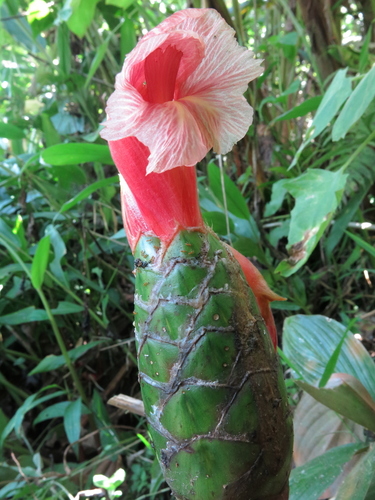
(c) Bernard DUPONT, some rights reserved (CC BY)
(c) Bernard DUPONT, some rights reserved (CC BY)

iNaturalist · cc-by-nc
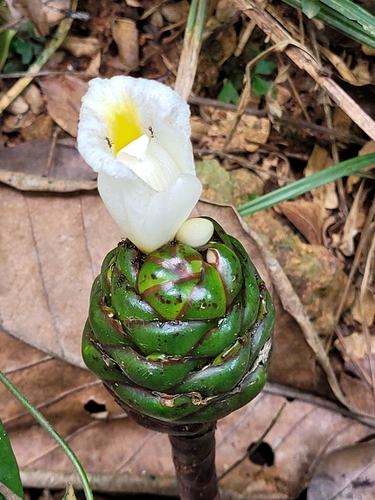
(c) Suzu Sato, some rights reserved (CC BY-NC)
(c) Suzu Sato, some rights reserved (CC BY-NC)

wikimedia · cc-by-sa
Wikimedia Commons - Bernard DUPONT from FRANCE
Wikimedia Commons - Bernard DUPONT from FRANCE
What to Eat
Edible parts: Shoots
The young shoots are eaten.
Known Hazards
Where to Find It
It is a tropical plant. It grows on the edges of forests and in moist places in valleys. It grows up to 1,700 m above sea level.
Asia, Indonesia, Malaysia, SE Asia*,
Countries: United Arab Emirates, Afghanistan, Armenia, Azerbaijan, Bangladesh, Bahrain, Brunei, Bhutan, China, Georgia, Indonesia, Israel, India, Iraq, Iran, Jordan, Japan, Kyrgyzstan, Cambodia, North Korea, South Korea, Kuwait, Kazakhstan, Laos, Lebanon, Sri Lanka, Myanmar, Mongolia, Maldives, Malaysia, Nepal, Oman, Philippines, Pakistan, Qatar, Saudi Arabia, Singapore, Syria, Thailand, Tajikistan, Timor-Leste, Turkmenistan, Turkey, Taiwan, Uzbekistan, Vietnam, Yemen
How to Identify
A herb. It grows 4 m tall. It has rhizomes. The stems are robust and branched. They are twisted in spirals and covered with large scales 2-12 cm long. The leaves are oblong to sword shaped and 15-20 cm long by 6-10 cm wide. The leaves are alternate and smooth above and hairy underneath. The flowering shoots are oval and 5-15 cm long and the flowers are funnel shaped. They are red and yellow. The fruit is an oval capsule 1.5 cm long. There are many black seeds.
Names & Synonyms
Pacing spiral
Costus dhaninivati K. LarsenCostus globosus BlumeCostus globosus var. kingii (Baker) HolttumCostus globosus var. ridleyi (K. Schum.) HolttumCostus globosus var. velutinus (Ridl.) HolttumCostus kingii BakerCostus ridleyi K. Schum.Costus velutinus Ridl.
References (2)
- Hoare, A., 2003, Food use of the Lundayeh SW Sabah. Borneo Research Council.
- Sukarya, D. G., (Ed.) 2013, 3,500 Plant Species of the Botanic Gardens of Indonesia. LIPI p 1089