Hibiscus asper
Hook. f.
Wild sorrel
no rights reserved

(c) Frances Murray-Hudson, some rights reserved (CC BY-NC)
no rights reserved
What to Eat
Edible parts: Leaves, Vegetable, Fruit
Kenaf is cultivated for its fibre in India, Bangladesh, United States of America, Indonesia, Malaysia, South Africa, Vietnam, Thailand, parts of Africa, and to a small extent in southeast Europe. The stems produce two types of fibre: a coarser fibre in the outer layer (bast fibre), and a finer fibre in the core. The bast fibres are used to make ropes. Kenaf matures in 100 to 200 days. First grown in Egypt over 3000 years ago, the leaves of the kenaf plant were a component of both human and animal diets, while the bast fibre was used for bags, cordage, and the sails for Egyptian boats. This crop was not introduced into southern Europe until the early 1900s. Today, while the principal farming areas are China and India, Kenaf is also grown in countries including the US, Mexico, and Senegal. The main uses of kenaf fibre have been rope, twine, coarse cloth (similar to that made from jute), and paper. In California, Texas, Louisiana and Mississippi, 3,200 acres (13 km2) of kenaf were grown in 1992, most of which was used for animal bedding and feed. Uses of kenaf fibre include engineered wood; insulation; clothing-grade cloth; soil-less potting mixes; animal bedding; packing material; and material that absorbs oil and liquids. It is also useful as cut bast fibre for blending with resins in the making of plastic composites, as a drilling fluid loss-preventive for oil drilling muds, and for a seeded hydromulch for erosion control. Kenaf can be made into various types of environmental mats, such as seeded grass mats for instant lawns and moldable mats for manufactured parts and containers. Panasonic has set up a plant in Malaysia to manufacture kenaf fibre boards and export them to Japan. Additionally, as part of an overall effort to make vehicles more sustainable, Ford and BMW are making the material for the automobile bodies in part from kenaf. The first implementation of kenaf within a Ford vehicle was in the 2013 Ford Escape. The BMW i3 uses kenaf in the black surrounds. The use of kenaf is anticipated to offset 300,000 pounds of oil-based resin per year in North America and should reduce the weight of the door bolsters by 25 percent. Reported in 2021, Kenaf Ventures, an Israeli company, is developing and producing sustainable raw materials made from the kenaf plant (Hibiscus cannabinus) in an effort to decarbonize the construction sector without reducing product quality.
Where to Find It
It is a tropical plant. It grows in the Sahel. It grows in fallow fields and on the edges of forests.
Africa, Benin, Burkina Faso, Cameroon, Central Africa, Congo, East Africa, Ghana, Guinea, Guinée, Guinea-Bissau, Madagascar, Mali, Mozambique, Nigeria, Sahel, Senegal, Togo, West Africa,
How to Identify
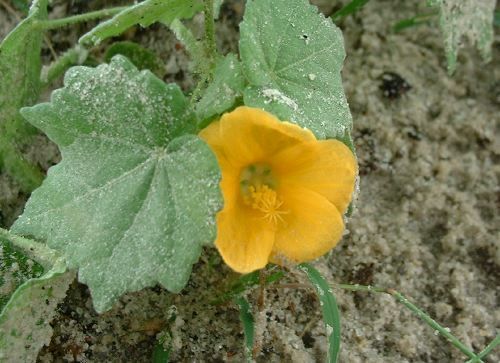
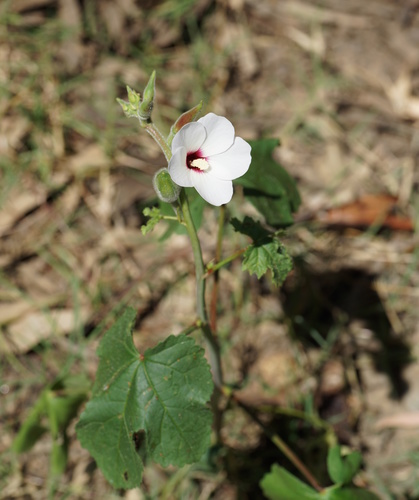
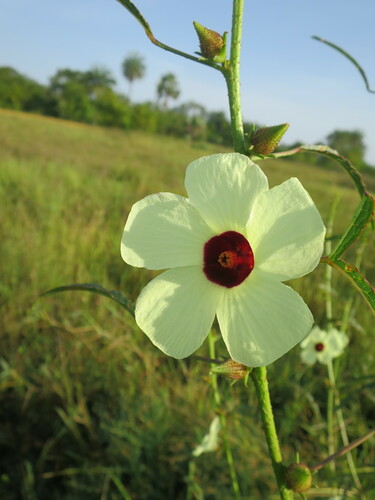
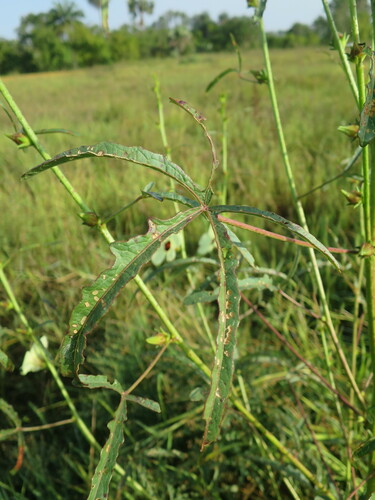
An annual herb. It grows 2 m high. The stems have fine prickles. The leaves are simple and alternate. The leaf stalks can be 1 cm to 18 cm long. The leaves blade is narrowly oval and can have 3-5 shallow lobes. The leaves are 18 cm long by 14 cm wide. There can be teeth along the edge. The flowers are in the axils of leaves. They can occur singly or in clusters. The petals are yellow with a red-purple base. The fruit is an oval capsule. The seed are dark brown and kidney shaped. They are 4 mm long.
How to Grow
A locally selected type of Hibiscus asper with narrow leaves is cultivated on a small scale in Senegal.
Propagation: Seed - sow in situ or in containers. Germination is usually quite rapid. Prick out container-grown seedlings into individual pots when they are large enough to handle and plant them out into their permanent positions when they are 10cm or more tall.
Medicinal Uses
The leaves are dried over a fire and then applied to eczematous sores. The leaves are also used to treat a range of other skin problems. The plant is antidote, depurative, diuretic, restorative and tonic. It is used to treat a variety of complaints including urethritis, anaemia, jaundice, malaria, angina, poisoning, painful and irregular menstruation, and leucorrhoea.
Other Uses
A fibre is obtained from the plant. Although the source is not mentioned, it is almost certainly from the stem bark.
Other Information
It is occasionally cultivated as a vegetable. It is a minor vegetable.
Names & Synonyms
Baguitche-di-mato, Bere, Biri, Bissao, Bussaga, Folere, Kudiass, N'coco, Sangume, Tikansibouoti, Tikli
References (9)
- Achigan-Dako, E, et al (Eds), 2009, Catalogue of Traditional Vegetables in Benin. International Foundation for Science.
- Batawila, K., et al, 2007, Diversite et gestion des legumes de cueillete au Togo. African Journal of Food, Agriculture, Nutrition and Development 7( 3& 4): 66
- Belem, M., et al, 2017, Strategy of Conservation and Protection of Wild Edible Plants Diversity in Burkina Faso. ANADOLU 27 (2) 2017, 82- 90
- Dansi, A., et al, 2008, Traditional leafy vegetables and their use in the Benin Republic. Genet Resour Crop Evol (2008) 55:1239–1256
- Diouf, M., et al, Leafy Vegetables in Senegal. Bioversity webite
- Gallagher, D. E., 2010, Farming beyond the escarpment: Society, Environment, and Mobility in Precolonial Southeastern Burkina Faso. PhD University of Michigan.
- Grubben, G. J. H. and Denton, O. A. (eds), 2004, Plant Resources of Tropical Africa 2. Vegetables. PROTA, Wageningen, Netherlands. p 314
- N'Danikou, S. et al, 2010, Eliciting Local Values of Wild Edible Plants in Southern Bénin to Identify Priority Species for Conservation. Economic Botany, 20(10), 2011, pp. 1–15.
- Segnon, A. C. & Achigan-Dako, E. G., 2014, Comparative analysis of diversity and utilization of edible plants in arid and semi-arid areas in Benin. Journal of Ethnobiology and Ethnomedicine 2014, 10:80