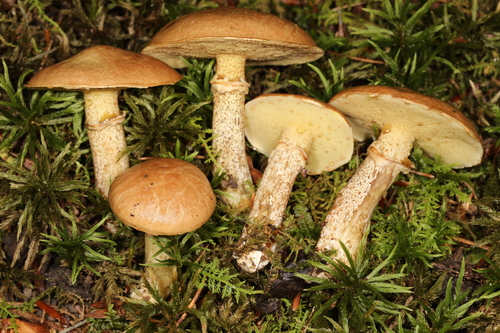
Suillus brevipes
(Peck) Kuntze
Short-stalked suillus

(c) Damon Tighe, some rights reserved (CC BY-NC), uploaded by Damon Tighe
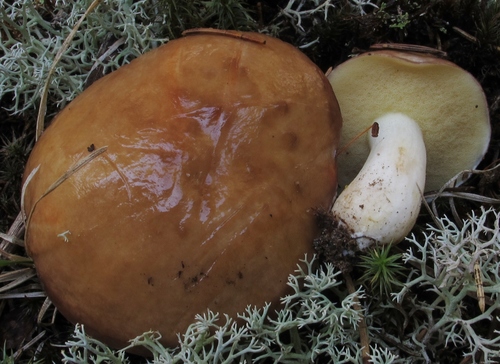
(c) mycowalt, some rights reserved (CC BY-SA), uploaded by mycowalt

(c) noah_siegel, some rights reserved (CC BY-NC-SA), uploaded by noah_siegel
What to Eat
Edible parts: Mushroom, Fungus
Like many species of the genus Suillus, S. brevipes is edible, and the mushroom is considered choice by some. The odor is mild, and the taste mild or slightly acidic. Field guides typically recommended to remove the slimy cap cuticle, and, in older specimens, the tube layer before consumption. The fatty acid composition of S. brevipes fruit bodies has been analyzed. The cap contained a higher lipid content than the stipe—18.4% of the dry weight, compared to 12.4%. In the cap, linoleic acid made up 50.7% of the total lipids (65.7% in the stipe), oleic acid was 29.9% (12.4% in the stipe), followed by palmitic acid at 10.5% (12.6% in the stipe). Linoleic acid—a member of the group of essential fatty acids called omega-6 fatty acids—is an essential dietary requirement for humans.
Where to Find It
It is a temperate plant. California.
Asia, China, Hong Kong, Mexico, North America, USA,
How to Identify
A mushroom.
Wikipedia
Source ↗Suillus brevipes is a species of fungus in the family Suillaceae. First described by American mycologists in the late 19th century, it is commonly known as the stubby-stalk or the short-stemmed slippery Jack. The fruit bodies (mushrooms) produced by the fungus are characterized by a chocolate to reddish-brown cap covered with a sticky layer of slime, and a short whitish stipe that has neither a partial veil nor prominent, colored glandular dots. The cap can reach a diameter of about 10 cm (4 in), while the stipe is up to 6 cm (2+3⁄8 in) long and 2 cm (3⁄4 in) thick. Like other bolete mushrooms, S. brevipes produces spores in a vertically arranged layer of spongy tubes with openings that form a layer of small yellowish pores on the underside of the cap. Suillus brevipes grows in a mycorrhizal association with various species of two- and three-needled pines, especially lodgepole and ponderosa pine. The fungus is found throughout North America, and has been introduced to several other countries via transplanted pines. In the succession of mycorrhizal fungi associated with the regrowth of jack pine after clearcutting or wildfires, S. brevipes is a multi-stage fungus, found during all stages of tree development. The mushrooms are edible, and are high in the essential fatty acid linoleic acid.
Notes
Also put in the family Boletaceae.
Names & Synonyms
Duanbing runiuganjun
References (4)
- Boa, E. R., 2004, Wild edible fungi and their importance to people. FAO Non Wood Forest Products Booklet 17
- http://www.mykoweb.com/CAF/edible.html
- Pace, G., 1998, Mushrooms of the world. Firefly books. p 192 (As Boletus brevipes)
- Zamora-Martinez, M. et al, 1995, Natural production of wild edible mushrooms in the southwestern rural territory of Mexico City, Mexico. Forest Ecology and Management 72:13-20