Hydrangea petiolaris
Siebold & Zucc.
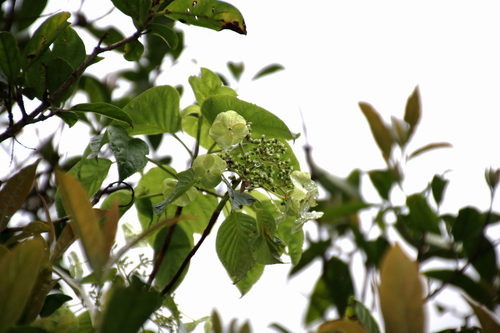
(c) 空猫 T. N, some rights reserved (CC BY-NC), uploaded by 空猫 T. N

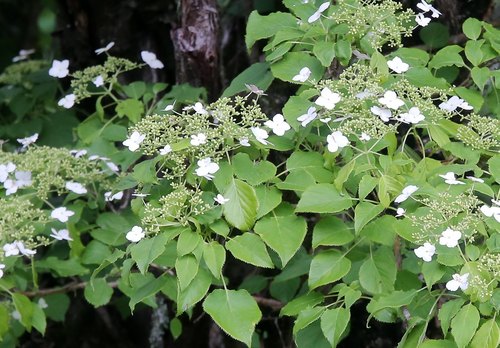
(c) evieco, some rights reserved (CC BY-NC)

(c) Leon Perrie, some rights reserved (CC BY-NC), uploaded by Leon Perrie
What to Eat
Edible parts: Leaves
The leaves are edible.
Where to Find It
It is a temperate plant. In Japan it grows in mountain forest. Arboretum Tasmania.
Asia, Australia, Japan, Slovenia, Tasmania,
How to Identify
A shrub in the Hydrangeaceae family found in temperate regions, including mountain forests in Japan and at arboretums in Tasmania.
Wikipedia
Source ↗Hydrangea petiolaris, a climbing hydrangea (syn: Hydrangea anomala subsp. petiolaris), is a species of flowering plant in the family Hydrangeaceae native to the woodlands of Japan, the Korean peninsula, and on Sakhalin island of easternmost Siberia in the Russian Far East. Hydrangea petiolaris is sometimes treated as a subspecies of the closely related Hydrangea anomala from China, Myanmar, and the Himalaya, as Hydrangea anomala subsp. petiolaris. The Hydrangea anomala species differs in being smaller (to 12 metres (39 ft) ) and having flower corymbs up to 15 cm (5.9 in) diameter. The common name climbing hydrangea is applied to both species, or to species and subspecies.
Names & Synonyms
Plezava hortenzija
References (1)
- Chen, B. & Qiu, Z., Consumer's Attitudes towards Edible Wild Plants, Ishikawa Prefecture, Japan. p 23 www.hindawi.com/journals/ijfr/aip/872413.pdf