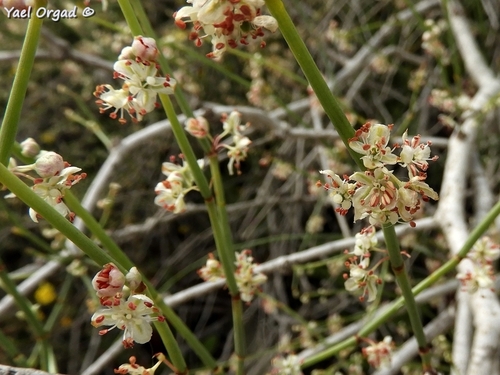
Eriogonum wrightii
Torr. ex Benth.
Bastardsage
PolygonaceaeSeeds/Nuts

iNaturalist · cc-by
(c) Matt Berger, some rights reserved (CC BY), uploaded by Matt Berger
(c) Matt Berger, some rights reserved (CC BY), uploaded by Matt Berger

iNaturalist · cc-by-nc
(c) Mannuel Nevarez Flores, some rights reserved (CC BY-NC), uploaded by Mannuel Nevarez Flores
(c) Mannuel Nevarez Flores, some rights reserved (CC BY-NC), uploaded by Mannuel Nevarez Flores

iNaturalist · cc-by-nc
(c) Michael Stein, some rights reserved (CC BY-NC), uploaded by Michael Stein
(c) Michael Stein, some rights reserved (CC BY-NC), uploaded by Michael Stein
What to Eat
Edible parts: Seeds
Seeds are pounded into a meal and eaten dry or mixed with water as a drink.
Where to Find It
It is a temperate plant.
North America, USA,
Countries: Antigua & Barbuda, Barbados, Bahamas, Belize, Canada, Costa Rica, Cuba, Dominica, Dominican Republic, Grenada, Guatemala, Honduras, Haiti, Jamaica, St Kitts & Nevis, St Lucia, Mexico, Nicaragua, Panama, Puerto Rico, El Salvador, Trinidad & Tobago, United States, St Vincent
How to Identify
A herb or small shrub. It grows 15-100 cm long by 10-150 cm wide. The stems are spreading. The leaves are at the base and in tufts at the top. The leaves are broadly sword shaped and 1-3 cm long by 0.1-1 cm wide. The seeds are light brown and 1.5-3 mm long.
Wikipedia
Source ↗Eriogonum wrightii is a species of wild buckwheat known by the common names bastardsage and Wright's buckwheat. It is native to the Southwestern United States, California, and northwest Mexico, where it grows in many plant communities, such as chaparral, in rocky habitats from mountains to deserts.
References (1)
- Moerman, D. F., 2010, Native American Ethnobotany. Timber Press. p 224