Grewia kakothamnos
K. Schum.

Susan Brown

Susan Brown

Susan Brown
What to Eat
Edible parts: Fruit
The fruit are eaten raw or cooked by frying.
Where to Find It
It is a tropical plant. It grows between 100-1,180 m above sea level.
Africa, East Africa, Ethiopia, Kenya, Tanzania, Uganda,
How to Identify
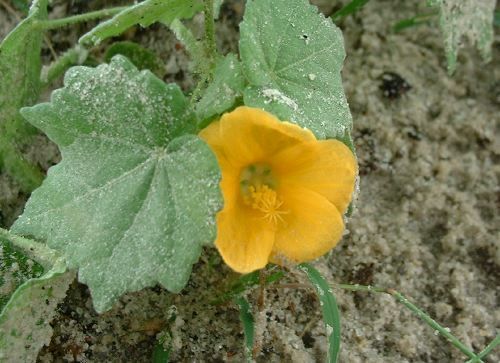
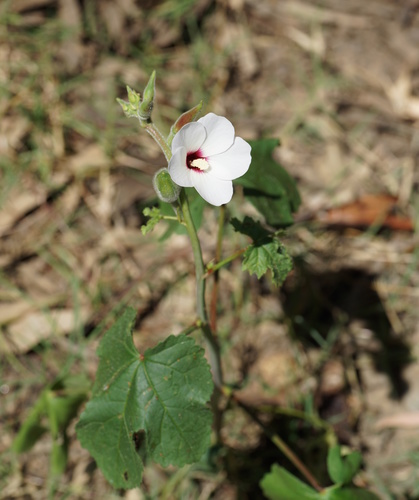
A shrub. It grows 4 m tall. It keeps growing from year to year. It flowers when it has no leaves. The leaves are green and can be slightly hairy on both surfaces. The leaves are 2-7 cm long by 2-5 cm wide. They are rounded at both ends. There are irregular rounded teeth along the edge. The flowers occur singly opposite the leaves. They are white to pale lilac. The fruit have 2-4 lobes. They are green when young and turn orange when ripe.
Wikipedia
Source ↗Grewia kakothamnos is a species of flowering plant in the family Malvaceae, found from southern Ethiopia to Tanzania. Its flowers are white to pale lilac, and its two or four-lobed fruit are orange when ripe, and edible in a famine situation. Grewia kakothamnos is particularly enjoyed as a forage by domestic goats (Capra aegagrus hircus), which will even eat the dead fallen leaves during the dry season.
Other Information
It is a famine food
Notes
These were in the families Sparrmanniaceae and the Tiliaceae.
Names & Synonyms
Demak, Mnangu
References (6)
- Edwards. S., et al, (Eds), 1995, Flora of Ethiopia and Eritrea. Vol.2, Part 2 Canellaceae to Euphorbiaceae. Uppsala, Sweden. p 152
- Harkonen, M. & Vainio-Mattila, K., 1998, Some examples of Natural Products in the Eastern Arc Mountains. Journal of East African Natural History 87:265-278
- Lulekal, E., et al, 2011, Wild edible plants in Ethiopia: a review on their potential to combat food insecurity. Afrika Focus - Vol. 24, No 2. pp 71-121
- Mutie, F. M., et al, 2023, Important Medicinal and Food Taxa (Orders and Families) in Kenya, Based on Three Quantitative Approaches. Plants 2023, 12, 1145
- Teklehaymanot, T., and Giday., M., 2010, Ethnobotanical study of wild edible plants of Kara and Kwego semi-pastoralist people in Lower Omo River Valley, Debub Omo Zone, SNNPR, Ethiopia. J Ethnobiol Ethnomed. 2010; 6: 23.
- Vainio-Mattila, K., 2000, Wild vegetables used by the Sambaa in the Usumbara Mountains, NE Tanzania. Ann. Bot. Fennici 37:57-67