Coccothrinax barbadensis
(Lodd. ex Mart.) Becc.
Silver thatch, Barbados silver thatch

(c) vjethro, some rights reserved (CC BY-NC)

(c) Guillaume Martin, some rights reserved (CC BY-NC)

(c) Guillaume Martin, some rights reserved (CC BY-NC)
What to Eat
Edible parts: Fruit, Seeds
The fruit and seeds are edible and are especially popular among children.
Where to Find It
It suits tropical and subtropical climates. It suits alkaline soils. It grows in coastal woodland on limestone soils. It grows up to 300 m above sea level and occasionally up to 600 m. It suits hardiness zones 9-12.
Antigua, Asia, Barbados, Central America, Dominica, Dominican Republic, Guadeloupe, Haiti, Hawaii, Indonesia, Lesser Antilles, Nicaragua, Pacific, Puerto Rico, SE Asia, Trinidad* and Tobago, Venezuela, West Indies,
How to Identify
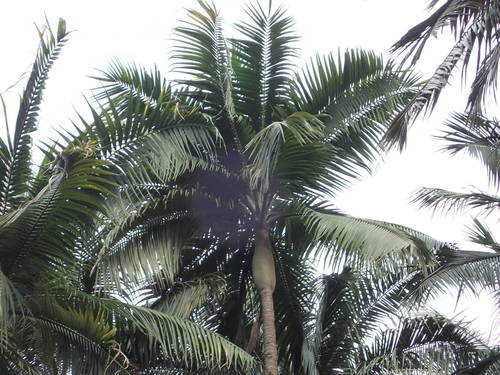
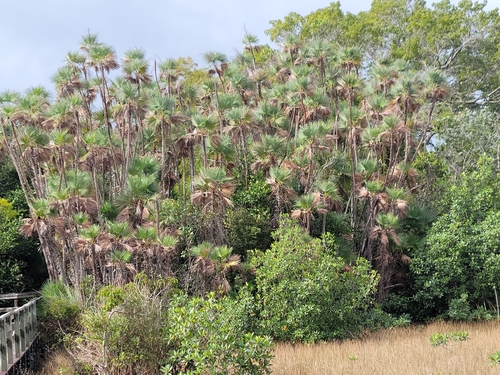
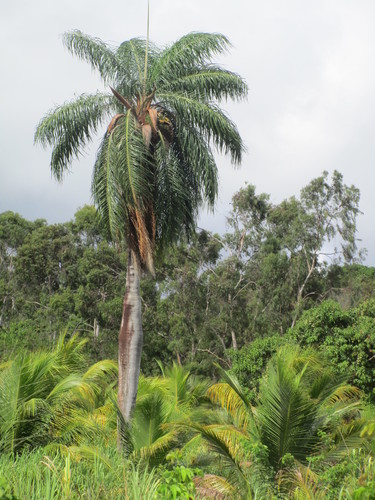
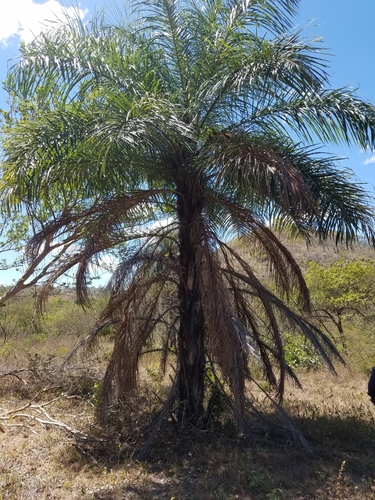
A solitary fan palm. The trunk can be 16 m tall. The trunk is 5-18 cm across. The leaves are fan shaped with about 60 segments. They are 100 cm wide. They are flexed at the tip. The flowering shoots come from among the leaves. They have 3-10 branches. The fruit is round and purple black. They are 0.6-1.2 cm across.
How to Grow
Plants can be grown from seed.
Other Uses
The leaves are used for thatching.
Wikipedia
Source ↗Coccothrinax barbadensis (latanier, latanier balai) is a palm native to Venezuela, the Lesser Antilles and Trinidad and Tobago. Like other members of the genus Coccothrinax, C. barbadensis is a fan palm. The leaves are widely used to thatch roofs. The species is native to Antigua, Barbados, Barbuda, Dominica, Guadeloupe, Marie Galante, Martinique, Saint Lucia, Trinidad and Tobago and Venezuela (including the Venezuelan Antilles). Henderson and coauthors report that the species was probably present throughout the Lesser Antilles, but was extirpated on many of them. In 2005, George Proctor (in Acevedo-Rodríguez & Strong, 2005) considered Coccothrinax alta to be a distinct species (based on its shorter, more slender trunk, fewer stamens and much smaller fruit, but Rafaël Govaerts considered it a synonym of C. barbadensis.
Other Information
The fruit and seeds are especially eaten by children.
Names & Synonyms
Baye, Guano, Latanye bourik, Latannye, Natannye, Palem perak, Palma de abanico, Palma de escoba, Palm koyo, Yarey
References (3)
- Grandtner, M. M. & Chevrette, J., 2013, Dictionary of Trees, Volume 2: South America: Nomenclature, Taxonomy and Ecology. Academic Press p 149
- James, A., 2009, Notes on the Uses of Dominica's Native Palms. Palms, Vol. 53(2): p 62
- Sukarya, D. G., (Ed.) 2013, 3,500 Plant Species of the Botanic Gardens of Indonesia. LIPI p 769