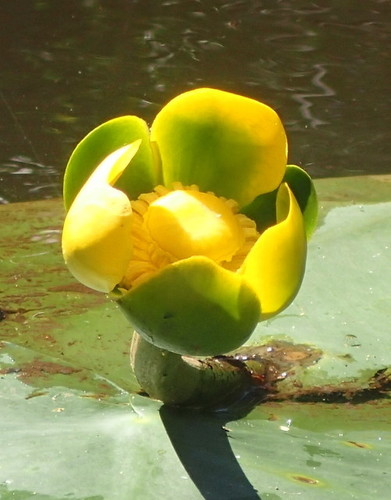
Nymphaea rubra
Roxb. ex Andrews
Indian red water-lily
(c) Татьяна Химера, some rights reserved (CC BY-NC), uploaded by Татьяна Химера

(c) Татьяна Химера, some rights reserved (CC BY-NC), uploaded by Татьяна Химера

(c) Татьяна Химера, some rights reserved (CC BY-NC), uploaded by Татьяна Химера
What to Eat
Edible parts: Leaf stalk, Root, Fruit, Seeds
The peduncles, and seeds are used as food.
Where to Find It
It is a tropical plant. It grows in water. It grows in wetlands. It forms roots in the mud and then floats. In XTBG Yunnan.
Asia, Bangladesh, China, Guianas, Guyana, India, Indochina, Northeastern India, SE Asia, South America, Suriname, Thailand, Vietnam,
How to Identify
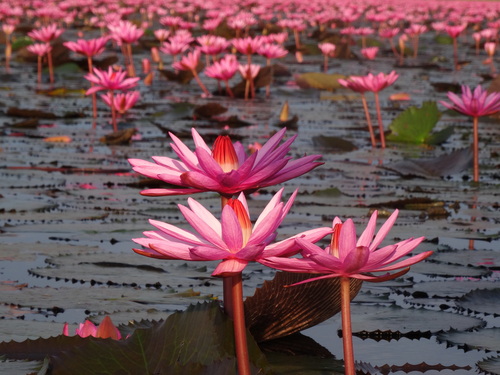
A waterlily. It is a herb that grows in water. The corm is 7-10 cm across. The leaves are 15-30 cm across. They are round or oval. They have teeth along the edge. The flowers are 7-10 cm across. They are red. The fruit have 10-20 cells.
Wikipedia
Source ↗Nymphaea rubra is a species of waterlily native to the region spanning from Sri Lanka and northeastern India to western and central Malesia. Additionally, it has been introduced to regions such as Southeast China, Cuba, Guyana, Hungary, and Suriname.
Other Information
It is sold in local markets.
Names & Synonyms
Buasaidaeng, Lalkamal, Lal shapla, Lemphu, Li'ne aluk, Mokua, Ronga bet, Ronga seluk, Sapla, Seluk, Sung do, Sung com
References (12)
- Banerjee, A., et al, 2013, Ethnobotanical Documentation of Some Wild Edible Plants in Bankura District, West Bengal, India. The Journal of Ethnobiology and Traditional Medicine. Photon 120 (2013) 585-590
- Chandrakumar, P., et al, 2015, Ethnobotanical studies of wild edible plants of Gond, Halba and Kawar tribes of Salekasa Taluka, Gondia District, Maharashtra State, India. International Research Journal of Pharmacy 6(8)
- Chowdhury, A. & Das, A. P., 2014, Conservation through sustainable utilization of wetland leafy vegetables of Terai and Duars, West Bengal, India. International Journal of Advanced Life Sciences (IJALS), 7(4) p 657
- Deka, N. & Devi, N., 2015, Wild edible aquatic and marshland angiosperms of Baka district, BTC area, Assam, India. Asian J. Plant Sci. Res. 5(1):32-48
- Devi, O.S., P. Komor & D. Das, 2010, A checklist of traditional edible bio-resources from Ima markets of Imphal Valley, Manipur, India. Journal of Threatened Taxa 2(11): 1291-1296
- Hossain, U. & Rahman, A., 2018, Study and quantitative analysis of wild vegetable floral diversity available in Barisal district, Bangladesh. Asian J. Med. Biol. Res. 2018, 4 (4), 362-371
- Jiwajinda, S., et al, 2002, Suppressive Effects of Edible Thai Plants on Superoxide and Nitric Oxide Generation. Asian Pacific Journal of Cancer Prevention, Vol 3, 2002
- Lim, T. K., 2015, Edible Medicinal and Non Medicinal Plants. Volume 9, Modified Stems, Roots, Bulbs. Springer p 59
- Mohan, V. R. & Kalidass, C., 2010, Nutritional and Antinutritional Evaluation of some Unconventional Wild Edible Plants. Tropical and Subtropical Agroecosystems, 12 (2010): 495- 506
- Pagag, K. & Borthakur, S.K., 2012, Wild edible wetland plants from Lakhimpur district of Assam, India. Pleione 6(2): 322 - 327
- Patiri, B. & Borah, A., 2007, Wild Edible Plants of Assam. Geethaki Publishers. p 5
- Pegu, R., et al, 2013, Ethnobotanical study of Wild Edible Plants in Poba Reserved Forest, Assam, India. Research Journal of Agriculture and Forestry Sciences 1(3):1-10