Desmoncus orthacanthos
Mart.
Big kamwari, Basket tie-tie rattan
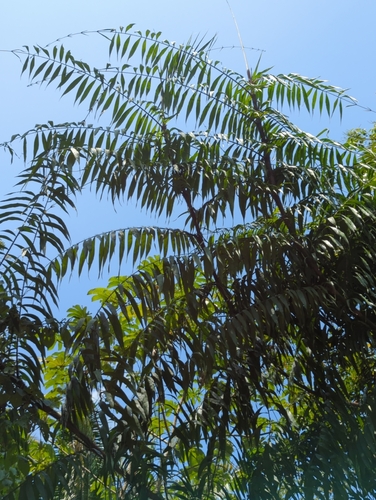
(c) Vinod Babu, some rights reserved (CC BY-NC), uploaded by Vinod Babu
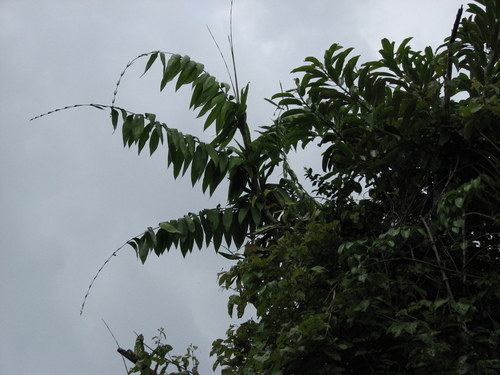
(c) Francisco Jose Gomez Marin, some rights reserved (CC BY-NC), uploaded by Francisco Jose Gomez Marin
What to Eat
Edible parts: Fruit, Seeds
The fruit is eaten, and the jelly inside the seed is consumed.
Where to Find It
It is a tropical plant. It grows in secondary forests and swamp forests. It grows up to 1,000 m above sea level.
America, Asia, Belize, Brazil, Central America, Colombia, Guiana, Guianas, Guyana, Indonesia, Mexico, SE Asia, South America*, Suriname, Trinidad & Tobago, Venezuela,
How to Identify
A climbing palm. It grows in clusters. The stems are heavily armed. The stems are 2-12 m long and 1.5-2 cm wide. The sheaths have short black spines. The leaves have hooks that curve backwards near the tip. The leaves have leaflets along the stalks. There are 7-25 on each side. The flowering shoots are large. The fruit is bright red and fleshy. There is one seed.
How to Grow
Plants can be grown from seeds.
Medicinal Uses
A decoction of the root is used as a drastic; it is considered excellent for treating dartre, eczema and certain dermatoses.
Other Uses
Mature stems are used for basket making.
Wikipedia
Source ↗Desmoncus orthacanthos is a spiny, climbing palm native to tropical South America. Stems grow clustered together, and are 2–12 m long and 1.5–2 cm in diameter. Stems, leaf sheaths and often leaves are covered with black spines up to 6 cm long. Desmoncus orthacanthos is found in Colombia, Venezuela, Trinidad and Tobago, Guyana, Suriname, French Guiana, Brazil, Bolivia, Ecuador and Peru. The stems are used for basket weaving.
Names & Synonyms
Alakule, Atitara, Bambamaka, Bayal, Grigri palm, Hi yoron, Iatitara, Jacitara, Kamwari, Ratan titi, Tucum-preto, Urubamba, Weheyu
References (7)
- Bortolotto, I. M., et al, 2015, Knowledge and use of wild edible plants in rural communities along Paraguay River, Pantanal, Brazil. Journal or Ethnobiology and Ethnomedicine. 11:46
- Bortolotto, I. M., et al, 2018, Lista preliminar das plantas alimenticias nativas de Mato Grosso do Sul, Brasil. Iheringia, Serie Botanica, Porto Alegre, 73 (supl.):101-116
- Kermath, B. M., et al, 2014, Food Plants in the Americas: A survey of the domesticated, cultivated and wild plants used for Human food in North, Central and South America and the Caribbean. On line draft. p 303
- Reis, S. V. and Lipp, F. L., 1982, New Plant Sources for Drugs and Foods from the New York Botanical Garden herbarium. Harvard. p 18 (As Desmoncus prostratus)
- Roa, J. A. G. & Boada, D. S. G., 2018, Fundación para el Fortalecimiento de la Fruticultura y Plantas Alimenticias no Convencionales en Colombia.
- Sukarya, D. G., (Ed.) 2013, 3,500 Plant Species of the Botanic Gardens of Indonesia. LIPI p 776
- van Andel, T., 2000, Useful plants of Guyana. Non-timber forest products of the North-West District of Guyana. Part 2. A Field Guide. Tropenbos-Guyana Programme. p 298