Hibiscus vitifolius
L.
Tropical rose mallow

(c) Grant Reed, some rights reserved (CC BY-NC)

(c) Grant Reed, some rights reserved (CC BY-NC)

(c) Grant Reed, some rights reserved (CC BY-NC)
What to Eat
Edible parts: Flowers ?, Vegetable
The flowers and vegetative parts are edible.
Where to Find It
It is a tropical plant. It grows near the edge of dry rainforest.
Africa, Asia, Australia, Comoros, Congo DR, Côte d'Ivoire, Dominican Republic, East Africa, Egypt, Eritrea, Ghana, India, Indochina, Ivory Coast, Kenya, Madagascar, Mali, Mozambique, SE Asia, Somalia, South Africa, Southern Africa, Sri Lanka, Tanzania, Vietnam, West Africa, West Indies,
How to Identify
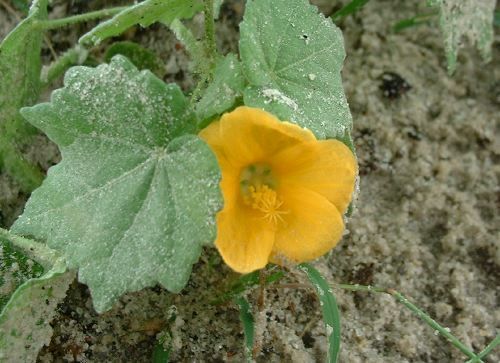
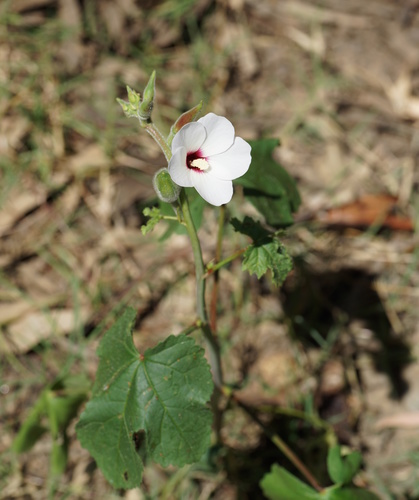
A herb or low shrub. It grows 1.5 m tall. The leaves are alternate and can be simple or have 3-5 lobes. The leaves at the top of the plant are oval. They are 2-15 cm long by 1-18 cm wide. They are hairy and have teeth along the edge. The flowers occur singly in the axils of leaves. They are pale yellow with a dark red spot at the base. They are about 3 cm long. The fruit is a capsule that is a flattened round shape. It is about 1 cm long.
How to Grow
Often found as a weed of cultivated crops within its native range, it has the potential to spread as a weed in other, suitable areas.
Other Uses
A fibre is obtained from the stem. Of good quality, it is used in combination with jute (Corchorus species))
Wikipedia
Source ↗Hibiscus vitifolius, the grape-leaved mallow or tropical rose mallow, is a species of flowering plant in the family Malvaceae. It is native to the seasonally dry Old World tropics and subtropics, and has been introduced to the West indies. A perennial herb reaching 2 m (6 ft) and becoming woody at maturity, it is found in a wide variety of habitats, and is a weed of cultivation. It is used locally as a source of fiber, often mixed with jute.
Names & Synonyms
Bup la-nho
References (4)
- Melzer, R. & Plumb, J., 2011, Plants of Capricornia. Belgamba, Rockhampton. p 173
- Mutie, F. M., et al, 2023, Important Medicinal and Food Taxa (Orders and Families) in Kenya, Based on Three Quantitative Approaches. Plants 2023, 12, 1145
- PROTA
- World Checklist of Useful Plant Species 2020. Royal Botanic Gardens, Kew