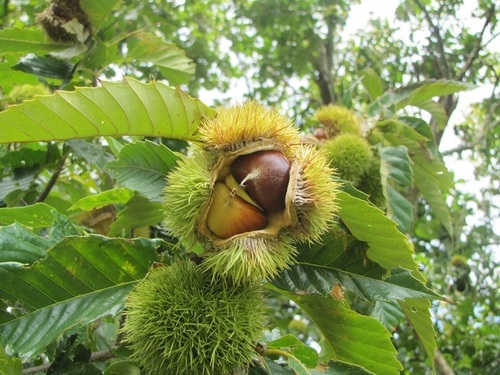
Castanopsis cuspidata
(Thunb.) Schottky
Japanese chinquapin
(c) Inti-sol~commonswiki, some rights reserved (CC BY-SA)

(c) mutolisp, some rights reserved (CC BY-NC-SA)

(c) Krzysztof Ziarnek, Kenraiz, some rights reserved (CC BY-SA)
What to Eat
Edible parts: Nuts, Seeds
The cotyledon of the nut is eaten boiled or roasted.
Where to Find It
It is a temperate plant. It suits hardiness zones 7-10.
Asia, Australia, Britain, China*, Europe, Japan, Korea,
How to Identify
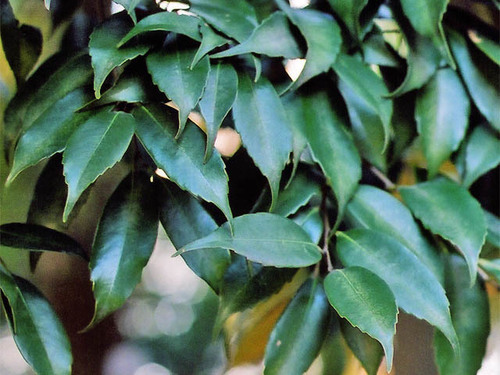
A tree. It grows 24 m high. The leaves are narrow and pointed. The edges are smooth or slightly toothed. The young leaves are a coppery colour. They are nearly white underneath. The flowers are in yellow-green catkins. They are fragrant. The nuts are edible.
How to Grow
Propagation: Seed requires a period of cold stratification and is best sown as soon as it is ripe in a cold frame. The seed has short viability and should not be allowed to dry out. It can be stored for a few months if kept cool and moist — a plastic bag in the salad compartment of a fridge works well. Stored seed should be soaked in warm water for 24–48 hours before sowing. Germination usually takes place within 1–3 months at 15°C. Prick out seedlings into individual pots as soon as they are large enough to handle and plant out in mid summer if possible, otherwise overwinter in a cold frame and plant out in late spring. Give young plants some protection from cold for their first few winters outdoors.
Medicinal Uses
None known
Other Uses
None known. The plant is noted for its scented qualities.
Wikipedia
Source ↗Castanopsis cuspidata (Japanese chinquapin; Japanese tsuburajii, 円椎) is a species of Castanopsis native to southern Japan and southern Korea. It is a medium-sized evergreen tree growing to 20–30 m tall, related to beech and oak. The leaves are 5–9 cm long and 2–4 cm broad, leathery in texture, with an entire or irregularly toothed margin. It grows in woods and ravines, especially near the sea. The cotyledon of the nut is eaten boiled or roasted. Its dead wood serves as host to many mushroom types, most notably the shiitake, whose Japanese name (椎茸) is composed of shii (椎, the Castanopsis tree), and take (茸; "mushroom").
Notes
There are about 120 Castanopsis species. Many have edible nuts.
Names & Synonyms
Tsubura-jii
References (9)
- Bot. Jahrb. Syst. 47:682. 1912
- Cundall, P., (ed.), 2004, Gardening Australia: flora: the gardener's bible. ABC Books. p 339
- Etherington, K., & Imwold, D., (Eds), 2001, Botanica's Trees & Shrubs. The illustrated A-Z of over 8500 trees and shrubs. Random House, Australia. p 189
- Facciola, S., 1998, Cornucopia 2: a Source Book of Edible Plants. Kampong Publications, p 115
- Lyle, S., 2006, Discovering fruit and nuts. Land Links. p 123
- Menninger, E.A., 1977, Edible Nuts of the World. Horticultural Books. Florida p 18 (As Lithocarpus cuspidatus)
- Plants for a Future database, The Field, Penpol, Lostwithiel, Cornwall, PL22 0NG, UK. http://www.scs.leeds.ac.uk/pfaf/
- Solomon, C., 2001, Encyclopedia of Asian Food. New Holland. p 158
- Wickens, G.E., 1995, Edible Nuts. FAO Non-wood forest products. FAO, Rome. p 125
More from Fagaceae