Grewia balensis
Kirkup & Sebsebe
MalvaceaeFruit

gbif · cc-by
Royal Botanic Gardens, Kew
Royal Botanic Gardens, Kew

gbif · cc-by
Royal Botanic Gardens, Kew
Royal Botanic Gardens, Kew

gbif · cc-by
Royal Botanic Gardens, Kew
Royal Botanic Gardens, Kew
What to Eat
Edible parts: Fruit
The fruit are eaten.
Where to Find It
It is a tropical plant. In Somalia it grows between 50-320 m above sea level.
Africa, East Africa, Ethiopia, Kenya, Somalia,
Countries: Angola, Burkina Faso, Burundi, Benin, Botswana, Congo (DRC), Central African Republic, Congo (Republic), Cote d'Ivoire, Cameroon, Cape Verde, Djibouti, Algeria, Egypt, Eritrea, Ethiopia, Gabon, Ghana, Gambia, Guinea, Equatorial Guinea, Guinea-Bissau, Kenya, Comoros, Liberia, Lesotho, Libya, Morocco, Madagascar, Mali, Mauritania, Mauritius, Malawi, Mozambique, Namibia, Niger, Nigeria, Rwanda, Seychelles, Sudan, Sierra Leone, Senegal, Somalia, South Sudan, Sao Tome & Principe, Eswatini, Chad, Togo, Tunisia, Tanzania, Uganda, South Africa, Zambia, Zimbabwe
How to Identify
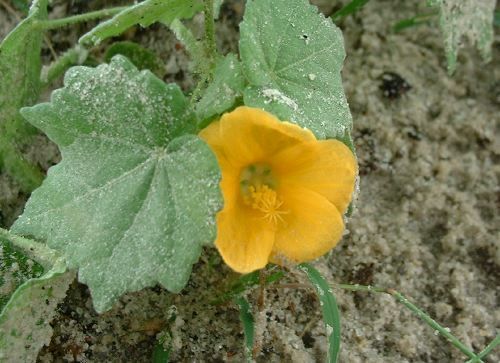
A shrub. It has several stems. It grows 4 m tall. The young branches have a covering of yellow hairs. They become smooth with age. The leaves are green and have short hairs on the upper surface. They are oval and 1-6 cm long by 1-3 cm wide. They can be heart shaped at the base. The flowering shoots occur singly. They are 1-2 cm long. There are 2-3 flowers. The petals are yellow. The fruit have 2 lobes. Each lobe is 4-6 mm across. They are hairy.
Notes
These were in the families Sparrmanniaceae and the Tiliaceae.
Names & Synonyms
Bereza, Dawaita
References (2)
- Addis, G., Asfaw, Z & Woldu, Z., 2013, Ethnobotany of Wild and Semi-wild Edible Plants of Konso Ethnic Community, South Ethiopia. Ethnobotany Research and Applications. 11:121-141
- Lulekal, E., et al, 2011, Wild edible plants in Ethiopia: a review on their potential to combat food insecurity. Afrika Focus - Vol. 24, No 2. pp 71-121