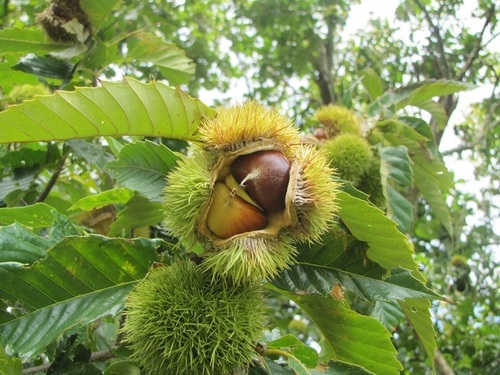
Castanopsis inermis
(Lindley ex Wallich) Benth. & Hook. f.

(c) 106611639464075912591, some rights reserved (CC BY-NC-SA), uploaded by 106611639464075912591
(c) SunGW, some rights reserved (CC BY-NC)
(c) SunGW, some rights reserved (CC BY-NC)
What to Eat
Edible parts: Nuts
The seeds are cooked — they can be boiled, parched, or roasted. Seeds range from 20–30mm in size.
Where to Find It
A tropical plant. It grows in secondary forests at about 800 m above sea level.
Asia, East Africa, Indochina, Indonesia, Malaysia, Myanmar, SE Asia, Thailand, Uganda,
How to Identify
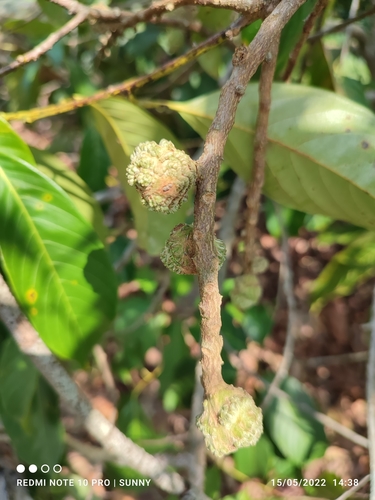
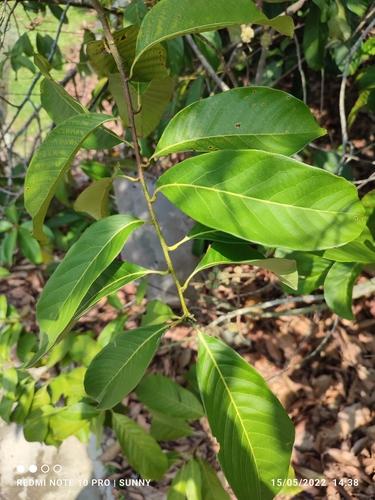
A tall evergreen tree. It grows 30 m tall. The leaves are narrowly oval and 7-23 cm long by 3-9 cm wide. The base is rounded and they taper to the tip. The leaf stalks are softly hairy. The seeds or nuts are triangle shaped. The nuts are in a case which does not have spines. It is 25 mm across.
How to Grow
Castanopsis species are generally tolerant of a range of soils, preferably well-drained. They succeed in full sun, though young plants generally grow best in dappled woodland shade.
Propagation: Seed.
Medicinal Uses
None known
Other Uses
The plant may be able to tolerate park conditions. It is the preferred local food plant for caterpillars of the ciliate blue butterfly (Anthene emolus) and the moth Calliteara angulata.
Wikipedia
Source ↗Fast-growing evergreen tree reaching 20 m tall and 20 m wide. Insect-pollinated flowers appear throughout the growing season. Grows in light sandy, medium loamy, or heavy clay soils with preference for well-drained conditions and mildly acid to basic pH. Tolerates semi-shade to full sun and prefers moist soil. Hardy to UK zone 10.
Other Information
Fruit are sold in markets. Trees are planted.
Notes
There are about 120 Castanopsis species. Many have edible nuts.
Names & Synonyms
Berangan, Beragam makan, Berangan betul, Berangan padi, Ko khaao, Parang berangan
More from Fagaceae