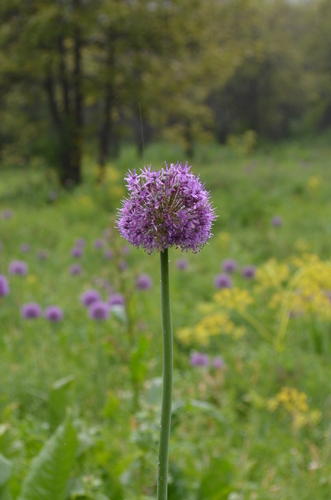
Allium jacquemontii
Kunth

Qarshi Industries Pvt Ltd

Royal Botanic Garden Edinburgh

GBIF
What to Eat
Edible parts: Leaves, Vegetable
The leaves are eaten as a vegetable and used in chutney and for flavouring.
Where to Find It
It is a temperate plant. It grows above 2,500 m in cold arid areas in India. In western China it grows on high plateaus and gravelly places between 4,200-4,600 m above sea level.
Asia, Central Asia, China, Himalayas, India, Pakistan, Tajikistan, Tibet,
How to Identify
A herb. It has a single bulb. This is oval and 1 cm across. There are 2 or 3 leaves. These are 1-2 mm wide. The stalk is 25-40 cm long.
Wikipedia
Source ↗Allium jacquemontii is a plant species native to India, Pakistan, Afghanistan, Tajikistan, Xizang (Tibet) and Xinjiang. It grows high in the mountains at elevations of 4,000–4,500 metres (13,100–14,800 ft). Allium jacquemontii forms solitary egg-shaped bulbs about 10 millimetres (0.39 in) across. Scapes are up to 40 centimetres (16 in) tall. Umbel forms a hemisphere of many densely packed red or purple flowers.
Notes
They have also been put in the family Alliaceae.
Names & Synonyms
Gao yuan xie
References (3)
- Badwar, R. R., & Fernandez, R. R., 2011, Edible Wild Plants of the Himachal Pradesh State by IHBT, Himalayas, Daya Publishing House,. Delhi, India
- Rana, J.C. et al, 2011, Genetic resources of wild edible plants and their uses among tribal communities of cold arid regions of India. Genetic Resources and crop Evolution. (2012) 59:135-149
- Sharma, L. et al, 2018, Diversity, distribution pattern, endemism and indigenous uses of wild edible plants in Cold Desert Biosphere Reserve of Indian Trans Himalaya. Indian Journal of Traditional Knowledge. Vol 17(1) January 2018 pp 122-131