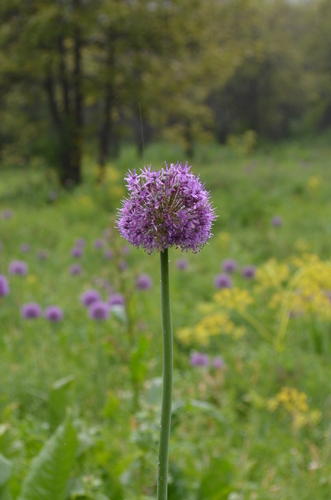
Allium macranthum
Baker
Flowering grass onion
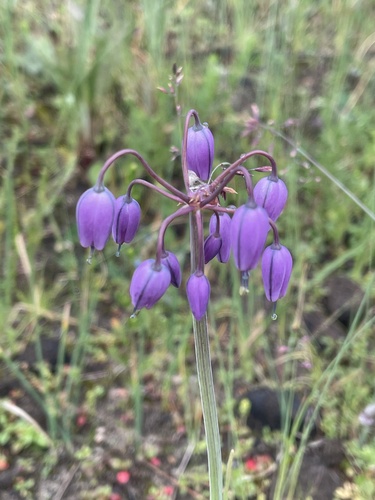
(с) Larry Chen, некоторые права защищены (CC BY-NC), загрузил Larry Chen
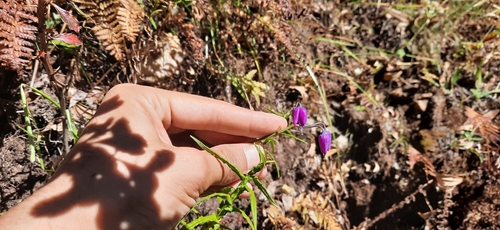
(c) Phuentsho, some rights reserved (CC BY-NC-SA)
What to Eat
Edible parts: Leaves, Plant, Bulb, Vegetable
The bulbs are eaten fresh as a vegetable and spice, and the plant is used in soups. The leaves and bulbs are edible.
Where to Find It
It is a temperate plant. In the Himalayas it grows between 2,000-2,500 m above sea level. In China it grows in damp places and stream banks between 2,700-4,200 m above sea level. In Sichuan and Yunnan.
Asia, Bhutan, China, Himalayas, India, Northeastern India, Sikkim, Tibet,
How to Identify
An onion plant. It is a herb. It has one bulb. The leaves are 4-10 mm wide. The stalk is 20-60 cm long and 2 or 3 angled.
Wikipedia
Source ↗Allium macranthum is an Asian species of wild onion native to Bhutan, Sikkim, Gansu, Shaanxi, Sichuan and Tibet. It grows in wet places at elevations of 2700–4200 metres. Allium macranthum has short, thick roots and a cylindrical bulb. Scapes are up to 60 cm tall. Leaves are flat, long, and thin, about the same length as the scapes but less than 2 cm across. Umbels have only a few purple, bell-shaped flowers.
Notes
They have also been put in the family Alliaceae.
Names & Synonyms
Jimbo, Na ga su
References (4)
- Boesi, A., 2014, Traditional knowledge of wild food plants in a few Tibetan communities. Journal of Ethnobiology and Ethnomedicine 10:75
- Cheng, Z., et al, 2022, Ethnobotanical study on wild edible plants used by Dulong people in northwestern Yunnan, China. Journal of Ethnobiology and Ethnomedicine (2022) 18:3
- Sundriyal, M., et al, 1998, Wild edibles and other useful plants from the Sikkim Himalaya, India. Oecologia Montana 7:43-54
- Yeshi, K. et al, 2017, Taxonomical Identification of Himalayan Edible Medicinal Plants in Bhutan and the Phenolic Contents and Antioxidant Activity of Selected Plants. TBAP 7 (2) 2017 pp 89 - 106