Castanopsis lecomtei
Hickel & A. Camus
Ca oi sa pa

gbif · cc-by-nc
Copyright Royal Botanic Garden Edinburgh. Contact us for rights to commercial use.
Copyright Royal Botanic Garden Edinburgh. Contact us for rights to commercial use.

gbif · cc-by-nc
Copyright Royal Botanic Garden Edinburgh. Contact us for rights to commercial use.
Copyright Royal Botanic Garden Edinburgh. Contact us for rights to commercial use.

gbif · cc-by-nc
Copyright Royal Botanic Garden Edinburgh. Contact us for rights to commercial use.
Copyright Royal Botanic Garden Edinburgh. Contact us for rights to commercial use.
What to Eat
Edible parts: Fruit, Seeds, Nuts
The nuts are eaten; the nut contains edible starch.
Where to Find It
A tropical plant. It grows from subtropical to tropical forests.
Asia, China, Indochina, Laos, SE Asia, Vietnam,
Countries: United Arab Emirates, Afghanistan, Armenia, Azerbaijan, Bangladesh, Bahrain, Brunei, Bhutan, China, Georgia, Indonesia, Israel, India, Iraq, Iran, Jordan, Japan, Kyrgyzstan, Cambodia, North Korea, South Korea, Kuwait, Kazakhstan, Laos, Lebanon, Sri Lanka, Myanmar, Mongolia, Maldives, Malaysia, Nepal, Oman, Philippines, Pakistan, Qatar, Saudi Arabia, Singapore, Syria, Thailand, Tajikistan, Timor-Leste, Turkmenistan, Turkey, Taiwan, Uzbekistan, Vietnam, Yemen
How to Identify
An evergreen tree. It grows 25-28 m tall. The trunk is 40-60 cm across. The fruit is a single nut.
Notes
There are about 120 Castanopsis species. Many have edible nuts.
References (1)
- Forest Inventory and Planning Institute, 1996, Vietnam Forest Trees. Agriculture Publishing House p 263
More from Fagaceae

Castanea alnifolia
Bush chinkapin, Florida chinkapin, Trailing chinkapin, Downy chinquapin

Castanea crenata
Japanese chestnut

Castanea dentata
American chestnut, American sweet chestnut

Castanea henryi
Zhui li, Conic chestnut
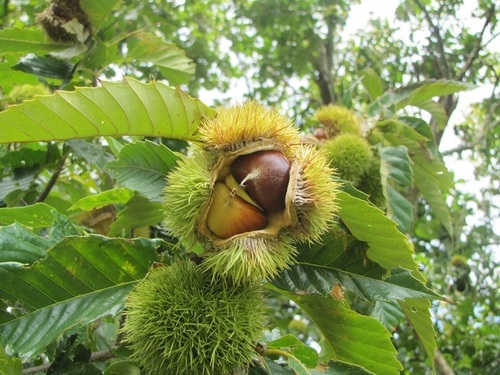
Castanea mollissima
Chinese chestnut

Castanea ozarkensis
Ozark chinkapin, Ozark chestnut