Castanopsis lucida
(Nees) Soepadmo
Berangan papan
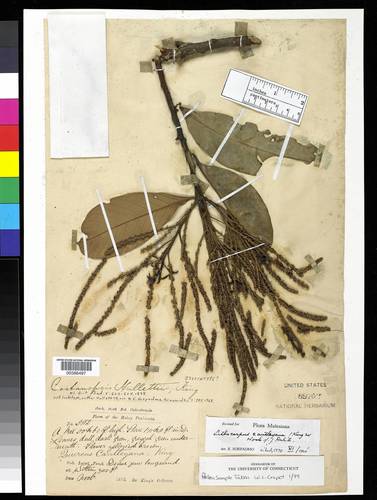
(c) Smithsonian Institution, National Museum of Natural History, Department of Botany, some rights reserved (CC BY-NC-SA)

(c) Anthony J. Gadzi, some rights reserved (CC BY-NC)

(c) Anthony J. Gadzi, some rights reserved (CC BY-NC)
What to Eat
Edible parts: Nuts
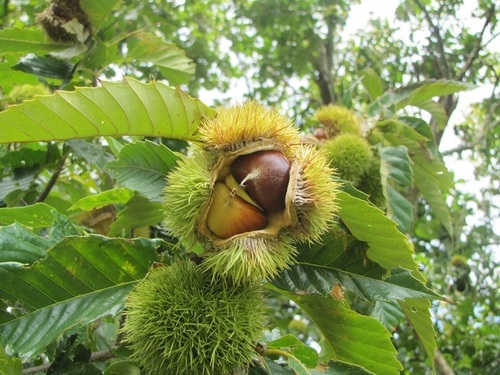
Seeds - raw or cooked. The nuts are eaten raw, cooked, roasted or used in chocolates and pastries. The ovoid seeds are 15 - 20mm wide with a thick, woody seedcoat; 2 - 4 seeds are produced in each cupule.
Where to Find It
A tropical plant. It grows in mixed forest up to 500 m above sea level.
Asia, Indochina, Indonesia, Malaysia, SE Asia, Singapore, Thailand,
How to Identify
A tree. It grows 20 m tall. The trunk is 40 cm across. It has buttresses 1.6 m tall. The leaves are thick and leathery. They are smooth and shiny above. There are a few hairs underneath. The leaves are narrowly oval and 16-21 cm long by 8-10 cm wide. The male and female flowers are separate. The male flowering stalks are 10-15 cm long and have flowers in clusters of 3-5. The female flowering stalks are 8-10 cm long and the flowers are in clusters of 3. The fruit cup is a flattened round shape and 3-4 cm across. It is prickly. There are 2-4 nuts in each cup. They are oval and up to 2 cm across.
How to Grow
Castanopsis species are generally tolerant of a range of soils, preferably well-drained. They succeed in full sun, though young plants generally grow best in dappled woodland shade. Trees do not respond well to coppicing.
Propagation: Seed - easy to germinate if sown fresh. Self-sown seedlings can be transplanted.
Other Uses
The bark is a source of tannins and can be used as a dye, to weatherproof fibres etc. The branches and stems of many Castanopsis species are used as bed logs in mushroom cultivation. The sapwood is dirty white. The wood is hard, difficult to work and liable to splitting. The wood is a good fuel and can be used to make charcoal.
Wikipedia
Source ↗Castanopsis lucida is a tree in the family Fagaceae. The specific epithet lucida is from the Latin meaning 'shining', referring to the leaf surface.
Notes
There are about 120 Castanopsis species. Many have edible nuts.
Names & Synonyms
Berangan babi, Berangan papan, Kertak tangga, Sebilek
References (6)
- Burkill, I.H., 1966, A Dictionary of the Economic Products of the Malay Peninsula. Ministry of Agriculture and Cooperatives, Kuala Lumpur, Malaysia. Vol 1 (A-H) p 493 (As Castanopsis hullettii)
- Menninger, E.A., 1977, Edible Nuts of the World. Horticultural Books. Florida p 16 (As Castanopsis hullettii)
- Milow, P., et al, 2013, Malaysian species of plants with edible fruits or seeds and their evaluation. International Journal of Fruit Science. 14:1, 1-27
- Slik, F., www.asianplant.net
- Soepadmo, E. and Saw, L. G., 2000, Tree Flora of Sabah and Sarawak. Forestry Malaysia. Volume Three. p 20
- Wickens, G.E., 1995, Edible Nuts. FAO Non-wood forest products. FAO, Rome. p 125
More from Fagaceae