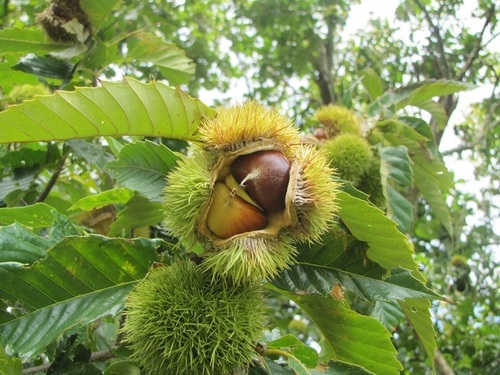
Castanopsis tribuloides
(Smith) A. DC.
Hill chestnut
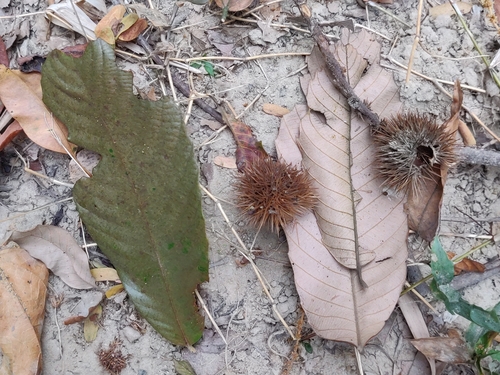
(c) T R Shankar Raman, some rights reserved (CC BY)
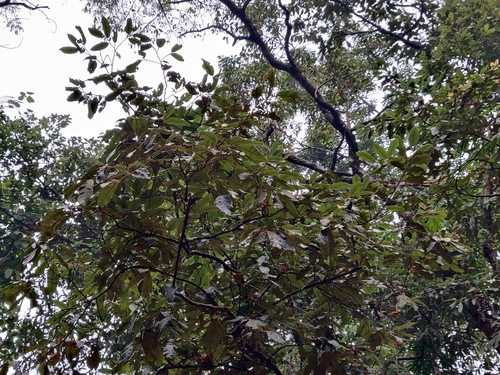
(c) T R Shankar Raman, some rights reserved (CC BY)
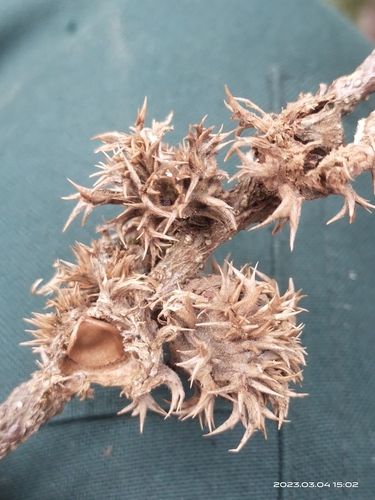
(c) Rinzin Dorji, some rights reserved (CC BY-NC)
What to Eat
Edible parts: Seeds, Nuts, Leaves - tea
The seeds can be eaten raw or cooked and resemble a filbert (Corylus maxima) in both size and flavour, measuring about 16mm in diameter.
Known Hazards
Where to Find It
A tropical and subtropical plant. In Nepal plants grow between 100-1500 m altitude. In the Indian Himalayas it grows between 1,200-2,000 m above sea level. In Sikkim is grows between 450-2,300 m above sea level.
Asia, Bangladesh, Bhutan, China, Himalayas, India, Indochina, Laos, Myanmar, Nepal, Northeastern India, Pakistan, SE Asia, Sikkim, Thailand,
How to Identify
An evergreen tree. It grows to about 20 m tall. The bark is cracked. The leaves are 4.5-19 cm long by 1.5-7 cm wide. They are sword shaped. The flowers do not have stalks. The fruit is a nut enclosed in a spiny top shaped covering.
How to Grow
We have very little information on this species and do not know if it will be hardy in Britain, though judging by its native range it could succeed outdoors at least in the milder parts of this country. It coppices well. The following notes are based on the general needs of the genus. Prefers a good deep medium to stiff loam. Requires a sheltered position in semi-shade and a lime-free soil. Although cold hardy in Britain, this species really requires a warm continental climate if it is to prosper and it does not do well in the maritime climate of this country. The seed takes two growing seasons from fertilization to maturity. The catkins have an unpleasant hawthorn-like smell to attract midges for their pollination.
Propagation: Seed requires a period of cold stratification and is best sown as soon as it is ripe in a cold frame. The seed has short viability and should not be allowed to dry out. It can be stored for a few months if kept cool and moist — a plastic bag in the salad compartment of a fridge works well. Stored seed should be soaked in warm water for 24–48 hours before sowing. Germination usually takes place within 1–3 months at 15°C. Prick out seedlings into individual pots as soon as they are large enough to handle and plant out in mid summer if possible, otherwise overwinter in a cold frame and plant out in late spring. Give young plants some protection from cold for their first few winters outdoors.
Medicinal Uses
None known
Other Uses
The wood is moderately hard but not durable, and is used for planks, shingles, and shading.
Wikipedia
Source ↗Castanopsis tribuloides is a species of flowering plant in the beech family Fagaceae, native to the Himayalas and higher areas of mainland Southeast Asia. In Vietnam it is cultivated for its edible nuts, and in India it is coppiced for firewood.
Production
In the Himalayas it flowers July to November and fruits August to October. In Sikkim February to April.
Other Information
Fruit sold in market.
Notes
There are about 120 Castanopsis species. Many have edible nuts.
Names & Synonyms
Bara hingari, Bara hingra, Bara hinguri, Chisi, Dhalekatush, Dieng-soh-ot, Ginsa kinsa, Ginsa-matsawi, Katauj, Katonj, Katus, Ko keut, Kotur, Kyanza, Musrey katus, Musuray katus, Musure katus, Phul-singori, Sa ut, Sili batna, Tain tha, Thazarshi, Tumari, U-thangji
References (39)
- Altschul, S.V.R., 1973, Drugs and Foods from Little-known Plants. Notes in Harvard University Herbaria. Harvard Univ. Press. Massachusetts. no. 646
- Ambasta S.P. (Ed.), 2000, The Useful Plants of India. CSIR India. p 111
- Anderson, E. F., 1993, Plants and people of the Golden Triangle. Dioscorides Press. p 205
- Aryal, K. P., et al, 2018, Diversity and use of wild and non-cultivated edible plants in the Western Himalaya. Journal of Ethnobiology and Ethnomedicine (2018) 14:10
- Castillo, C., 2013, The Archaeobotany of Khao Sam Kaeo and Phu Khao Thong: The Agriculture of Late Prehistoric Southern Thailand. Ph. D. thesis University College, London p 380
- Chakraborty, S. & Chaturbedi, H. P., 2014, Some Wild Edible Fruits of Tripura- A Survey. Indian Journal of Applied research. (4) 9
- Chettri, N. & Sharma, E., Non-timber Forest Produce: Utilization, Distribution and Status in the Khangchendzonga Biosphere Reserve, Sikkim, India.
- Dobriyal, M. J. R. & Dobriyal, R., 2014, Non Wood Forest Produce an Option for Ethnic Food and Nutritional Security in India. Int. J. of Usuf. Mngt. 15(1):17-37
- Gautam, R. S., et al, 2020, Wild Edible Fruits of Nepal. Int. J. Appl. Sci. Biotechnol. Vol 8(3): 289-304
- Hazarika, T. K., et al, 2012, Studies on wild fruits of Mizoram, India used as ethno-medicines. Genetic Resources and Crop Evolution. Published on line 03 February, 2012
- Hu, Shiu-ying, 2005, Food Plants of China. The Chinese University Press. p 347
- J. Bot. 1:182. 1863
- Jeeva, S., 2009, Horticultural potential of wild edible fruits used by the Khasi tribes of Meghalaya. Journal or Horticulture and Forestry Vol. 1(9) pp. 182-192
- Johnson, N., 2002, Environmental Change in northern Thailand: Impact on Wild Edible Plant Availability. Ecology of Food and Nutrition, 41: 5, 373-399
- Joshi, A. R.. and Joshi, J., 2009, Plant Diversity and Ethnobotanical Notes on tree species of Syabru Village, Langtang National Park, Nepal. Ethnobotanical Leaflets 13:651-64
- Kumar, A., et al, 2012, Ethnobotanical Edible Plant Biodiversity of Lepcha Tribes. Indian Forester, 138 (9):798-803
- Lehmann, L., et al, Forests and Trees of the Central Highlands of Xieng Khouang, Lao P. D. R., A field guide.
- Majumdar, K and Datta, N., 2009, Traditional wild edible fruits for the forest dwellers of Tripura, India. Pleione 3(2) 167-178
- Manandhar, N.P., 2002, Plants and People of Nepal. Timber Press. Portland, Oregon. p 141
- Meitei, L. R., et al, 2022, An ethnobotanical study on the wild edible plants used by forest dwellers in Yangoupokpi Lokchao Wildlife Sanctuary, Manipur, India. Ethnobotany Research and Application 23:15
- Mozhui, R., et al, 2011, Wild edible fruits used by the tribals of Dimapur district of Nagaland, India. Pleione 5(1): 56 - 64.
- Mukhia, P.K., et al, 2013, Wild plants as Non Wood Forest Products used by the rural community of Dagana, a southern foothill district of Bhutan, SAARC Journal, 27 pages
- Murtem, G. & Chaudhrey, P., 2016, An ethnobotanical note on wild edible plants of Upper Eastern Himalaya, India. Brazilian Journal of Biological Sciences, 2016, v. 3, no. 5, p. 63-81
- Pasha, M. K. & Uddin, S. B., 2019, Minor Edible Fruits of Bangladesh. Bangladesh J. Plant Taxon. 26(2): 299–313
- Phawa, G. M., Dkhar, E. K. & Marbaniang, D., 2019, Indigenous Wild Edible Plants of Bataw Village, East Jaintia Hills District, Meghalaya. International Journal of Arts, Science and Humanities. 7(2)
- Plants for a Future database, The Field, Penpol, Lostwithiel, Cornwall, PL22 0NG, UK. http://www.scs.leeds.ac.uk/pfaf/
- Sawian, J. T., et al, 2007, Wild edible plants of Meghalaya, North-east India. Natural Product Radiance Vol. 6(5): p 414
- Sharma, G., et al, 2016, Agrobiodiversity in the Sikkim Himalaya. International Centre for Integrated Mountain Development, ICIMOD Working Paper 2016/5 p 20
- Singh, H.B., Arora R.K.,1978, Wild edible Plants of India. Indian Council of Agricultural Research, New Delhi. p 81
- Suksri, S., et al, 2005, Ethnobotany in Bung Khong Long Non-Hunting Area, Northeast Thailand. Kasetsart J., (Nat. Sci) 39: 519-533
- Sundriyal, M., et al, 2004, Dietary Use of Wild Plant Resources in the Sikkim Himalaya, India. Economic Botany 58(4) pp 626-638
- Sundriyal, M. & Sundriyal, R. C., 2004, Structure, Phenology, Fruit Yield, and Future Prospects of some Prominent Wild Edible Plant Species of the Sikkim Himalaya, India. Journal of Ethnobiology 24(1): 113-138
- Suresh, C. P. et al, 2014, Wild Edible Tree Fruits of Sikkim Himalayas. Journal of Tree Sciences 33(1): 43-48
- Upreti, K., et al, 2010, Diversity and Distribution of Wild Edible Fruit Plants of Uttarakhand. Bioversity Potentials of the Himalaya. p 165
- Wickens, G.E., 1995, Edible Nuts. FAO Non-wood forest products. FAO, Rome. p 125
- Wild edible plants of Himachal Pradesh
- World Checklist of Useful Plant Species 2020. Royal Botanic Gardens, Kew
- www.mekonginfo.org/assets/midocs/0001714-environment-forests-and-trees-of-the-central-highlands-of-xieng-khouang-lao
- www.pang-soong-lodge.com website
More from Fagaceae