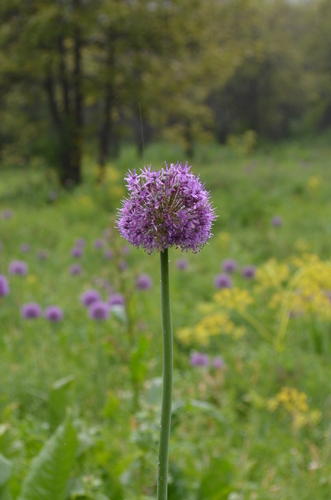
Allium cupani
Raf.
Turkish dwarf onion

(c) Sami Tamson, some rights reserved (CC BY-NC), uploaded by Sami Tamson

Zennora Brna (via Wikimedia Commons)

GBIF

GBIF

GBIF
What to Eat
Edible parts: Flowers, Leaves, Bulb, Root
The bulb, which grows up to 15mm in diameter, can be eaten raw or cooked. Leaves are also edible raw or cooked. The flowers can be eaten raw and used as a garnish on salads.
Where to Find It
It can grow up to 2,200 m above sea level in Turkey. It can be in rocky places and in pine and oak forests. It can grow in a range of well-drained soils. It needs to be in a sunny position. It can be in dry or moist soils. It suits hardiness zone 8.
Albania, Asia, Europe, Mediterranean, Turkey, Türkiye,
How to Identify
A small bulb plant from the central and eastern Mediterranean region, growing 20 cm high with bulbs approximately 15 mm across, found in rocky areas, pine and oak forests, and suited to zone 8 and well-drained soils in sunny positions.
How to Grow
Plants can be grown by seeds or division.
Propagation: Sow seed in spring in a cold frame. Prick out seedlings into individual pots once large enough to handle, or place three per pot to build clumps faster. Grow on in the greenhouse through at least the first winter before planting out in spring once vigorous and large enough. Division is best in spring, though plants can be divided at any point during the growing season. Pot up divisions in a cold frame or greenhouse until growing well, then plant out into permanent positions.
Medicinal Uses
No specific medicinal uses have been recorded for this species, but like other members of its genus it is a healthy dietary addition. It contains sulphur compounds responsible for its onion flavour, and when consumed regularly it can help reduce blood cholesterol, act as a digestive tonic, and support the circulatory system.
Other Uses
The juice of the plant can be used as a moth repellent. The whole plant is also said to repel insects and moles.
Notes
They have also been put in the family Alliaceae.
Names & Synonyms
References (1)
- Plants for a Future database, The Field, Penpol, Lostwithiel, Cornwall, PL22 0NG, UK. http://www.pfaf.org