Ceiba pentandra
(L.) Gaertn.
Kapok, White silk cotton tree

no rights reserved, uploaded by Manuel Ortiz
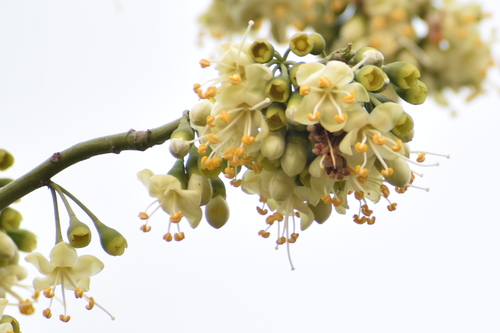
(c) Aniruddha Singhamahapatra, some rights reserved (CC BY-NC), uploaded by Aniruddha Singhamahapatra
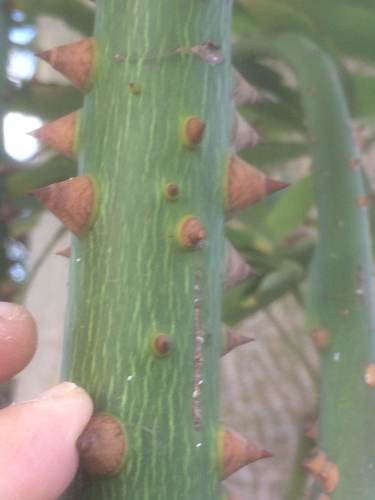
(c) Patrick Scannell, some rights reserved (CC BY-NC), uploaded by Patrick Scannell
What to Eat
Edible parts: Seeds, Leaves, Calyces, Flowers, Vegetable, Fruit, Oil
Tender leaves, buds, and young fruit are mucilaginous and can be eaten in the same way as okra. Seeds can be eaten raw or cooked; when roasted and ground into a powder they are added to soups and used as a flavouring. Seeds can also be sprouted and eaten raw or added to soups. One report notes the seed is toxic, though the oil extracted from it is edible. This cooking oil is yellow with a mild, pleasant odour and taste resembling cottonseed oil, but it turns rancid quickly when exposed to air. Flowers are blanched and eaten with chilli sauce, and the dried stamens are added to curries and hot, sour soups for colouring. Wood ash serves as a salt substitute, and the resin from the trunk is mixed with water and drunk.
Known Hazards
Where to Find It
It is a tropical plant. Mostly in the lowlands and up to about 1000 m. It suits rainforest areas with a heavy rainfall. It suits humid locations. The soil needs to be well drained. It can grow in seasonally flooded forests. The tree is easily damaged by strong winds. It needs a temperature of 25°-30°C and not below 15°C. It is light demanding. It suits hardiness zones 11-12. In XTBG Yunnan.
Africa, Andamans, Antigua and Barbuda, Asia, Australia, Barbados, Belize, Benin, Bolivia, Brazil, British Indian Ocean Terr., BIOT, Burkina Faso, Cambodia, Cameroon, Cape Verde, Caribbean, Central Africa, Central African Republic, CAR, Central America, China, Colombia, Congo DR, Congo R, Costa Rica, Côte d'Ivoire, Cuba, Dominica, Dominican Republic, East Africa, East Timor, Ecuador, El Salvador, Ethiopia, Fiji, Gabon, Gambia, Ghana, Guadeloupe, Guam, Guatemala, Guiana, Guianas, Guinea, Guinée, Guinea-Bissau, Guyana, Haiti, Hawaii, India, Indochina, Indonesia, Ivory Coast, Jamaica, Kenya, Laos, Madagascar, Malawi, Malaysia, Mali, Mariana Islands, Marquesas, Martinique, Mexico, Micronesia, Mozambique, Myanmar, Nauru, Nepal, Nicaragua, Niger, Nigeria, Niue, North America, Pacific, Pakistan, Palau, Panama, Papua New Guinea, PNG, Peru, Philippines, Puerto Rico, Rotuma, Rwanda, Sahel, Samoa, Sao Tome and Principe, SE Asia, Senegal, Sierra Leone, Singapore, Somalia, South Africa, Southern Africa, South America, Sri Lanka, St. Kitts and Nevis, St Lucia, Sudan, Suriname, Tanzania, Thailand, Timor-Leste, Togo, Tonga, Trinidad & Tobago, Uganda, USA, Venezuela, Vietnam, Wallis & Futuna, West Africa, West Indies, West Timor, Yap, Zambia, Zimbabwe,
How to Identify
A very large tree with a straight trunk and height of 30-40 m. Trees can be 60 m high and the trunk 8 m around. It has large prickly buttresses near the base. The branches come out horizontally and there is a ring of them around the trunk. The leaves are compound. The leaflets spread out like fingers on a hand, with 5-8 leaflets. They are 5-18 cm long by 2-4.5 cm wide. The leaf stalk is 7-20 cm long. The leaves all fall off the tree (deciduous). Flowers are yellowish white, in clusters near the ends of branches. These hang downwards. A long seed capsule hangs from branches. It is 10-30 cm long. It splits into 5 valves. The seeds are embedded in white or grey kapok.
Nutrition Score: 58/100
| Part | Moisture | kJ | kcal | Protein | Vit A | Vit C | Iron | Zinc |
|---|---|---|---|---|---|---|---|---|
| Seeds dried | 6.8 | 2065 | 494 | 30.9 | — | — | — | — |
| Leaves | — | — | — | — | — | — | — | — |
| Flowers | — | — | — | — | — | — | — | — |
| Fruit | — | — | — | — | — | — | — | — |
| Sap | — | — | — | — | — | — | — | — |
How to Grow
Plants can be grown from seed. Seeds germinate quickly and seedlings can be transplanted. It can be easily grown from large cuttings. Plants can be budded.
Propagation: Sow seed as soon as ripe. Without pre-treatment, germination is slow — less than 10% within the first month — and may continue for 3–4 months. In the wild, bush fires can trigger simultaneous germination. Seedling growth is relatively fast: plants can reach 29cm after 6 weeks and 63cm after 51 weeks. Cuttings of half-ripe wood can be used, and cuttings of long stems 1.2–2 metres long are used commercially in the tropics, placed directly into open ground. Seed treatment trials using two-year-old seeds from West Africa found that soaking in cold water germinated 2 out of 10 seeds within six days, while soaking in 250ml of boiling water and leaving to soak for 24 hours produced 10 out of 10 germinations within five days.
Medicinal Uses
Kapok is an astringent, diuretic herb that lowers fevers, relaxes spasms, and controls bleeding. The leaves contain derivatives of quercetin and kaempferol, tannins, and caffeic acid. They are abortifacient, alterative, emollient, laxative, and sedative, used to treat scabies, diarrhoea, coughs, hoarse throats, fatigue, and lumbago. A decoction of tender shoots is used as a contraceptive. Young leaves warmed and mixed with palm oil are eaten as a remedy for heart problems. Leaf sap is drunk for mental illness. Juice from bruised young branches is prepared as an asthma remedy. Pounded leaves applied externally treat sores, sprains, tumours, abscesses, and whitlows. Leaf sap is applied on skin infections, and leaf macerations are used in baths to treat fatigue, fevers, limb stiffness, headache, and bleeding in pregnant women. They are also used as an eye-bath to treat conjunctivitis, remove foreign bodies from the eye, and aid wound healing. Leaves can be harvested at any time during the growing season and used fresh or dried. The bark and leaves together treat bronchial congestion and are used in baths for fevers and headaches. Root and stem barks have emetic and antispasmodic properties. A stem bark decoction treats stomach problems, diarrhoea, hernia, gonorrhoea, heart trouble, oedema, fever, asthma, and rickets. Bark macerations are used for heart trouble and hypertension and are credited with stimulant and anthelmintic properties. Stem bark decoctions are used as mouthwashes for toothache and mouth problems, and applied externally on swollen fingers, wounds, sores, furuncles, and leprous macules. Bark powder is used on wounds, and bark decoctions as a wash for fevers; bark is usually harvested in the dry season. The gum is abortifacient and astringent; eaten to relieve stomach upset and taken internally to control abnormal uterine bleeding, dysentery, and childhood diarrhoea. It is harvested from incisions made in young tree trunks as the sap rises at the end of the dry season. A decoction of boiled roots treats oedema, diarrhoea, dysentery, dysmenorrhoea, and hypertension, and is said to be oxytocic. The root also forms part of preparations used against leprosy. The flowers are emollient and used as a remedy for constipation. The fruit is emollient, and its powder taken with water treats intestinal parasites and stomach-ache. Seed floss is used to clean wounds, and the seed oil is rubbed onto affected areas to relieve rheumatism and applied to heal wounds.
Other Uses
Kapok is a large, fast-growing pioneer species that requires open light to germinate and cannot establish under dense forest canopy. It is used in reforestation of native woodland and is valued for soil erosion control and watershed protection. In agroforestry it has been grown to provide shade for coffee and cacao, and in Java it serves as a support for pepper plants. The fruit fibre combines springiness, resilience, and resistance to vermin, making it ideal for stuffing pillows, mattresses, and cushions; hospital mattresses stuffed with kapok can be dry-sterilised without losing quality. The fibre weighs one eighth as much as cotton, is water-repellent and buoyant, and is used in life jackets, lifeboats, and other naval safety equipment. It is an excellent thermal insulator used in iceboxes, refrigerators, cold-storage plants, offices, theatres, and aeroplanes, and serves as an effective acoustic insulator. The seed contains 20–25% non-drying oil similar to cottonseed oil, with main fatty acids of palmitic acid (10–16%), stearic acid (2–9%), oleic acid (49–53%), and linoleic acid (26–29%); it is used as a lubricant, illuminant, in soap manufacturing, and in cooking. Wood ash is rich in potash and used in soap-making. The bark is used to make hut walls and doors, and yields both a gum and a reddish-brown dye. The heartwood varies from creamy white to light brown, often with greyish veins; grain is interlocked and sometimes irregular, texture is coarse, and silica content is low. The wood is soft, weak, and very light, extremely vulnerable to decay in contact with soil and susceptible to termites, though it accepts preservation treatment readily. It seasons with only slight risk of checking or distortion and is moderately stable once dry. It machines easily but leaves fuzzy surfaces requiring very sharp tools; nailing, screwing, and gluing performance varies. The wood peels easily for veneer. Reported uses include plywood, packaging, lumber core stock, light construction, boxes, crates, cheap furniture, matches, pulp, and paper products, as well as traditional uses for canoes, rafts, and farm implements. It is not well suited for fuel as it only smoulders.
Wikipedia
Source ↗Ceiba pentandra is a tropical tree of the order Malvales and the family Malvaceae (previously placed in the family Bombacaceae), native to Central America, the Caribbean, and the northern half of South America; some authors also consider it native in western and central Africa. It is widely introduced in other tropical regions including South and Southeast Asia, where it is cultivated. The tree and the cotton-like fluff obtained from its seed pods are commonly known in English as kapok, a Malay-derived name which originally applied to the related species Bombax ceiba, a native of tropical Asia. In Spanish-speaking countries the tree is commonly known as "ceiba" and in French-speaking countries as fromager. The tree is cultivated for its cottonlike seed fibre, particularly in south-east Asia, and is also known as the Java cotton, Java kapok, silk-cotton or samauma.
Production
It is a fast growing tree. Pods are produced seasonally.
Other Information
It is a cultivated plant.
Notes
There are 4-15 Ceiba species. (The fibres of the pods are used for pillows.) The seeds contain linoleic acid. Also put in the family Bombacaceae. In the subfamily Bombacoideae.
Names & Synonyms
Agougou, Ai-lele, Am-polon, Araba, Atagodon, Banan, Banda, Bantahi, Bantam-o, Bantan, Bantango, Bantanhe, Bategehi, Benteng, Bili buraga, Breque, Buraga, Bu sana, Busana, Cob-be, Egnan, Elevam, Ferenji tuti, Fromager, Gbanda, Gon ta, Gunga, Hattian, Hazomorengy, Ilavu, Ilavum, Ilivam, Kabu kabes, Kabu-kabu, Kafamba, Kapoaka, Kapok-kapok, Katan, Kifampa, Kor, Kotin-tri, Koulbana, Kuci, Le-moh-pin, Lewah, M'bath, Marga, Mengkapas, Metchene, Mfuma, Msufi, Mukomu, Mullilavu, Mutunda, Myali, N'tene, Ngiu noi, Ngukho, Nguwei, Nninye, Nun, Okha, Pandhari, Panji, Pentene, Pentia, Pohon kapuk randu, Poilao, Poilon, Polom, Polon-de, Poor, Psahe, Pthae, Rimi, Rumbum, Rymy, Safed simal, Salmali, Schwetsimul, Semar, Sveta salmali, Tatafu, Tella buraga, Thinbaw-letpan, Tixoxante, Untepe, Usufu, Vauvau ni vavalangi, Vavae, Won
References (103)
- Abbiw, D.K., 1990, Useful Plants of Ghana. West African uses of wild and cultivated plants. Intermediate Technology Publications and the Royal Botanic Gardens, Kew. p 41
- Achigan-Dako, E, et al (Eds), 2009, Catalogue of Traditional Vegetables in Benin. International Foundation for Science.
- Ambasta S.P. (Ed.), 2000, The Useful Plants of India. CSIR India. p 113
- Bahru, T., et al, 2013, Wild Edible Plants: Sustainable Use and Management by Indigenous Communities in and the Buffer Area of Awah National Park, Ethiopia. Ethiop. J. Sci., 36(2): 93-108
- Batawila, K., et al, 2007, Diversite et gestion des legumes de cueillete au Togo. African Journal of Food, Agriculture, Nutrition and Development 7( 3& 4): 64
- Barwick, M., 2004, Tropical and Subtropical Trees. A Worldwide Encyclopedic Guide. Thames and Hudson p 104
- Bekele-Tesemma A., Birnie, A., & Tengnas, B., 1993, Useful Trees and Shrubs for Ethiopia. Regional Soil Conservation Unit. Technical Handbook No 5. p 144
- Belem, B., et al, 2007, Use of Non Wood Forest Products by local people bordering the “Parc National Kaboré Tambi”, Burkina Faso. The Journal of Transdisciplinary Environmental Studies vol. 6, no. 1 p 9
- Belem, M., et al, 2017, Strategy of Conservation and Protection of Wild Edible Plants Diversity in Burkina Faso. ANADOLU 27 (2) 2017, 82- 90
- Bernholt, H. et al, 2009, Plant species richness and diversity in urban and peri-urban gardens of Niamey, Niger. Agroforestry Systems 77:159-179
- Bodkin, F., 1991, Encyclopedia Botanica. Cornstalk publishing, p 231
- Bojang, L. 1999, Non-wood Forest Products in the Gambia. EC-FAO Partnership Progrmme (1998-2000) p 8
- Bonou, A., et al, 2013, Valeur economique des Produits Forestiers Non Ligneux (PFNL) au Benin. Editions Universitaires Europeennes p 98
- Borrell, O.W., 1989, An Annotated Checklist of the Flora of Kairiru Island, New Guinea. Marcellin College, Victoria Australia. p 59, 179
- Bremness, L., 1994, Herbs. Collins Eyewitness Handbooks. Harper Collins. p 44
- Brickell, C. (Ed.), H., & Phummai, S., 2000, A Field Guide to Tropical Plants of Asia. Timber Press. p 97
- Choudhary, S., 1999, Ethnobotany of Janjangbureh Island, The Gambia, West Africa. Honors thesis Dept. Biology City University of New York.
- Codjia, J. T. C., et al, 2003, Diversity and local valorisation of vegetal edible products in Benin. Cahiers Agricultures 12:1-12
- Condit, R., et al, 2011, Trees of Panama and Costa Rica. Princeton Field Guides. p 274
- Dansi, A., et al, 2008, Traditional leafy vegetables and their use in the Benin Republic. Genet Resour Crop Evol (2008) 55:1239–1256
- Diarra, N. et al, 2016, Etude ethnobotanique des plantes alimentaires utilisées en période de soudure dans les régions Sud du Mali. Int. J. Biol. Chem. Sci. 10(1): 184-197
- Diop, A. l., et al, 2021, Cultural importance of wild edible plants in three sympatric communities: Agni, Akyé and Gwa in the Department of Alépé (Southeast of Côte d’Ivoire). Ethnobotany Research and Applications 22:35. p 6
- Djihounouck, Y., et al, 2018, Diversité Et Importance Socio-Economique Des Espèces Fruitières Sauvages Comestibles En Zone Kasa (Sud-Ouest Du Sénégal). European Scientific Journal December 2018 edition Vol.14, No.36 ISSN: 1857 – 7881
- Djihounouck, Y., et al, 2021, Ethnobotanical Uses of Non-cultivated Edible Fruit Species in the Department of Oussouye (South Senegal). Journal of Food Research; Vol. 10, No. 4 p 20
- Duarte, M. C., et al, 2022, Diversity of Useful Plants in Cabo Verde Islands: A Biogeographic and Conservation Perspective. Plants 2022, 11, 1313 p 14
- Etherington, K., & Imwold, D., (Eds), 2001, Botanica's Trees & Shrubs. The illustrated A-Z of over 8500 trees and shrubs. Random House, Australia. p 196
- Facciola, S., 1998, Cornucopia 2: a Source Book of Edible Plants. Kampong Publications, p 50
- FAO, 1988, Traditional Food Plants, FAO Food and Nutrition Paper 42. FAO Rome p 163
- FAO, 2012, Forest Genetic Resources Situation in Mexico. Final Report of Project TCP/ 3301 p 286
- Forest Inventory and Planning Institute, 1996, Vietnam Forest Trees. Agriculture Publishing House p 77
- Fowler, D. G., 2007, Zambian Plants: Their Vernacular Names and Uses. Kew. p 44
- French, B.R., 1986, Food Plants of Papua New Guinea, A Compendium. Asia Pacific Science Foundation p 327
- Fruct. sem. pl. 2:244. 1791 (As (L) Gaertn.)
- Gallagher, D. E., 2010, Farming beyond the escarpment: Society, Environment, and Mobility in Precolonial Southeastern Burkina Faso. PhD University of Michigan.
- GAMMIE, (As Eriodendron anfractuosum)
- Garba, A., Useful Plants in the Chad region of North-East Nigeria. (As Eriodendron orientale)
- Gardner, S., et al, 2000, A Field Guide to Forest Trees of Northern Thailand, Kobfai Publishing Project. p 77
- Gilbert, T., et al, 2017, Diversity and local transformation of indigenous edible fruits in sahelian domain of Cameroon. Journal of Animal & Plant Sciences Vol. 26 (2): 5289-5300
- Grandtner, M. M., 2008, World Dictionary of Trees. Wood and Forest Science Department. Laval University, Quebec, Qc Canada. (Internet database http://www.WDT.QC.ca)
- Grandtner, M. M. & Chevrette, J., 2013, Dictionary of Trees, Volume 2: South America: Nomenclature, Taxonomy and Ecology. Academic Press p 116
- Grubben, G. J. H. and Denton, O. A. (eds), 2004, Plant Resources of Tropical Africa 2. Vegetables. PROTA, Wageningen, Netherlands. p 560
- Hahn, K., et al, 2018, The Use of Wild Plants for Food: a National Scale Analysis for Burkina Faso (West Africa) Flora et Vegetatio Sudano-Sambesica 21, 25-33
- Hanawa, Y., 2013, Wild edible plants used by Guiziga people of far north region of Cameroon. Int. J. Med. Arom. Plants. Vol 3 (2) : 136-143
- Hearne, D.A., & Rance, S.J., 1975, Trees for Darwin and Northern Australia. AGPS, Canberra p 43, Pl 11
- http://en.hortipedia.com
- Jardin, C., 1970, List of Foods Used In Africa, FAO Nutrition Information Document Series No 2.p 40, 65 (Also as Ceiba thonningii)
- Keay, R.W.J., 1989, Trees of Nigeria. Clarendon Press, Oxford. p 138
- Kiple, K.F. & Ornelas, K.C., (eds), 2000, The Cambridge World History of Food. CUP p 1795
- Krishen P., 2006, Trees of Delhi, A Field Guide. DK Books. p 214
- Latham, P., 2004, Useful Plants of Bas-Congo province. Salvation Army & DFID p 72
- Liefting, A., et al, Samoan plant names. http://en.wikipedia.org
- Llamas, K.A., 2003, Tropical Flowering Plants. Timber Press. p 262
- Martin, F.W. & Ruberte, R.M., 1979, Edible Leaves of the Tropics. Antillian College Press, Mayaguez, Puerto Rico. p 91, 179 (Also as Ceiba guineensis and Ceiba thonningii)
- Martin, M.A., 1971, Introduction L'Ethnobotanique du Cambodge. Centre National de la Recherche Scientifique. Paris.
- Mbuya, L.P., Msanga, H.P., Ruffo, C.K., Birnie, A & Tengnas, B., 1994, Useful Trees and Shrubs for Tanzania. Regional Soil Conservation Unit. Technical Handbook No 6. p 174
- Menninger, E.A., 1977, Edible Nuts of the World. Horticultural Books. Florida p 64
- Morley, B. & Everard, B., 1970, Wild Flowers of the World. Ebury press. Plate 57
- MORTIMORE,
- Nkeoua, G. & Boundzanga, G. C., 1999, Donnees sur les produits forestieres non ligneux en Republique du Congo. FAO. p 22
- Ochse, J.J. et al, 1931, Vegetables of the Dutch East Indies. Asher reprint. p 79
- Okigbo, B.N., Vegetables in Tropical Africa, in Opena, R.T. & Kyomo, M.L., 1990, Vegetable Research and development in SADCC countries. Asian Vegetable Research and development Centre. Taiwan. p 38
- Palgrave, K.C., 1996, Trees of Southern Africa. Struik Publishers. p 589
- Peekel, P.G., 1984, (Translation E.E.Henty), Flora of the Bismarck Archipelago for Naturalists, Division of Botany, Lae, PNG. p 370, 368
- Pham-Hoang Ho, 1999, An Illustrated Flora of Vietnam. Nha Xuat Ban Tre. p 513
- Phon, P., 2000, Plants used in Cambodia. © Pauline Dy Phon, Phnom Penh, Cambodia. p 145
- Piedra-Malagón, E. M., et al, 2022, Edible native plants of the Gulf of Mexico Province. Biodiversity Data Journal 10: e80565 p 24
- Plants of Haiti Smithsonian Institute http://botany.si.edu/antilles/West Indies
- Purseglove, J.W., 1968, Tropical Crops Dicotyledons, Longmans. p 34
- Raponda-Walker, A & Sillans, R., 1961, Les Plantes Utiles du Gabon. Editions Paul Lechevalier, Paris. p 106
- Roa, J. A. G. & Boada, D. S. G., 2018, Fundación para el Fortalecimiento de la Fruticultura y Plantas Alimenticias no Convencionales en Colombia.
- Sahni, K.C., 2000, The Book of Indian Trees. Bombay Natural History Society. Oxford. p 40
- Savill, P. S. & Fox, J. E. D., Trees of Sierra Leone. p 56
- Segnon, A. C. & Achigan-Dako, E. G., 2014, Comparative analysis of diversity and utilization of edible plants in arid and semi-arid areas in Benin. Journal of Ethnobiology and Ethnomedicine 2014, 10:80
- Segura, S., et al, 2018, The edible fruit species in Mexico. Genet Resour Crop Evol (2018) 65:1767–1793
- SHORTT, (As Eriodendron anfractuosum)
- Smith, A.C., 1981, Flora Vitiensis Nova, Lawaii, Kuai, Hawaii, Volume 2 p 413
- Staples, G.W. and Herbst, D.R., 2005, A tropical Garden Flora. Bishop Museum Press, Honolulu, Hawaii. p 194
- Sukarya, D. G., (Ed.) 2013, 3,500 Plant Species of the Botanic Gardens of Indonesia. LIPI p 188
- Tang Ya, BOMBACACEAE [Draft], Flora of China
- Timyan, J., 1996, Bwa Yo: Important Trees of Haiti. SE Consortium for International Development. Washington. p 211
- Topp, J. M. W., 1988, An Annotated Check List of the Flora of Diego Garcia, British Ocean Territory. Atoll Research Bulletin No. 313
- Torre, de la L., et al, 2008, Enciclopedia de las Plantas Útiles del Ecuador. Herbario QCA. Pontificia Universidad Católica del Ecuador. p 248
- Turreira Garcia, N., et al, 2017, Ethnobotanical knowledgeof the Kuy and Khmer people in Prey Lang, Cambodia. Cambodian Journal of Natural History 2017 (1): 76-101
- Vickery, M.L. and Vickery, B., 1979, Plant Products of Tropical Africa, Macmillan. p 73
- WATT, (As Eriodendron anfractuosum)
- Wickens, G.E., 1995, Edible Nuts. FAO Non-wood forest products. FAO, Rome. p 110
- Williams, C.N., Chew, W.Y., and Rajartnam, J.A., 1989, Tree and Field Crops of the Wetter Regions of the Tropics. Longman, p 84
- Williamson, J., 2005, Useful Plants of Malawi. 3rd. Edition. Mdadzi Book Trust. p 59
- Young, J., (Ed.), 2001, Botanica's Pocket Trees and Shrubs. Random House. p 218
- Yuncker, T.G., 1959, Plants of Tonga, Bernice P. Bishop Museum, Hawaii, Bulletin 220. p 185
- Zeven, A.C., 1979, Kapok, in Simmonds N.W.,(ed), Crop Plant Evolution. Longmans. London. p13
- Zuchowski W., 2007, Tropical Plants of Costa Rica. A Zona Tropical Publication, Comstock Publishing. p 41, Flora of China
- Vickery, M.L. and Vickery, B., 1979, Plant Products of Tropical Africa, Macmillan. p 73
- WATT, (As Eriodendron anfractuosum)
- Wickens, G.E., 1995, Edible Nuts. FAO Non-wood forest products. FAO, Rome. p 110
- Williams, C.N., Chew, W.Y., and Rajartnam, J.A., 1989, Tree and Field Crops of the Wetter Regions of the Tropics. Longman, p 84
- Williamson, J., 2005, Useful Plants of Malawi. 3rd. Edition. Mdadzi Book Trust. p 59
- World Checklist of Useful Plant Species 2020. Royal Botanic Gardens, Kew
- Young, J., (Ed.), 2001, Botanica's Pocket Trees and Shrubs. Random House. p 218
- Yuncker, T.G., 1959, Plants of Tonga, Bernice P. Bishop Museum, Hawaii, Bulletin 220. p 185
- Zeven, A.C., 1979, Kapok, in Simmonds N.W.,(ed), Crop Plant Evolution. Longmans. London. p13
- Zeven, A. C. & de West, J. M. J., 1982, Dictionary of cultivated plants and their regions of diversity. Wageningen. p 50, 123
- Zuchowski W., 2007, Tropical Plants of Costa Rica. A Zona Tropical Publication, Comstock Publishing. p 41