Rhododendron decorum
Franch.
Da bai du juan

(c) 刘光裕 Liu Guangyu, some rights reserved (CC BY-NC), uploaded by 刘光裕 Liu Guangyu
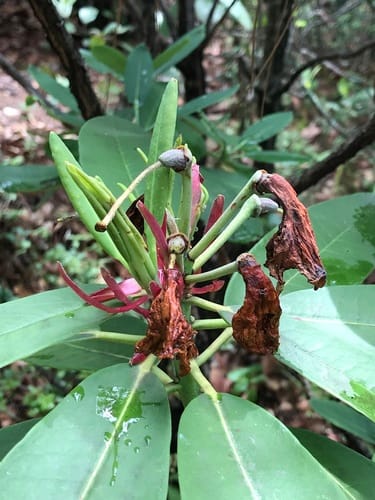
(c) 刘光裕 Liu Guangyu, some rights reserved (CC BY-NC)

(c) lordworm_cryptopsy, some rights reserved (CC BY-NC)
What to Eat
Edible parts: Flowers
The flowers are eaten fresh and are a favored edible vegetable in southwestern China, where they are treated as a common vegetable.
Where to Find It
It is a temperate plant. It Myanmar it grows between 1,000-3,300 m above sea level. It can grow in sun or light shade. It needs constant moisture. It is best in acidic soils. It can tolerate frost. It suits hardiness zones 6-9b. In Sichuan and Yunnan. In Rhodo gardens.
Asia, Australia, China, Indochina, Laos, Myanmar, SE Asia, Tasmania, Tibet,
How to Identify
An evergreen shrub or small tree. It grows 6 m tall and spreads 2.5 m wide. The leaves are leathery and oblong to oval. They are 5-19 cm long by 3-11 cm wide. The flowers are white or pale pink.
Wikipedia
Source ↗Rhododendron decorum, the great white rhododendron (Chinese: 大白杜鹃) is a species of flowering plant in the heath family Ericaceae. It is an evergreen shrub native to high forested regions of northern Myanmar and Guizhou, Sichuan, Xizang, and Yunnan, China growing at altitudes of 1,800–4,000 m (5,900–13,100 ft). Depending on the growing environment (either temperate or sub-alpine forest) it can be found as a shrub or small tree of 1–6 m (3.3–19.7 ft), with leathery leaves that are oblong, oblong-ovate or oblong-elliptic in shape and between 5–19 cm in length and 3–11 cm in width. Flowers are borne in trusses, white to pale pink, with a yellow throat, large and very fragrant. It was first described by French botanist Adrien René Franchet in 1886. In cultivation in the UK, Rhododendron decorum has gained the Royal Horticultural Society's Award of Garden Merit. It is hardy down to −20 °C (−4 °F) but requires a sheltered position and an acid soil that is rich in leaf mould.
Other Information
It is a common vegetable. The flowers are a favourite edible vegetable in SW China.
Names & Synonyms
References (2)
- Liu, Yi-tao, & Long, Chun-Lin, 2002, Studies on Edible Flowers Consumed by Ethnic Groups in Yunnan. Acta Botanica Yunnanica. 24(1):41-56
- Wang, X., 2009, HORTSCIENCE 44(7):2028–2030.