Alcea setosa
(Boiss.) Alef.
Marsh mallow, Bristly hollyhock
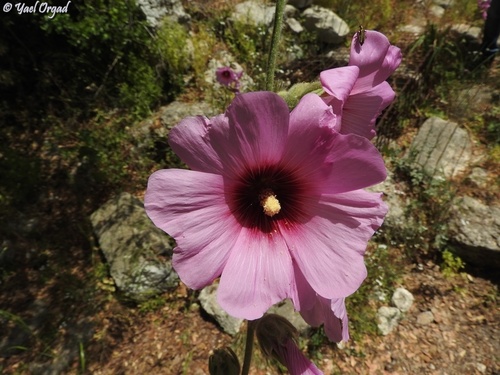
(c) Yael Orgad, some rights reserved (CC BY-NC), uploaded by Yael Orgad
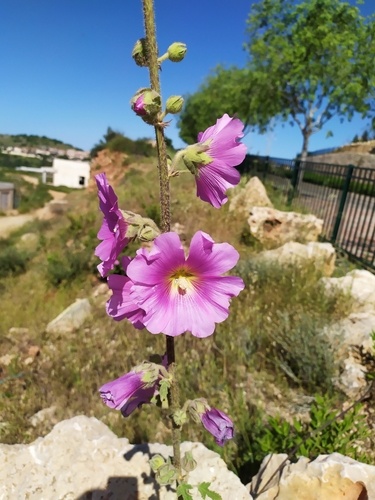
(c) alen-jbo, some rights reserved (CC BY-NC)

(c) elenakuraeva, some rights reserved (CC BY-NC)
What to Eat
Edible parts: Flowers - tea
The flowers are used to make tea.
Where to Find It
It is a Mediterranean climate plant.
Crete, Israel, Jordan, Middle East, Turkey, Türkiye,
How to Identify
A herb. It grows 2 m tall. The leaves are on long leaf stalks. The leaves are 20 cm across. The flowers are pink.
Wikipedia
Source ↗Alcea setosa, the bristly hollyhock, is an ornamental plant in the family Malvaceae. The bristly hollyhock is native to the Levant: ranging from Crete, Turkey, Lebanon and Syria to the botanical region of Palestine (including Israel and Jordan). The part above ground of the plant withers and dies in the summer. In the winter, a rosette of flowers develops and a vertical flowering stem grows out of it. The pink flowers are numerous and large, while in the Galilee and the Carmel the flowers are darker and in the Gilboa and Samaria the flowers are lighter. In the Mount Lebanon, flowers ranging from dark pink to white can be found. The whole plant is bristly, hence its common name. The plant flowers from April until June. In folk medicine, the liquid of the plant is used to treat injuries, burns, coughs and inflammation. The flower buds are edible, cooked and raw, and are considered as medicine for sicknesses in the airways. In Lebanese villages, Bristly hollyhock flowers are dried in the sun, then mixed with other herbs and wild flowers, prepared as concoctions, and served as tea drinks.
Names & Synonyms
U'waynat Al Bakara, Wadet Al-ghula
References (2)
- Al-Qura'n, S. A., 2010, Ethnobotanical and Ecological Studies of Wild Edible Plants in Jordan. Libyan Agriculture Research Center Journal International 1(4):231-243
- Demir, I. & Ayaz, N., 2022, Wild edible plants contributing to the traditional foods of Mardin (Turkey) Province. Indian Journal of Traditional Knowledge Vol 21(3), July 2022, pp 569-582