Rumex trisetifer
Stokes
PolygonaceaeLeaves
iNaturalist · cc-by-nc-sa
(c) 鳥松の熊, some rights reserved (CC BY-NC-SA), uploaded by 鳥松の熊
(c) 鳥松の熊, some rights reserved (CC BY-NC-SA), uploaded by 鳥松の熊
iNaturalist · cc-by-nc
(c) MP Zhou, some rights reserved (CC BY-NC)
(c) MP Zhou, some rights reserved (CC BY-NC)
What to Eat
Edible parts: Leaves, Vegetable
The leaves are cooked and eaten as a vegetable.
Where to Find It
It is a tropical plant. It grows from sea level to 1,300 m above sea level. It is often in moist places and beside water. In Yunnan.
Asia, Bhutan, China, Himalayas, India, Indochina, Laos, Myanmar, SE Asia, Taiwan, Thailand, Vietnam,
Countries: United Arab Emirates, Afghanistan, Armenia, Azerbaijan, Bangladesh, Bahrain, Brunei, Bhutan, China, Georgia, Indonesia, Israel, India, Iraq, Iran, Jordan, Japan, Kyrgyzstan, Cambodia, North Korea, South Korea, Kuwait, Kazakhstan, Laos, Lebanon, Sri Lanka, Myanmar, Mongolia, Maldives, Malaysia, Nepal, Oman, Philippines, Pakistan, Qatar, Saudi Arabia, Singapore, Syria, Thailand, Tajikistan, Timor-Leste, Turkmenistan, Turkey, Taiwan, Uzbekistan, Vietnam, Yemen
How to Identify
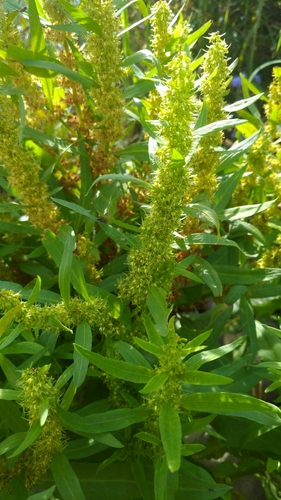
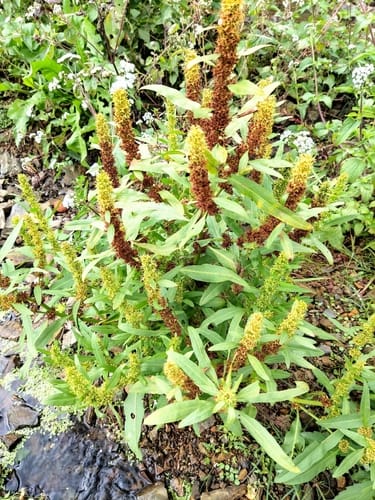
A herb. It re-grows each year. The roots are large. It grows 30-80 cm tall. It has smooth spreading branches. The lower leaves have stalks 3-5 cm long. The leaf blade is oblong to sword shaped and 8-20 cm long by 2-5 cm wide. The base is wedge shaped and the edges are wavy. The leaves on the stem have short stalks and the leaf blade is narrowly sword shaped.
Names & Synonyms
Payawei lang
Rumex chinensis Campd.
References (2)
- Flora of China @ efloras.org Volume 5
- Xu, You-Kai, et al, 2004, Wild Vegetable Resources and Market Survey in Xishuangbanna, Southwest China. Economic Botany. 58(4): 647-667.