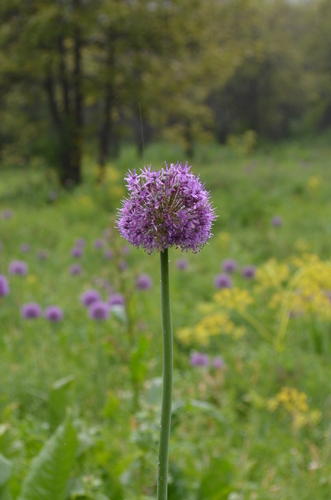
Allium hookeri var. muliense
Thwaites, Airy-Shaw

Royal Botanic Gardens, Kew

Royal Botanic Gardens, Kew

Royal Botanic Gardens, Kew
What to Eat
Edible parts: Leaves
Allium hookeri is widely cultivated outside its native range, and valued as a food item in much of South and Southeast Asia.
Where to Find It
It is a temperate plant. It grows on the edges of forests and in moist places between 2,800-4,200 m above sea level. It grows in Sichuan and Yunnan in China.
Asia, China, Himalayas, Tibet,
How to Identify
An onion.
Wikipedia
Source ↗Allium hookeri is a plant species native to India, Sri Lanka, Myanmar (Burma), Bhutan, and southwestern China (Sichuan, Tibet and Yunnan). Common names include Hooker chives and garlic chives. Allium hookeri produces thick, fleshy roots and a cluster of thin bulbs. Scapes are up top 60 cm tall. Leaves are flat and narrow, about the same length as the scapes but only 1 cm across. Umbels are crowded with many white or greenish-yellow flowers.
Notes
They have also been put in the family Alliaceae.
Names & Synonyms
Rijiucai
References (1)
- Ju, Y., et al, 2013, Eating from the wild: diversity of wild edible plants used by Tibetans in Shangri-la region, Yunnan, China, Journal of Ethnobiology and Ethno medicine 9:28