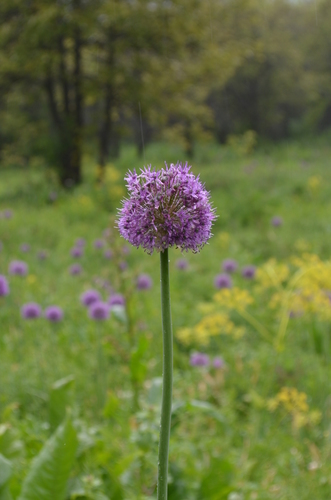
Allium ovalifolium
Hand.-Mazz.

(c) Ed Shaw, some rights reserved (CC BY-NC-SA)

(c) peganum, some rights reserved (CC BY-SA)
What to Eat
Edible parts: Leaves
The leaves are cooked in stir fry dishes and added to soups.
Where to Find It
It is a temperate plant. It grows on the edges of forests and along stream banks between 1,500-4,000 m above sea level. It grows in Sichuan and Yunnan in China.
Asia, China, Himalayas, Tibet,
How to Identify
An onion herb. There can be one or a cluster of bulbs. There are 2 leaves. They are sword shaped and 5-15 cm long by 3-7 cm wide. The base is deeply heart shaped. The stalk is 30-60 cm long.
Wikipedia
Source ↗Allium ovalifolium is a Chinese species of onion widely cultivated as an ornamental in other regions. It grows at elevations of 1500–4000 m. The Tibetan people of Shangri-La and nearby areas eat its scapes. Allium ovalifolium produces narrow cylindrical bulbs. Scapes are up to 60 cm tall, round in cross-section. Leaves are flat, lanceolate to ovate, up to 15 cm long by 7 cm wide. Umbel is spherical, densely crowded with many white or pale red flowers. Varieties Allium ovalifolium var. cordifolium (J.M.Xu) J.M.Xu - Sichuan Allium ovalifolium var. leuconeurum J.M.Xu - Sichuan Allium ovalifolium var. ovalifolium - Gansu, Guizhou, Hubei, Qinghai, Shaanxi, Sichuan, Yunnan
Notes
They have also been put in the family Alliaceae.
Names & Synonyms
Gejiu, Rijiucai, Yejiu
References (3)
- Ju, Y., et al, 2013, Eating from the wild: diversity of wild edible plants used by Tibetans in Shangri-la region, Yunnan, China, Journal of Ethnobiology and Ethno medicine 9:28
- Kang, Y., et al, 2012, Wild food plants and wild edible fungi in two valleys on the Qinling Mountains (Shaanxi, central China) Journal of Ethnobiology and Ethnomedicine; 9:26
- Wang, J., et al, 2020, An ethnobotanical survey of wild edible plants used by the Yi people of Liangshan Prefecture, Sichuan Province, China. Journal of Ethnobiology and Ethnomedicine 16:10