Aphananthe cuspidata
(Blume) Planch.
Netleaf hackberry
(c) José Ignacio Márquez Corro, some rights reserved (CC BY-NC), uploaded by José Ignacio Márquez Corro

(c) tkp123, some rights reserved (CC BY-NC)

(c) tkp123, some rights reserved (CC BY-NC)
What to Eat
Edible parts: Fruit
The ripe fruit are eaten.
Where to Find It
It is a tropical plant. It grows on slopes of hills between 100-900 m above sea level in southern China. In Yunnan.
Asia, Bhutan, China, Himalayas, India, Indochina, Indonesia, Malaysia, Myanmar, Northeastern India, SE Asia, Sikkim, Sri Lanka, Thailand, Vietnam,
How to Identify
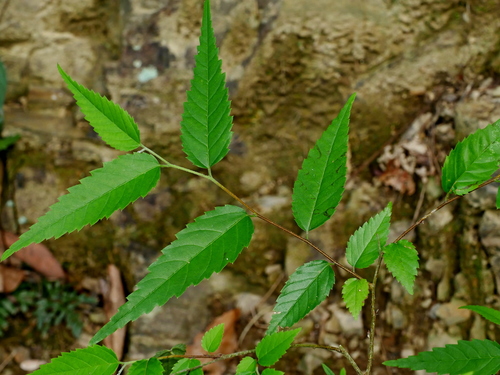
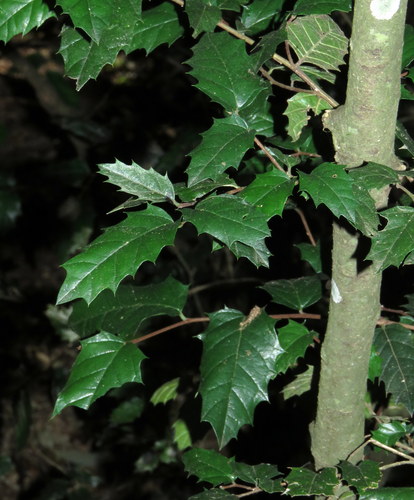
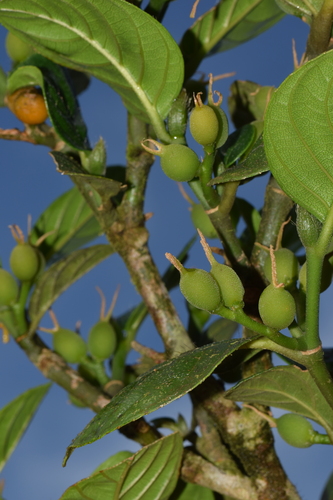
A tree. It grows 15-20 m tall. The trunk is 50-80 cm across. The bark is greyish brown. The leaves are narrowly oval and 10-15 cm long by 3-5 cm wide. The male flowers are in pairs and the female flowers occur singly. The fruit are reddish brown when ripe. They are oval and 2 cm long by 1 cm wide.
Medicinal Uses
The bark is depurative. It is taken internally with lemon juice as a purifier of blood, for relieving itches and other cutaneous eruptions. The plant yields a crystalline substance, lime methyl-indole or skatole.
Production
In southern China plants flower in March and April or September to November and fruit in July to September or November to December.
Names & Synonyms
Babbuchekke, Dineg-charkhei, Khomanig, Koditani, Nara-kiya, Naraka-bhutali, Narakiyood, Nyal, Shee-kung, Sukar, Thei-seh-ret
References (6)
- Altschul, S.V.R., 1973, Drugs and Foods from Little-known Plants. Notes in Harvard University Herbaria. Harvard Univ. Press. Massachusetts. no. 669 (As Gironniera cuspidata)
- Ambasta, S.P. (Ed.), 2000, The Useful Plants of India. CSIR India. p 236 (As Gironniera cuspidata)
- Chakraborty, S. & Chaturbedi, H. P., 2014, Some Wild Edible Fruits of Tripura- A Survey. Indian Journal of Applied research. (4) 9
- Dobriyal, M. J. R. & Dobriyal, R., 2014, Non Wood Forest Produce an Option for Ethnic Food and Nutritional Security in India. Int. J. of Usuf. Mngt. 15(1):17-37 (As Gironniera cuspidata)
- Flora of China @ efloras.org Volume 5
- Kar, A., et al, 2013, Wild Edible Plant Resources used by the Mizos of Mizoram, India. Kathmandu University Journal of Science, Engineering and Technology. Vol. 9, No. 1, July, 2013, 106-126