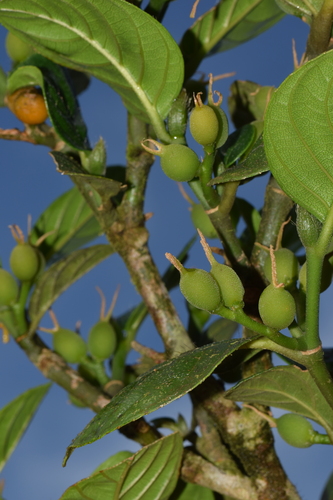
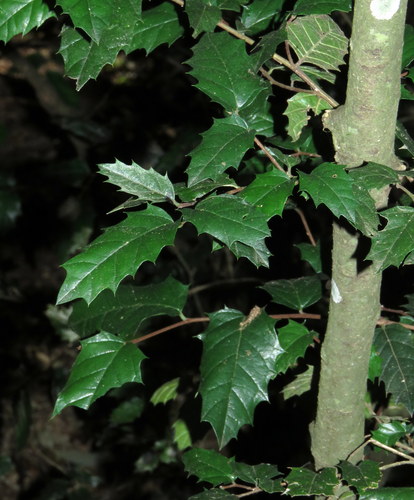
Aphananthe aspera
(Blume) Planchon
Muku tree, Rough leaf tree
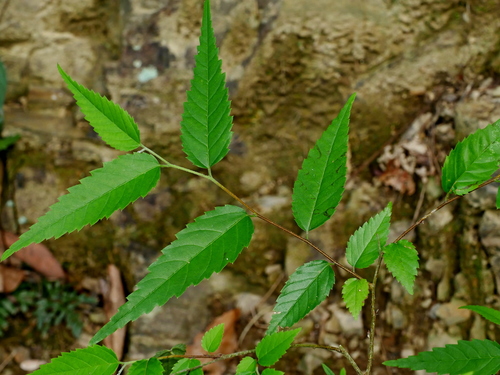
(c) Jacy Chen, some rights reserved (CC BY), uploaded by Jacy Chen

(c) harum.koh, some rights reserved (CC BY-SA), uploaded by harum.koh

(c) harum.koh, some rights reserved (CC BY-SA), uploaded by harum.koh
What to Eat
Edible parts: Fruit
Edible Parts: Fruit Edible Uses: Fruit. The fruit is about 6 - 8mm in diameter.
Where to Find It
It is a subtropical plant. In China it grows between 100-1,600 m above sea level. In Indonesia it grows on a variety of soils from the lowlands to 1,300 m above sea level. In Sichuan and Yunnan.
Asia, China, Indochina, Indonesia, Japan, Korea, SE Asia, Taiwan, Vietnam,
How to Identify
A tree. It loses its leaves during the year. It grows 20 m high. It is covered with rough hairs. The leaves are oval and 5-13 cm long by 3-6 cm wide. They have fine teeth. The male and female flowers are separate but on the same tree. Male flowers are on young branches and female flowers are in the axils of upper leaves. They occur singly. The fruit is small and oval. It is 8-10 mm across and blue to black.
How to Grow
Plants can be grown from seed.
Propagation: Seed - it probably requires 2 - 3 months stratification. It is best to sow the seed as soon as it is ripe in a cold frame, otherwise sow as soon as possible in the year. Remove any pulp from the seed before sowing it. When large enough to handle, prick the seedlings out into individual pots and grow them on in the greenhouse for at least their first winter before planting them out in late spring or early summer, after the last expected frosts.
Medicinal Uses
None known
Other Uses
Fibre Paper Sandpaper Wood The leaves, gathered in autumn, are used as a sandpaper on wood. The fibre from the bark is used for manufacturing ropes and staple rayon. The wood is fine and strong. Special Uses
Wikipedia
Source ↗Aphananthe aspera, commonly known as scabrous aphananthe or muku tree, is a flowering plant in the family Cannabaceae. It is found on slopes and stream banks between 100 and 1600 m. It is native to China, Taiwan, Japan, Korea, and Vietnam.
Notes
Also put in the family Ulmaceae. The Ulmaceae are usually tropical and subtropical. There are 5 Aphananthe species.
Names & Synonyms
Pohon gadog
References (8)
- Altschul, S.V.R., 1973, Drugs and Foods from Little-known Plants. Notes in Harvard University Herbaria. Harvard Univ. Press. Massachusetts. no. 668
- A. L. P. P. de Candolle, Prodr. 17:208. 1873
- Flora of China @ efloras.org Volume 5
- Hedrick, U.P., 1919, (Ed.), Sturtevant's edible plants of the world. p 521 (As Prunus aspera)
- Hu, Shiu-ying, 2005, Food Plants of China. The Chinese University Press. p 352
- Nova Acta Regiae Soc. Sci. Upsal. 4:38. 1783 - Ulmaceae (Celtidaceae) not Rosaceae (As Prunus aspera)
- Plants for a Future database, The Field, Penpol, Lostwithiel, Cornwall, PL22 0NG, UK. http://www.scs.leeds.ac.uk/pfaf/
- Sukarya, D. G., (Ed.) 2013, 3,500 Plant Species of the Botanic Gardens of Indonesia. LIPI p 130