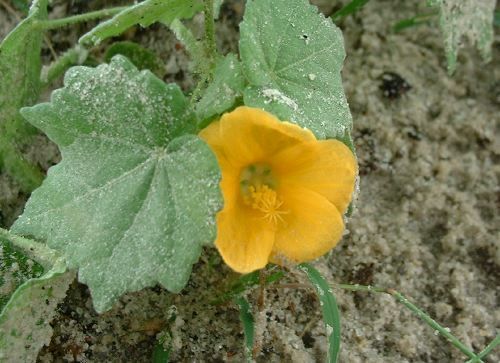
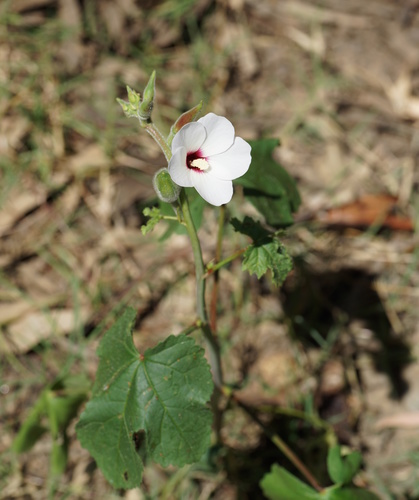
Hibiscus hispidissimus
Griff.

(c) shivaprakash, some rights reserved (CC BY-NC)
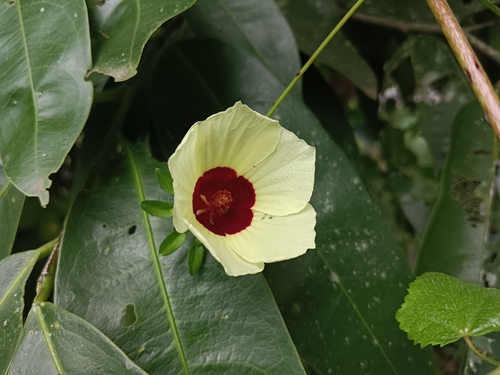
(c) renjus box, some rights reserved (CC BY)
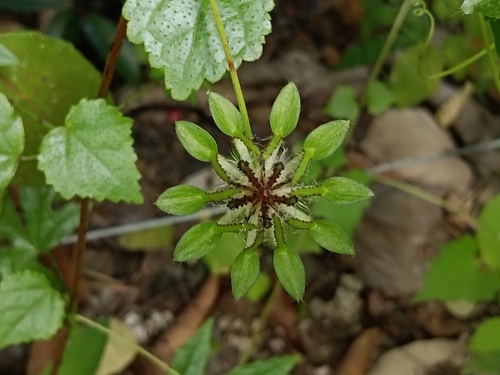
(c) renjus box, some rights reserved (CC BY)
What to Eat
Edible parts: Leaves, Fruit
Young leaves are eaten raw or added to soups, and the cooked or fried fruits are used as a vegetable.
Where to Find It
It is a tropical plant. In southern China it grows at about 1,500 m above sea level. In Yunnan.
Africa, Asia, Bangladesh, China, India, Indochina, Myanmar, Northeastern India, SE Asia, Sri Lanka, Thailand,
How to Identify
A herb or shrub. It grows 1.5 m tall. It can be trailing. It has hairs and prickles. The leaves are broadly oval or with 3-5 lobes spread out like fingers on a hand. The leaves are 3-10 cm long by 3-8 cm wide. The flowers occur singly in the axils of leaves. They are yellow with a purple centre. The fruit is an oval capsule 1.5 cm across.
How to Grow
Propagation: Seed - sow in situ or in containers. Germination is usually fairly rapid and no special pretreatment is needed, although germination will be faster if the seed is abraded or soaked prior to sowing. Prick out container-grown seedlings into individual pots when they are large enough to handle and plant them out into their permanent positions when they are 10cm or more tall. Cuttings of half-ripe wood in a frame. They generally strike readily, particularly if cuttings are taken on an angle through a node and rooting hormone is applied to their ends.
Medicinal Uses
The leaves are eaten as a tonic for pregnant women.
Wikipedia
Source ↗Hibiscus hispidissimus is a species of flowering plant in the family Malvaceae. It is found in South East Asia.
Production
In southern India plants flower and fruit September to March.
Names & Synonyms
Adavi, Mehnal, Mupparacham, Paruthiyila, Pulchapu
References (5)
- Ajesh, T. P., et al, 2012, Ethnobotanical Documentation of Wild Edible Fruits used by Muthuvan Tribes of Idukki, Kerala-India. International Journal of Pharma and Bio Sciences 3(3): 479-487
- Gangte, H. E., et al, 2013, Wild Edible Plants used by the Zou Tribe in Manipur, India. International Journal of Scientific and Research Publications, Volume 3, Issue 5 (As Hibiscus aculeatus Roxb.)
- Guite, C., 2016, A study of wild edible plants associated with the Paite tribe of Manipur, India, International Journal of Current Research. Vol. 8, Issue, 11, pp. 40927-40932 (As Hibiscus aculeatus Roxb.)
- Narayanan Ratheesh, M. K. et al, 2011, Wild edible plants used by the Kattunaikka, Paniya and Kuruma tribes of Wayanad District, Kerala, India. Journal of Medicinal Plants Research Vol. 5(15), pp. 3520-3529
- Ramachandran,V. S., & Udhayavani, C., 2013, Knowledge and uses of wild edible plants by Paniyas and Kurumbas of Western Nilgiris, Tamil Nadu. Indian Journal of Natural Products and Resources. 4(4) December 2013, pp 412-418