Luffa echinata
Roxb.
Bristly luffa, Bitter sponge gourd

(c) Dinesh Valke, some rights reserved (CC BY-SA)

(c) Dinesh Valke, some rights reserved (CC BY-SA)

(c) Dinesh Valke, some rights reserved (CC BY-SA)
What to Eat
Edible parts: Fruit, Caution
In Sri Lanka, it's called වැටකොළු (Waeṭakola, the Luffa acutangula variety) in Sinhalese and is a common ingredient in curries, even in dried forms. In Vietnamese cuisine, the gourd is called "mướp hương" and is a common ingredient in soups and stir-fried dishes. In China (where it is called Chinese: 丝瓜; pinyin: sīguā, or in English, "silk melon"), Indonesia (where it is called oyong), and the Philippines (where it is called patola in Tagalog and kabatiti in Ilokano), in Taiwan (where it is called Chinese: 菜瓜; pinyin: càiguā; Tâi-lô: tshài-kue, or in English, "vegetable melon"), in Timor-Leste it is also called "patola" or "batola" in Tetum and in Manipur, India, (where it is called sebot) the luffa is eaten as a green vegetable in various dishes. In Japan it is called hechima (へちま) and is cultivated all over the country during summer. It is commonly used as a green vegetable in traditional dishes of the Ryukyu Islands (where it is called naabeeraa). In other regions it is also grown for uses other than food. In Nepal it is called ghiraula and consumed as a vegetable at a young age. When it becomes ripe and dried, it is used as a body scrubbing material during bathing. Luffa is also known as "Chinese okra" in Canada and the U.S.
Where to Find It
It is a tropical plant.
Africa, Asia, Bangladesh, India, Pakistan,
How to Identify
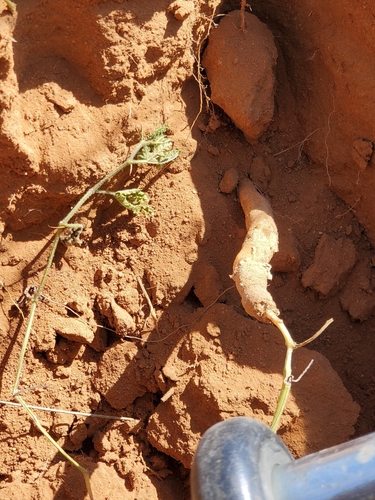
A pumpkin family creeper. It is a climber. It has bristles and tendrils. The leaves are kidney shaped and 5 lobed. The leaves have bristles on both surfaces and small teeth along the edge. The leaf stalk is 12 cm long. The flowers are white. The male flowers are in groups of 5-12 flowers 15 cm long. The fruit is oval and 2-5 cm long. It is densely covered with 2-5 cm long bristles. The seeds are black and oval.
Names & Synonyms
Bhat kalla, Bindal, Bindaal, Chyunke van toriya, Daivadaali, Deyatada, Jimuta, Kakora, Panibira, Pey-p-pirkku
References (1)
- Chowdery, T., et al, 2014, Wild edible plants of Uttar Dinajpur District, West Bengal. Life Science Leaflets. 47:pp 20-36 http://lifesciencesleaflets.ning.com