Coccoloba marginata
Benth.
Margined seagrape
PolygonaceaeFruit
iNaturalist · cc-by-nc
(c) Olivier Fortune - Isabelle Delafosse, some rights reserved (CC BY-NC), uploaded by Olivier Fortune - Isabelle Delafosse
(c) Olivier Fortune - Isabelle Delafosse, some rights reserved (CC BY-NC), uploaded by Olivier Fortune - Isabelle Delafosse

iNaturalist · cc-by-nc
(c) Nils Servientis - Bivouac Naturaliste, some rights reserved (CC BY-NC)
(c) Nils Servientis - Bivouac Naturaliste, some rights reserved (CC BY-NC)

iNaturalist · cc-by-nc
(c) Nils Servientis - Bivouac Naturaliste, some rights reserved (CC BY-NC)
(c) Nils Servientis - Bivouac Naturaliste, some rights reserved (CC BY-NC)
What to Eat
Edible parts: Fruit
The fruit are eaten fresh, though they are dry and astringent, and notably stain the mouth blue.
Where to Find It
It is a tropical plant.
Bolivia, Brazil, Colombia, Guianas, Guyana, Peru, South America, Trinidad and Tobago, Venezuela,
How to Identify
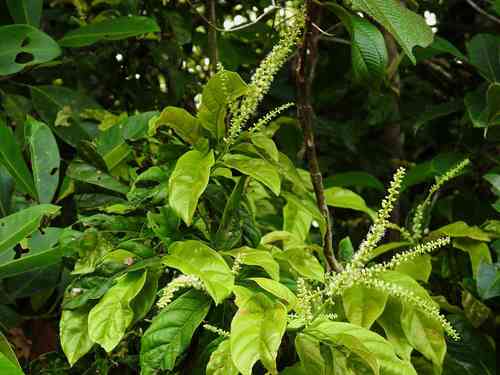
A scrambling shrub. The leaves are leathery. The fruit are reddish brown to black.
Names & Synonyms
Arehuequito, Baquerito, Bradilifi, Cipo-pau, Dukuadi-jodu, Etuburrucuaja, Guayapapon, Masari, Ocaiman, Pipoca, Una de gato, Vino huayo
Coccoloba guianensis Meisn.Coccoloba trinitatis LindauCoccoloba microneura Meisn.Uvifera guyanensis Kuntzeand others
References (4)
- Grandtner, M. M. & Chevrette, J., 2013, Dictionary of Trees, Volume 2: South America: Nomenclature, Taxonomy and Ecology. Academic Press p 148
- Kermath, B. M., et al, 2014, Food Plants in the Americas: A survey of the domesticated, cultivated and wild plants used for Human food in North, Central and South America and the Caribbean. On line draft. p 249
- Roa, J. A. G. & Boada, D. S. G., 2018, Fundación para el Fortalecimiento de la Fruticultura y Plantas Alimenticias no Convencionales en Colombia.
- van Andel, T., 2000, Useful plants of Guyana. Non-timber forest products of the North-West District of Guyana. Part 2. A Field Guide. Tropenbos-Guyana Programme. p 301