Desmoncus polyacanthos
Mart.
Kamwari

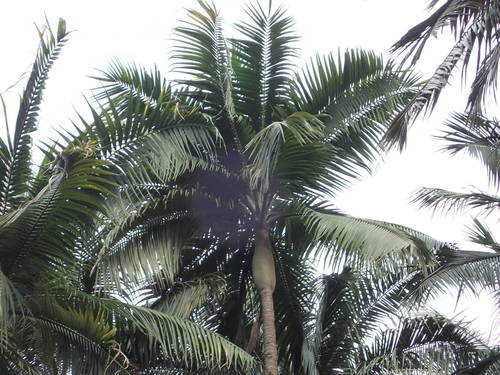
(c) Guillaume Léotard, some rights reserved (CC BY-NC), uploaded by Guillaume Léotard
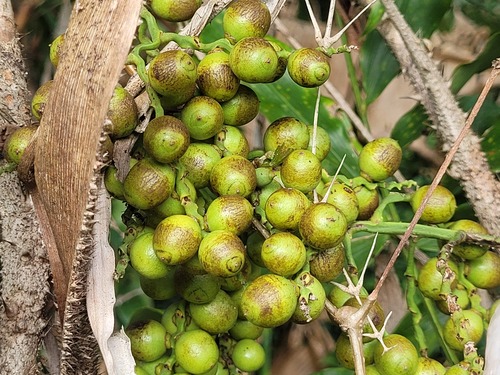
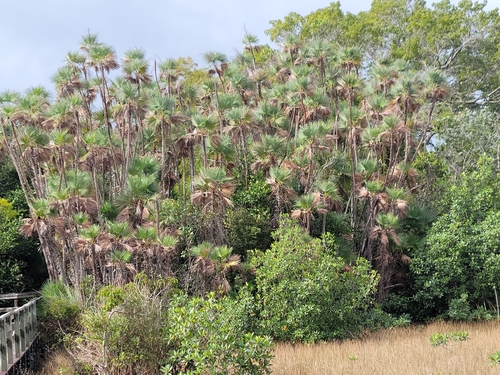
(c) Guillaume Léotard, some rights reserved (CC BY-NC), uploaded by Guillaume Léotard

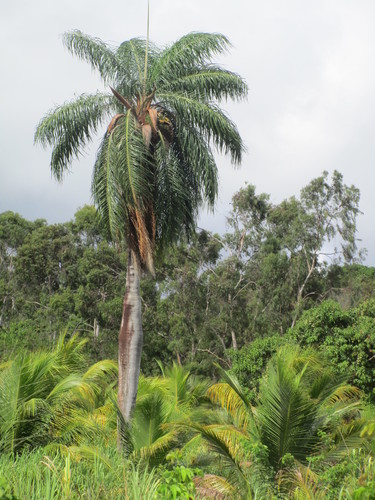
(c) Frederico Acaz Sonntag, some rights reserved (CC BY-NC), uploaded by Frederico Acaz Sonntag
What to Eat
Edible parts: Fruit, Seed
The fruit pulp is edible and occasionally eaten by children. The seeds are used to make a drink.
Where to Find It
It is a tropical plant.
Amazon, Brazil, Colombia, Ecuador, Guianas, Guyana, Peru, South America, Trinidad & Tobago, Venezuela,
How to Identify
A creeper or climbing palm. It can be 7-37 m long. The stems are 1-2 cm across. The stems are covered with leaf sheaths. There are 17-26 leaves. The fruit turn yellow then orange and red as they ripen. They are oval and 1.6 cm long by 1.3 cm wide. There is one seed. It is black and round.
How to Grow
Requires a sheltered, moist but well-drained position.
Medicinal Uses
The roots are anti-pruritic, anti-pyretic and depurative. A decoction is used externally to wash the skin in the treatment of itch, chicken pox, measles and fevers. It is also used in herbal baths. The ashes of the leaves are rubbed over the body as a treatment for fevers. The burned leaves are also used as a rub to treat abdominal pains.
Other Uses
The stems are used for weaving baskets and seives; and for tying various items.
Wikipedia
Source ↗Desmoncus polyacanthos, the jacitara palm, is a spiny, climbing palm native to the southern Caribbean and tropical South America. Stems grow clustered together, and are 2–12 m long and 0.5–2 cm in diameter. Petioles, rachis, cirrus and peduncular bracts are covered with short, curved spines. Two varieties are recognised: D. polyacanthos var. polyacanthos and D. polyacanthos var. prunifer (Poepp. ex Mart.) A.J.Hend. Desmoncus polyacanthos is found in Colombia, Venezuela, Saint Vincent and the Grenadines, Trinidad and Tobago, Guyana, Suriname, French Guiana, Brazil, Bolivia, Ecuador and Peru. The stems are used for baskets and sieves.
Other Information
The fruit are occasionally eaten by children.
Names & Synonyms
Asitaremu, Coco-titara, Enredadera, Espera-ai, Jacitara, Jassitara, Jequita, Jipiti, Urubamba, Weheyu, Yasitara
References (7)
- Bortolotto, I. M., et al, 2018, Lista preliminar das plantas alimenticias nativas de Mato Grosso do Sul, Brasil. Iheringia, Serie Botanica, Porto Alegre, 73 (supl.):101-116
- Kermath, B. M., et al, 2014, Food Plants in the Americas: A survey of the domesticated, cultivated and wild plants used for Human food in North, Central and South America and the Caribbean. On line draft. p 303
- Lopez-Diago, D. & Garcia, N., 2021, Wild edible fruits of Colombia. Biota ColomBiana 22 (2) p 31
- Maas, P.J. M., Non-Timber Forest Products of the North-West District of Guyana Part 2. The 85 most important NTFP species. p 76
- Marcia, M. J., et al, 2011, Palm Uses in Northwestern South America: A Quantitative Review. Bot. Rev. (2011) 77:462-570
- Roa, J. A. G. & Boada, D. S. G., 2018, Fundación para el Fortalecimiento de la Fruticultura y Plantas Alimenticias no Convencionales en Colombia.
- World Checklist of Useful Plant Species 2020. Royal Botanic Gardens, Kew