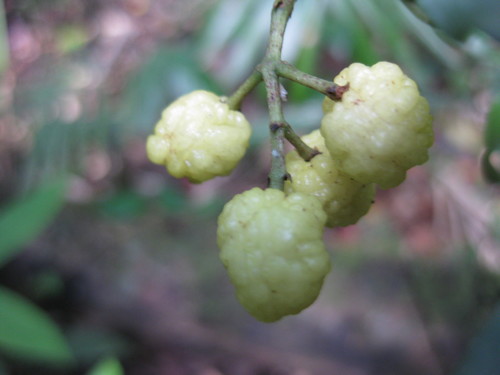
Citrus limon
(L.) Burm. f
Lemon

no rights reserved

no rights reserved

no rights reserved
What to Eat
Edible parts: Fruit, Herb, Spice, Flowers
The fruit is eaten raw or cooked and has a very acid flavour. It is mainly used as a drink and as a flavouring, and works well in salad dressings, where it acts as an antioxidant as well as providing acidity. The juice helps set jam. Fruits can grow up to 15cm long and 7cm wide. The dried rind is commonly used to flavour cakes and baked goods. Dried leaves are sometimes blended with tea leaves as a flavouring. An essential oil from the rind is used as a food flavouring. The flowers can be eaten in ice creams, fritters, and jams. Nutritional values per 100g fresh weight (28 calories): Water 90%, Protein 0.8g, Fat 0.5g, Carbohydrate 8.2g, Fibre 0.6g, Ash 5.4g; Calcium 33mg, Phosphorus 15mg, Iron 0.5mg, Sodium 3mg, Potassium 137mg; Vitamin A 12mg, Thiamine (B1) 0.5mg, Riboflavin (B2) 0.02mg, Niacin 0.1mg, Vitamin C 52mg. (Figures are the median of a reported range.)
Where to Find It
A subtropical plant. Trees do not do well on the coast in the tropics but they grow well at about 1300 m and will grow up to 2200 m altitude in Papua New Guinea. They prefer a light to medium, well drained soil. They are drought resistant but most varieties are frost tender. They need a temperature above 3-5°C for growth. They suit warm temperate regions. In Brisbane Botanical Gardens. It suits hardiness zones 9-11.
Africa, Andes, Andorra, Asia, Australia, Bangladesh, Benin, Bhutan, Brazil, Burkina Faso, Cambodia, Cameroon, Caucasus, Central Africa, Central African Republic, CAR, Central America, Central Asia, China, Colombia, Congo DR, Cook Islands, Costa Rica, Côte d'Ivoire, Cuba, Cyprus, East Africa, Ethiopia, Europe, Fiji, Georgia, Ghana, Georgia, Greece, Guam, Guinea-Bissau, Guyana, Haiti, Hawaii, Himalayas, India*, Indochina, Indonesia, Italy, Ivory Coast, Kenya, Kiribati, Korea, Laos, Lebanon, Madagascar, Malawi, Malaysia, Maldives, Malta, Mediterranean, Mexico, Micronesia, Middle East, Morocco, Mozambique, Myanmar, Nauru, Nepal, New Caledonia, Niger, Nigeria, North Africa, Northeastern India, Pacific, Pakistan*, Palau, Papua New Guinea, PNG, Peru, Philippines, Rotuma, Sahel, Sao Tome and Principe, Saudi Arabia, SE Asia, Senegal, Sierra Leone, Slovenia, Solomon Islands, South Africa, Southern Africa, South America, Spain, Sri Lanka, Suriname, Taiwan, Tajikistan, Tanzania, Thailand, Tokelau, Tonga, Turkey, Türkiye, Tuvalu, Uganda, United Arab Emirates, UAE, USA, Vanuatu, Vietnam, West Africa, West Indies, Zambia, Zimbabwe,
How to Identify
A small evergreen tree with short spines. It grows to 7 m high and spreads to 3 m across. It branches freely. Young branches are often reddish. Leaves are about 5-12 cm long. They are green and drawn out to a point, with notched edges. The leaf stalk is usually not winged. The leaves do not have much of a scent. The flowers are white, with 5 petals and have a strong sweet smell. They are 4-5 cm across. The fruit is oval shaped and with a knob at the end. Fruit can be 7-15 cm long. The skin is fairly thin, rough and light yellow. The flesh is sour and the seeds are oval.
Nutrition Score: 19/100
| Part | Moisture | kJ | kcal | Protein | Vit A | Vit C | Iron | Zinc |
|---|---|---|---|---|---|---|---|---|
| Fruit whole fruit | 83.3 | 65 | 15 | 1.1 | — | 80 | 0.4 | 0.1 |
| Fruit fresh Juice | 91.3 | 31 | 7 | 0.3 | — | 50 | 0.1 | — |
How to Grow
Many trees are seedlings. Better trees are grafted.
Propagation: Sow fresh seed in a greenhouse after thoroughly rinsing. Sow stored seed in March in a greenhouse. Germination usually takes place within 2–3 weeks at 13°C. Seedlings are prone to damping off and must be watered carefully and kept well ventilated. Seed is usually polyembryonic — two or more seedlings arise from each seed, genetically identical to the parent and typically free of any virus present in the parent. Prick out into individual pots when large enough to handle and grow on in the greenhouse for at least three growing seasons before attempting to establish outdoors. Plant out in summer with cold protection for the first few winters. Half-ripe cuttings can be taken in July–August in a frame. Layering in October.
Medicinal Uses
Lemons are an excellent preventative medicine with a wide range of domestic uses. The fruit is rich in vitamin C, which helps fight infection and prevent or treat scurvy — at one time it was a legal requirement that sailors receive an ounce of lemon daily for this purpose. Applied locally, the juice is an effective astringent and gargle for sore throats, and a strong bactericide. It is a good antiperiodic and has been used as a substitute for quinine in treating malaria and other fevers. Though very acid, lemon has an alkalizing effect on the body once consumed, making it useful in treating rheumatic conditions. The skin of ripe fruit is carminative and stomachic. The essential oil from the skin is strongly rubefacient and in small internal doses has stimulating and carminative properties. The stem bark is bitter, stomachic, and tonic. The fruit rind essential oil is used in aromatherapy with the keyword 'Refreshing'. Citrus species are rich in vitamin C, bioflavonoids, acids, and volatile oils. They contain coumarins such as bergapten, which sensitizes the skin to sunlight; bergapten is sometimes added to tanning preparations to promote pigmentation, though it can cause dermatitis or allergic reactions in some people. The bioflavonoids in the fruit strengthen the inner lining of blood vessels, particularly veins and capillaries, and help counter varicose veins and easy bruising.
Other Uses
A semi-drying oil from the seed is used in soap making. An essential oil from the peel — present at around 0.4% — is used as a food flavouring and in perfumery and medicines; a higher-quality essential oil is obtained from the flowers. An essential oil from the leaves and young twigs, called petitgrain oil, is also produced at yields of around 0.4%. The dried fruit rind can be used as an insect repellent in clothes cupboards and in pot-pourri. Lemon juice polishes neglected bronze and other metals, removes ink stains, and acts as a bleaching agent. The wood is attractively veined and takes a beautiful polish.
Wikipedia
Source ↗Evergreen shrub growing 3 m tall by 1 m wide at a medium rate. Hardy to UK zone 9, frost tender. In leaf and flower all year. Hermaphroditic with apomictic and insect pollination; self-fertile. Notable for attracting wildlife. Grows in medium loamy and heavy clay soils with good drainage. Tolerates mildly acidic, neutral, mildly alkaline, and very alkaline soils. Requires full sun and accepts either dry or moist soil conditions.
Other Information
Less common than West Indian limes on the coast in Papua New Guinea but more common in highland areas. It is a cultivated food plant.
Notes
There are 20 Citrus species. Several hybrids have been formed.
Names & Synonyms
Baranebu, Baranibu, Bijapura, Bijapuram, Bijori, Citroen, Demmuda dadaara, Dhoalhanbu, Ennimu, Goranebu, Gulgul, Idalimbu, Jambira, Jambhoshi, Jatti khatti, Jhambheri, Kagati, Kagizi, Khatta nabbu, Kro'ch chma' barang, Lala di ngani, Lebu, Lemun tsami, Limon, Moli karokaro, Moli witiwiti, Mosriri, Motulimbu, Mundino, Nemu, Nibuva, Nimbu, Ningmeng, Osan orombo, Osan wewe, Paharikaghzi, Paharinimbu, Periya yelumichai, Te remon, Than-bayo, Thoralimbu, Tipolo
References (104)
- AAK, 1994, Jeruk, Penerbit Kanisius, Jogyakarta. p 198
- Abbiw, D.K., 1990, Useful Plants of Ghana. West African uses of wild and cultivated plants. Intermediate Technology Publications and the Royal Botanic Gardens, Kew. p 42
- Ambasta, S.P. (Ed.), 2000, The Useful Plants of India. CSIR India. p 128
- Ashton, M. S., et al 1997, A Field Guide to the Common Trees and Shrubs of Sri Lanka. WHT Publications Ltd. pdf p 345
- Baishya, S. Kr., et al, 2013, Survey of Wild Edible Fruits of Dhubri District, Assam, India. Plant Archives Vol 13 (1): 155-158
- Barwick, M., 2004, Tropical and Subtropical Trees. A Worldwide Encyclopedic Guide. Thames and Hudson p 117
- Bernal, R., et al, (Eds), 2016, Catalogo de Plantas y Liquenes de Colombia, Volumen 2, Magnoliaceae a Zygophyllaceae. Universidad Nacional de Colombia. p 2558
- Bernholt, H. et al, 2009, Plant species richness and diversity in urban and peri-urban gardens of Niamey, Niger. Agroforestry Systems 77:159-179
- Bianchini, F., Corbetta, F., and Pistoia, M., 1975, Fruits of the Earth. Cassell. p 184
- Blamey, M and Grey-Wilson, C., 2005, Wild flowers of the Mediterranean. A & C Black London. p 123
- Bodkin, F., 1991, Encyclopedia Botanica. Cornstalk publishing, p 261
- Bourret, D., 1981, Bonnes-Plantes de Nouvelle-Caledonie et des Loyaute. ORSTOM. p 29
- Brickell, C. (Ed.), 1999, The Royal Horticultural Society A-Z Encyclopedia of Garden Plants. Convent Garden Books. p 272
- Brouk, B., 1975, Plants Consumed by Man. Academic Press, London. p 307
- Brown, D., 2002, The Royal Horticultural Society encyclopedia of Herbs and their uses. DK Books. p 172
- Burkill, H. M., 1985, The useful plants of west tropical Africa, Vol. 4. Kew.
- Burkill, I.H., 1966, A Dictionary of the Economic Products of the Malay Peninsula. Ministry of Agriculture and Cooperatives, Kuala Lumpur, Malaysia. Vol 1 (A-H) p 575
- Bussman, R. W., et al, 2016, A comparative ethnobotany of Khevsureti, Samtskhe-Javakheti, Tusheti, Svaneti, and Racha-Lechkhumi, Republic of Georgia (Sakartvelo), Caucasus. Journal of Ethnobiology and Ethnomedicine.
- Bussman, R. W. et al, 2017, Ethnobotany of Samtskhe-Javakheti, Sakartvelo (Republic of Georgia), Caucasus. Indian Journal of Traditional Knowledge Vol. 16(1) pp 7-24
- Bussman, R. W., et al, 2021, Unity in diversity—food plants and fungi of Sakartvelo (Republic of Georgia), Caucasus. Journal of Ethnobiology and Ethnomedicine (2021) 17:72 p 14
- Call, C. A., et al, 2004, Participatory Rural Appraisal in the Upland Ecosystem of Mt Malindang, Misamis Occidental, Philippines. Biodiversity Research Programme for Development in Mindanao. p 60
- Cameron, J.W. & Soost, R.K., 1979, Citrus, in Simmonds, N.W., (ed), Crop Plant Evolution. Longmans. London. p 261
- Chandrashekara, U. M., 2009, Tree species yielding edible fruit in the coffee-based homegardens of Kerala, India: their diversity, uses and management. Food Sec. 1:361-370
- Catarino, L., et al, 2016, Ecological data in support of an analysis of Guinea-Bissau's medicinal flora. Data in Brief 7 (2016):1078-1097
- Cheifetz, A., (ed), 1999, 500 popular vegetables, herbs, fruits and nuts for Australian Gardeners. Random House p 180
- Chin, H.F., & Yong, H.S., 1996, Malaysian Fruits in Colour. Tropical press, Kuala Lumpur p 51
- Clarke, W.C. & Thaman, R.R., 1993, Agroforestry in the Pacific Islands: Systems for sustainability. United Nations University Press. New York. p 230
- Cobley, L.S. (rev. Steele, W.M.) 2nd Ed., 1976, An Introduction to the Botany of Tropical Crops. Longmans. p 166
- Coronel, R.E., 1982, Fruit Collections in the Philippines. IBPGR Newsletter p 6
- Cribb, A.B. & J.W., 1976, Wild Food in Australia, Fontana. p 25
- Cruz, I. M., et al, 2015, Edible fruits and seeds in the State of Mexico. Revista Mexicana de Ciencias Agricolas. Vol. 6. Num. 2 pp 331-346
- Cundall, P., (ed.), 2004, Gardening Australia: flora: the gardener's bible. ABC Books. p 384
- D'Ambrosio, U., & Puri, R. K., 2016, Foodways in transition: food plants, diet and local perceptions of change in a Costa Rican Ngäbe community. Journal of Ethnobiology and Ethnomedicine (2016) 12:3 p 27
- Das, T. & Das, A. K., 2005, Inventorying plant biodiversity in homegardens: A case study in Barak Valley, Assam, North East India. CURRENT SCIENCE, VOL. 89, NO. 1, 10 JULY 2005
- Elevitch, C.R.(ed.), 2006, Traditional Trees of the Pacific Islands: Their Culture, Environment and Use. Permanent Agriculture Resources, Holualoa, Hawaii. p 245
- Etherington, K., & Imwold, D., (Eds), 2001, Botanica's Trees & Shrubs. The illustrated A-Z of over 8500 trees and shrubs. Random House, Australia. p 215
- Facciola, S., 1998, Cornucopia 2: a Source Book of Edible Plants. Kampong Publications, p 217
- Fl. indica 173. 1768
- Flora of Pakistan. www.eFloras.org
- Fowler, D. G., 2007, Zambian Plants: Their Vernacular Names and Uses. Kew. p 59
- Fox, F. W. & Young, M. E. N., 1982, Food from the Veld. Delta Books. p 329 (As Citrus medica var. limonum)
- Franklin, J., Keppel, G., & Whistler, W., 2008, The vegetation and flora of Lakeba, Nayau and Aiwa Islands, Central Lau Group, Fiji. Micronesica 40(1/2): 169–225, 2008
- French, B.R., 1986, Food Plants of Papua New Guinea, A Compendium. Asia Pacific Science Foundation p 227
- French, B.R., 2010, Food Plants of Solomon Islands. A Compendium. Food Plants International Inc. p 228
- Goode, P., 1989, Edible Plants of Uganda. FAO p 27
- Gurdal, B. & Kultur, S., 2014, The edible and miscellaneous useful plants in Marmaris (Southwest Turkey). İstanbul Ecz. Fak. Derg. / J. Fac. Pharm. Istanbul 44(1) 2014 pp.69-78
- Hearne, D.A., & Rance, S.J., 1975, Trees for Darwin and Northern Australia. AGPS, Canberra p 46
- Hiddins, L., 1999, Explore Wild Australia with the Bush Tucker Man. Penguin Books/ABC Books. p 132
- Hu, Shiu-ying, 2005, Food Plants of China. The Chinese University Press. p 492
- Jardin, C., 1970, List of Foods Used In Africa, FAO Nutrition Information Document Series No 2.p 128
- John, L., & Stevenson, V., 1979, The Complete Book of Fruit. Angus & Robertson p 171
- Kahlon, L. K. & Singh, R., 2019, Traditional knowledge & Dynamics of edible plants of primitive tribal group ‘Paudi Bhuyan’ with changing demography migration patterns in Northern Odisha. Indian Journal of Traditional Knowledge Vol 18(1), pp 7-15
- Khanal, R., et al, 2014, Documenting abundance and use of underutilized plant species in the mid hill region of Nepal. ECOPRINT 21: 63-71, 2014
- Kiple, K.F. & Ornelas, K.C., (eds), 2000, The Cambridge World History of Food. CUP p 433, 1800
- Kohila, A. & Kensa, V. M., 2019, Survey of Wild Edible Plants of Dhanakarkulam Panchayath, Tirunelveli District, Tamil Nadu, India. Kong. Res. J. 6(2): 20-27, 2019
- Kybal, J., 1980, Herbs and Spices, A Hamlyn Colour Guide, Hamlyn Sydney p 76
- Katende, A.B., Birnie, A & Tengnas B., 1995, Useful Trees and Shrubs for Uganda. Identification, Propagation and Management for Agricultural and Pastoral Communities. Technical handbook No 10. Regional Soil Conservation Unit, Nairobi, Kenya. p 186
- Lazarides, M. & Hince, B., 1993, Handbook of Economic Plants of Australia, CSIRO. p 61
- Lorenzi, H., Bacher, L., Lacerda, M. & Sartori, S., 2006, Brazilian Fruits & Cultivated Exotics. Sao Paulo, Instituto Plantarum de Estuados da Flora Ltda. p 538
- Lyle, S., 2006, Discovering fruit and nuts. Land Links. p 132
- Macmillan, H.F. (Revised Barlow, H.S., et al) 1991, Tropical Planting and Gardening. Sixth edition. Malayan Nature Society. Kuala Lumpur. p 277
- Manandhar, N.P., 2002, Plants and People of Nepal. Timber Press. Portland, Oregon. p 156
- Mashile, S. P., et al, 2019, Indigenous fruit plants species of the Mapulana of Ehlanzeni district in Mpumalanga province, South Africa. South African Journal of Botany 122 (2019) 180–183
- Mbuya, L.P., Msanga, H.P., Ruffo, C.K., Birnie, A & Tengnas, B., 1994, Useful Trees and Shrubs for Tanzania. Regional Soil Conservation Unit. Technical Handbook No 6. p 178
- Medhi, P. & Borthakur, S. K., 2012, Phytoresources from North Cachur Hills of Assam -3: Edible plants sold at Hflong market. Indian Journal of Natural Products and Resources. 3(1) pp 84-109
- Miguel, E., et al, 1989, A checklist of the cultivated plants of Cuba. Kulturpflanze 37. 1989, 211-357
- Miya, M. S. & Gautum, D., 2021, Checklist of floral species at the Institute of Forestry, Pokhara Campus, Pokhara, Nepal. Journal of Institute of Forestry, Nepal 18 (2021) 133-177
- Molla, A., Ethiopian Plant Names. http://www.ethiopic.com/aplants.htm
- Morton, J. F., 1987, Fruits of Warm Climates. Wipf & Stock Publishers p 160
- Mulherin, J., 1994, Spices and natural flavourings. Tiger Books, London. p 103
- Murtem, G. & Chaudhrey, P., 2016, An ethnobotanical note on wild edible plants of Upper Eastern Himalaya, India. Brazilian Journal of Biological Sciences, 2016, v. 3, no. 5, p. 63-81.
- Omawale, 1973, Guyana's edible plants. Guyana University, Georgetown p 26
- Partha, P., 2014, Ethnobotany of the Laleng (Patra) Community in Bangladesh. Journal of Pharmacognosy and Phytochemistry. 2(6):173-184
- Pascual-Mendoza, S. et al, 2021, Traditional knowledge of edible plants in an indigenous community in the Sierra Norte of Oaxaca, Mexico. Plant Biosystems - An International Journal Dealing with all Aspects of Plant Biology
- Phon, P., 2000, Plants used in Cambodia. © Pauline Dy Phon, Phnom Penh, Cambodia. p 159
- Plants for a Future database, The Field, Penpol, Lostwithiel, Cornwall, PL22 0NG, UK. http://www.scs.leeds.ac.uk/pfaf/
- Plants of Haiti Smithsonian Institute http://botany.si.edu/antilles/West Indies
- PROSEA handbook Volume 13 Spices. p 275
- PROSEA (Plant Resources of South East Asia) handbook, Volume 2, 1991, Edible fruits and nuts.
- Purseglove, J.W., 1968, Tropical Crops Dicotyledons, Longmans. p 502
- Roa, J. A. G. & Boada, D. S. G., 2018, Fundación para el Fortalecimiento de la Fruticultura y Plantas Alimenticias no Convencionales en Colombia.
- Rosero-Toro, et al, 2018, Cultural significance of the flora of a tropical dry forest in the Doche vereda (Villavieja, Huila, Colombia). Journal of Ethnobiology and Ethnomedicine (2018) 14:22 p 12
- Ruiters-Welcome, A. K., 2019, Food plants of southern Africa. Ph.D. thesis. Univ. of Johannesburg p 98
- Sambou, A., et al, 2016, The contribution of trees and palms to a blanced diet in three rural villages of the Fatick Province, Senegal. FORESTS, TREES AND LIVELIHOODS, 2016 VOL. 25, NO. 3, 212–225
- Segnon, A. C. & Achigan-Dako, E. G., 2014, Comparative analysis of diversity and utilization of edible plants in arid and semi-arid areas in Benin. Journal of Ethnobiology and Ethnomedicine 2014, 10:80
- Segura, S., et al, 2018, The edible fruit species in Mexico. Genet Resour Crop Evol (2018) 65:1767–1793
- Seidemann J., 2005, World Spice Plants. Economic Usage, Botany, Taxonomy. Springer. p 107
- Selvam, V., 2007, Trees and shrubs of the Maldives. RAP Publication No. 2007/12 p 66
- Small, E., 2009, Top 100 Food Plants. The world's most important culinary crops. NRC Research Press. p 309
- Staples, G.W. and Herbst, D.R., 2005, A tropical Garden Flora. Bishop Museum Press, Honolulu, Hawaii. p 503
- Sujanapal, P., & Sankaran, K. V., 2016, Common Plants of Maldives. FAO & Kerala FRI, p 80
- Thaman, R.R., 1976, The Tongan Agricultural System, University of the South Pacific, Suva, Fiji. p 389
- Thaman, R. R, 2016, The flora of Tuvalu. Atoll Research Bulletin No. 611. Smithsonian Institute p 112
- Tredgold, M.H., 1986, Food Plants of Zimbabwe. Mambo Press. p 94
- Tugume, P. & Nyakoojo, C., 2020, Traditional use of wild edible plants in the communities adjacent to Mabira Central Forest Reserve, Uganda. Ethnobotany Research & Applications 20:15 (2020)
- USDA, ARS, National Genetic Resources Program. Germplasm Resources Information Network - (GRIN). [Online Database] National Germplasm Resources Laboratory, Beltsville, Maryland. Available: www.ars-grin.gov/cgi-bin/npgs/html/econ.pl (10 April 2000)
- van Wyk, B., 2005, Food Plants of the World. An illustrated guide. Timber press. p 140
- Vickery, M.L. and Vickery, B., 1979, Plant Products of Tropical Africa, Macmillan. p 43
- Walter, A. & Lebot, V., 2007, Gardens of Oceania. ACIAR Monograph No. 122. p 132
- Welcome, A. K. & Van Wyk, B.-E., 2019, An inventory and analysis of the food plants of southern Africa. South African Journal of Botany 122 (2019) 136–179
- Wiersema, J. H. & Leon, B., 2013, World Economic Plants. A Standard Reference CRC Press. 2nd Ed. p 180, p 181 (As Citrus meyeri)
- Williamson, J., 2005, Useful Plants of Malawi. 3rd. Edition. Mdadzi Book Trust. p 67
- Young, J., (Ed.), 2001, Botanica's Pocket Trees and Shrubs. Random House. p 251
- Zeven, A. C. & de West, J. M. J., 1982, Dictionary of cultivated plants and their regions of diversity. Wageningen. p 62, 118