Citrus maxima
(Burman) Merr.
Pummelo, Pomelo

no rights reserved, uploaded by 葉子

kyrfylpy19

no rights reserved, uploaded by 葉子
no rights reserved, uploaded by 葉子
What to Eat
Edible parts: Fruit, Leaves - flavouring
The flesh and juice are edible, and the peel may be candied. It is eaten as a dessert, or used in salads. In the Philippines, a pink beverage is made from pomelo and pineapple juice. In East Asia, especially in Cantonese cuisine, braised pomelo pith is used to make dishes that are high in fibre and low in fat.
Where to Find It
A tropical plant. They thrive in warm lowland areas in the tropics. They can grow from sea level up to 1,300 m. They are tolerant of brackish and salty conditions. They suit humid climates. It suits areas with a rainfall between 1,900-2,400 mm. It is best with a temperature between 23°-30°C. It suits a pH between 5.5-6.5. In the Cairns Botanical Gardens. It suits tropical and subtropical locations. In XTBG Yunnan. It suits hardiness zones 10-12.
Africa, Andamans, Andes, Asia, Australia, Bangladesh, Barbados, Bougainville, Brazil, Cambodia, Cameroon, Cape Verde, Central Africa, Central America, China, Colombia, Cook Islands, Costa Rica, Côte d'Ivoire, Cuba, Dominican Republic, East Africa, East Timor, Ecuador, Europe, Fiji, French Polynesia, Guam, Haiti, Hawaii, Himalayas, India, Indochina, Indonesia, Iran, Ivory Coast, Japan, Laos, Madagascar, Malaysia, Maldives, Malesia*, Marquesas, Mediterranean, Mexico, Middle East, Myanmar, Nepal, Nigeria, North Africa, North America, Northeastern India, Pacific, Pakistan, Papua New Guinea, PNG, Philippines, Rotuma, Samoa, Sao Tome and Principe, SE Asia*, Sikkim, Solomon Islands, South America, Spain, Sri Lanka, Suriname, Tahiti, Thailand, Timor-Leste, Tonga, Turkey, Türkiye, USA, Vanuatu, Vietnam, West Africa, West Indies, Zimbabwe,
How to Identify
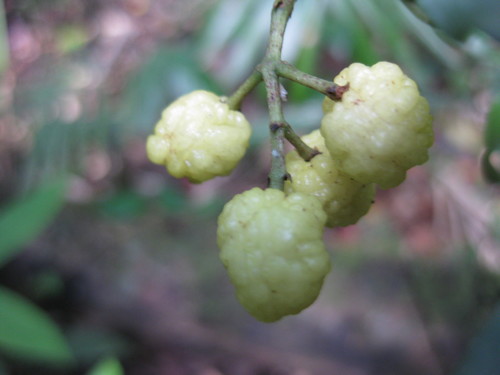
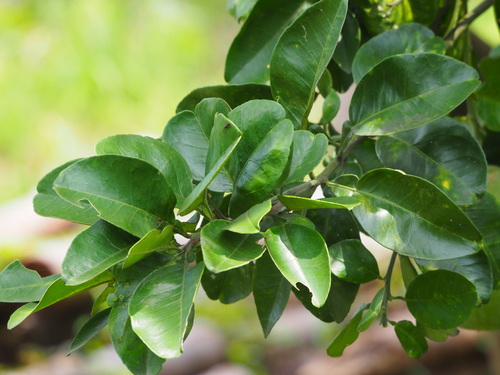
A spreading, spiny tree. It grows up to 15 m high. It is dome shaped. The leaves are very large. They are glossy and oval and downy underneath. The leaf stalks have broad wings. Young shoots and stems have fine hairs on them. Flowers are large (2 cm) and creamy white. The flowers are produced in bunches from woody shoots. The flowers have a sweet scent. The fruit are oval or pear shaped. The fruit is very large (20 cm) with a thick skin. The skin is dotted with oil glands. The fruit are green but become yellow when ripe. They contain 11-14 segments. The flesh can be pale yellow or pink. Each segment of the fruit is covered by a strong membrane. Some kinds have many seeds, while others are almost seedless. There are several named cultivated varieties.
Nutrition Score: 28/100
| Part | Moisture | kJ | kcal | Protein | Vit A | Vit C | Iron | Zinc |
|---|---|---|---|---|---|---|---|---|
| Fruit raw | 90.3 | 175 | 42 | 0.6 | 20 | 37 | 0.4 | — |
How to Grow
They are mostly grown from seed, but do not breed true. The seed only produce one seedling unlike many citrus. Trees are often produced by aerial layering, but budding or grafting can be used. Air-layered trees give sweeter fruit. Trees start producing after about 9 years. Trees need to be about 9 m apart. Trees grown away from other trees often produce almost seedless fruit.
Propagation: The seed is best sown in containers as soon as it is ripe, after thoroughly rinsing it. Sow stored seed in containers as soon as possible]. Germination usually takes place within 2 - 3 weeks at 13°c. Seedlings are liable to damp off so they must be watered with care and kept well ventilated. The seed is usually polyembryonic, two or more seedlings arise from each seed and they are genetically identical to the parent but they do not usually carry any virus that might be present in the parent plant. When large enough to handle, prick the seedlings out into individual pots and grow them on until they are 10cm or more tall before planting out into their permanent positions. Cuttings of half-ripe wood, July/August in a frame. This species grows easily from cuttings. Air layering.
Medicinal Uses
Various parts of the tree have traditional medicinal applications, including the leaves, flowers, fruits and seeds. They are used to treat a range of conditions, including coughs, fevers and gastric disorders. A decoction of the fresh leaves, in combination with the leaves from some other aromatic species, is used in the treatment of coryza, influenza and headache by inhalation of the vapour from the boiling decoction. A massage using the heated young leaves is an effective treatment for bruises The fruit rind is an effective treatment for dyspepsia, colic and cough, in a daily dose of 4 to 12g in the form of a decoction. The seed envelopes contain pectin, which is a haemostatic. The seeds, stripped of their envelope and charred, are applied externally as a treatment for impetigo.
Other Uses
An essential oil is obtained from the flowers. The aromatic flowers are used to make perfume in Vietnam. The leaves are put into the bath water to add a refreshing aroma. The wood is used for tool handles.
Production
Fruit is produced almost all the year round. The time from flowering to ripe fruit, is about 6 months. Fruit can be stored quite well. A tree may yield 50 fruits.
Other Information
Trees can be seen occasionally in several coastal areas of Papua New Guinea and they are common in New Ireland Province. It is cultivated.
Notes
There are 20 Citrus species. Several hybrids have been formed. The correct name is now Citrus maxima.
Names & Synonyms
Angibe, Banbulhabos, Batabilebu, Bhogate, Buntan, Buoi, Campirimosa, Chakotra, Chakotre, Chari, Foksay, Jamboa, Jambua, Jambura, Jamura, Jeruk Bali, Jeruk besar, Jumbola, Kurkuru, Limau besar, Lukban, Mahanibu, Ma-o, Mattu, Moli kana, Naranja, Nobab, Okabotru, Pains, Pambalimasu, Pampalamasam, Pamparamasam, Pampelmousse, Papnasa, Pohon jeruk bali, Pompelmoes, Riba, Rima rimocho, Sadaphal, Saiseh, Sakkota, Sankatra, Shaddock, Shouk-ton-oh, Soco vi kana, Som-oh, Som-or, Toranja, Toranja criolla, Toronja, Tremo
References (109)
- AAK, 1980, Bertanam Pohon Buah-buahan. Penerbitan Yayasan Kanisius, Jogyakarta. p 25
- AAK, 1994, Jeruk, Penerbit Kanisius, Jogyakarta. p 194 (As Citrus grandis)
- Aiguo, C. & Zhiling, D., 2001, Managing Agricultural Resources for Biodiversity Conservation. Case Study Yunnan, Southwest China. Environment Liaison Center International. p 40
- Alexander, D.M., Scholefield, P.B., Frodsham, A., 1982, Some tree fruits for tropical Australia. CSIRO, Australia. p 39 (As Citrus grandis)
- Altschul, S.V.R., 1973, Drugs and Foods from Little-known Plants. Notes in Harvard University Herbaria. Harvard Univ. Press. Massachusetts. no. 1948 (As Citrus decumana)
- Ambasta, S.P. (Ed.), 2000, The Useful Plants of India. CSIR India. p 129
- Anderson, E. F., 1993, Plants and people of the Golden Triangle. Dioscorides Press. p 206
- Arora, R. K., 2014, Diversity in Underutilized Plant Species - An Asia-Pacific Perspective. Bioversity International. p 62 (Also as Citrus grandis)
- Ashton, M. S., et al 1997, A Field Guide to the Common Trees and Shrubs of Sri Lanka. WHT Publications Ltd. pdf p 335 (As Citrus grandis)
- Barwick, M., 2004, Tropical and Subtropical Trees. A Worldwide Encyclopedic Guide. Thames and Hudson p 118
- Blamey, M and Grey-Wilson, C., 2005, Wild flowers of the Mediterranean. A & C Black London. p 123 (As Citrus grandis)
- Blench, R., 2004, Fruits and Arboriculture in the Indo-Pacific Region. Indo-Pacific Prehistory Association Bulletin 24. (Taipei Papers Volume 2) p 36
- Bodkin, F., 1991, Encyclopedia Botanica. Cornstalk publishing, p 261 (As Citrus grandis)
- Bodner, C. C. and Gereau, R. E., 1988, A Contribution to Bontoc Ethnobotany. Economic Botany, 43(2): 307-369
- Brouk, B., 1975, Plants Consumed by Man. Academic Press, London. p 179 (As Citrus grandis)
- Burkill, I.H., 1966, A Dictionary of the Economic Products of the Malay Peninsula. Ministry of Agriculture and Cooperatives, Kuala Lumpur, Malaysia. Vol 1 (A-H) p 577
- Call, C. A., et al, 2004, Participatory Rural Appraisal in the Upland Ecosystem of Mt Malindang, Misamis Occidental, Philippines. Biodiversity Research Programme for Development in Mindanao. p 60
- Cameron, J.W. & Soost, R.K., 1979, Citrus, in Simmonds, N.W., (ed), Crop Plant Evolution. Longmans. London. p 261
- Cameron, J.W. & Soost, R.K., 1979, Citrus, in Simmonds, N.W., (ed), Crop Plant Evolution. Longmans. London. p 261 (As Citrus grandis)
- Chakraborty, S. & Chaturbedi, H. P., 2014, Some Wild Edible Fruits of Tripura- A Survey. Indian Journal of Applied research. (4) 9
- Chandrashekara, U. M., 2009, Tree species yielding edible fruit in the coffee-based homegardens of Kerala, India: their diversity, uses and management. Food Sec. 1:361-370 (As Citrus decumana)
- Chatterjee, A. S., 1997, Fruit Trees in Cambodian Home Gardens. Trainers' training manual. Home garden series No.3 p 33
- Chin, H.F., & Yong, H.S., 1996, Malaysian Fruits in Colour. Tropical press, Kuala Lumpur p 45 (As Citrus grandis)
- Clarke, W.C. & Thaman, R.R., 1993, Agroforestry in the Pacific Islands: Systems for sustainability. United Nations University Press. New York. p 230 (As Citrus grandis)
- Cobley, L.S. (rev. Steele, W.M.) 2nd Ed., 1976, An Introduction to the Botany of Tropical Crops. Longmans. p 167 (As Citrus grandis)
- Coronel, R.E., 1982, Fruit Collections in the Philippines. IBPGR Newsletter p 6 (As Citrus grandis)
- Cundall, P., (ed.), 2004, Gardening Australia: flora: the gardener's bible. ABC Books. p 384
- D'Ambrosio, U., & Puri, R. K., 2016, Foodways in transition: food plants, diet and local perceptions of change in a Costa Rican Ngäbe community. Journal of Ethnobiology and Ethnomedicine (2016) 12:3 p 27
- Dangol, D. R. et al, 2017, Wild Edible Plants in Nepal. Proceedings of 2nd National Workshop on CUAOGR, 2017. (As Citrus decumana)
- Das, S. and De, B., 2013, Evaluation of Angiotension I-Converting Enzyme (ACE) inhibitory potential of some underutilized indigenous fruits of West Bengal using an in vitro model. Fruits, Vol. 68:499-506 (As Citrus decumana)
- Das, T. & Das, A. K., 2005, Inventorying plant biodiversity in homegardens: A case study in Barak Valley, Assam, North East India. CURRENT SCIENCE, VOL. 89, NO. 1, 10 JULY 2005
- Dhyani, S.K., & Sharma, R.V., 1987, Exploration of Socio-economic plant resources of Vyasi Valley in Tehri Garwhal. J. Econ. Tax. Bot. Vol. 9 No. 2 pp 299-310 (As Citrus decumana)
- Duarte, M. C., et al, 2022, Diversity of Useful Plants in Cabo Verde Islands: A Biogeographic and Conservation Perspective. Plants 2022, 11, 1313 p 16
- Elevitch, C.R.(ed.), 2006, Traditional Trees of the Pacific Islands: Their Culture, Environment and Use. Permanent Agriculture Resources, Holualoa, Hawaii. p 245
- Engel, D.H., & Phummai, S., 2000, A Field Guide to Tropical Plants of Asia. Timber Press. p 98 (As Citrus grandis)
- Etherington, K., & Imwold, D., (Eds), 2001, Botanica's Trees & Shrubs. The illustrated A-Z of over 8500 trees and shrubs. Random House, Australia. p 215
- Facciola, S., 1998, Cornucopia 2: a Source Book of Edible Plants. Kampong Publications, p 215 (As Citrus grandis)
- Flora of Pakistan. www.eFloras.org (As Citrus grandis)
- French, B.R., 1986, Food Plants of Papua New Guinea, A Compendium. Asia Pacific Science Foundation p 225 (As Citrus grandis)
- French, B.R., 2010, Food Plants of Solomon Islands. A Compendium. Food Plants International Inc. p 227 (As Citrus grandis)
- Friday, J. B., 2005, Forestry and Agroforestry Trees of East Timor. http://www.ctahr.hawaii.edu/forestry/data/Timor/Timor trees.html (As Citrus grandis)
- Fu, Yongneng, et al, 2003, Relocating Plants from Swidden Fallows to Gardens in Southwestern China. Economic Botany, 57(3): 389-402
- Ghimeray, A. K., Lamsal, K., et al, 2010, Wild edible angiospermic plants of the Illam Hills (Eastern Nepal) and their mode of use by local community. Korean J. Pl. Taxon. 40(1) (As Citrus decumana)
- Hazarika, B. et al. (2020). An overview of the unexplored underutilized fruit crops of Assam, India. Journal of Applied and Natural Science, 12(3): 442 - 453 (As Citrus grandis)
- Hearne, D.A., & Rance, S.J., 1975, Trees for Darwin and Northern Australia. AGPS, Canberra p 46 (As Citrus grandis)
- Hibbert, M., 2002, The Aussie Plant Finder 2002, Florilegium. p 68
- Hu, Shiu-ying, 2005, Food Plants of China. The Chinese University Press. p 493
- INFOODS:FAO/INFOODS Databases
- Interpr. Herb. amboin. 296. 1917
- Jardin, C., 1970, List of Foods Used In Africa, FAO Nutrition Information Document Series No 2.p 128
- John, L., & Stevenson, V., 1979, The Complete Book of Fruit. Angus & Robertson p 148
- John, L., & Stevenson, V., 1979, The Complete Book of Fruit. Angus & Robertson p 148 (As Citrus grandis)
- Kapelle, M., et al, 2000, Useful plants within a Campesino Community in a Costa Rican Montane Cloud Forest. Mountain Research and Development, 20(2): 162-171
- Khan, D. & Shaukat, S.S., 2006, The Fruits of Pakistan: Diversity, Distribution, Trends of Production and Use. Int. J. Biol. Biotech., 3(3):463-499
- Khanal, R., et al, 2014, Documenting abundance and use of underutilized plant species in the mid hill region of Nepal. ECOPRINT 21: 63-71, 2014
- Lembaga Biologi Nasional, 1977, Buah-Buahan, Balai Pustaka, Jakarta. p 48 (As Citrus grandis)
- Liu, Yi-tao, & Long, Chun-Lin, 2002, Studies on Edible Flowers Consumed by Ethnic Groups in Yunnan. Acta Botanica Yunnanica. 24(1):41-56 (As Citrus grandis)
- Lorenzi, H., Bacher, L., Lacerda, M. & Sartori, S., 2006, Brazilian Fruits & Cultivated Exotics. Sao Paulo, Instituto Plantarum de Estuados da Flora Ltda. p 543
- Macmillan, H.F. (Revised Barlow, H.S., et al) 1991, Tropical Planting and Gardening. Sixth edition. Malayan Nature Society. Kuala Lumpur. p 277
- Majumdar, K and Datta, N., 2009, Traditional wild edible fruits for the forest dwellers of Tripura, India. Pleione 3(2) 167-178
- Martin, M.A., 1971, Introduction L'Ethnobotanique du Cambodge. Centre National de la Recherche Scientifique. Paris. (As Citrus grandis)
- McMakin, P.D., 2000, Flowering Plants of Thailand. A Field Guide. White Lotus. p 108 (As Citrus grandis)
- Medhi, P. & Borthakur, S. K., 2012, Phytoresources from North Cachur Hills of Assam -3: Edible plants sold at Hflong market. Indian Journal of Natural Products and Resources. 3(1) pp 84-109
- Miguel, E., et al, 1989, A checklist of the cultivated plants of Cuba. Kulturpflanze 37. 1989, 211-357
- Morton, J. F., 1987, Fruits of Warm Climates. Wipf & Stock Publishers p 147
- Murtem, G. & Chaudhrey, P., 2016, An ethnobotanical note on wild edible plants of Upper Eastern Himalaya, India. Brazilian Journal of Biological Sciences, 2016, v. 3, no. 5, p. 63-81. (As Citrus decumana)
- Nathan, A., & Wong Y Chee, 1987, A Guide to Fruits and Seeds, Singapore Science Centre. p 62 (As Citrus grandis)
- Owen, S., 1993, Indonesian Food and Cookery, INDIRA reprints. p 60
- Partha, P., 2014, Ethnobotany of the Laleng (Patra) Community in Bangladesh. Journal of Pharmacognosy and Phytochemistry. 2(6):173-184
- Paul, A., 2013, Minor and uncultivated fruits of Eastern India, 2nd International Symposium on Minor Fruits and Medicinal Plants (As Citrus grandis)
- Peekel, P.G., 1984, (Translation E.E.Henty), Flora of the Bismarck Archipelago for Naturalists, Division of Botany, Lae, PNG. p 277, (As Citrus grandis)
- Penafield Anchundia, D. D., 2017, Traditional food consumption and its nutritional contribution in Guasaganda, Central Ecuador. PhD Ghent University p 72
- Phangchopi, U., et al, 2015, Diversity of wild edible plants in Marat Longri Wildlife Sanctuary, Assam. Indian Journal of Natural Products and Resources Vol. 6(4), December 2015 pp. 305-313
- Phon, P., 2000, Plants used in Cambodia. © Pauline Dy Phon, Phnom Penh, Cambodia. p 159
- Plants of Haiti Smithsonian Institute http://botany.si.edu/antilles/West Indies (As Citrus grandis)
- Priyadi, H., et al, Five hundred plant species in Gunung Halimun Salak National Park West Java. A checklist including Sundanese names, distribution and use. CIFOR, FFPRI, SLU p 64
- PROSEA (Plant Resources of South East Asia) handbook, Volume 2, 1991, Edible fruits and nuts.
- Purseglove, J.W., 1968, Tropical Crops Dicotyledons, Longmans. p 502 (As Citrus grandis)
- Rashid, H. E., 1977, Geography of Bangladesh. Westview. p 344 (As Citrus decumana)
- Roa, J. A. G. & Boada, D. S. G., 2018, Fundación para el Fortalecimiento de la Fruticultura y Plantas Alimenticias no Convencionales en Colombia.
- Segura, S., et al, 2018, The edible fruit species in Mexico. Genet Resour Crop Evol (2018) 65:1767–1793 (As Citrus grandis)
- Selvam, V., 2007, Trees and shrubs of the Maldives. RAP Publication No. 2007/12 p 68
- Shrestha, S., 2021, Wild Edible Plants of Dhankuta, Eastern Nepal. Rupantaran : A Multidisciplinary Journal Vol. V : pp 100-109, September, 2021 p 103 (As Citrus decumana)
- Small, E., 2009, Top 100 Food Plants. The world's most important culinary crops. NRC Research Press. p 296
- Singh, P.K., Singh, N.I., and Singh, L.J., 1988, Ethnobotanical Studies on Wild Edible Plants in the Markets of Manipur - 2. J. Econ. Tax. Bot. Vol. 12 No. 1 pp 113-119 (As Citrus decumana)
- Sujanapal, P., & Sankaran, K. V., 2016, Common Plants of Maldives. FAO & Kerala FRI, p 86
- Syst. veg. ed. 12:508. 1767 "decumanus" - an illegitimate, superfluous name (ICBN Art. 52) originally based on C. aurantium var. decumana L., itself an illegitimate, superfluous name for C. aurantium var. grandis L. (As Citrus decumana)
- Solomon, C., 2001, Encyclopedia of Asian Food. New Holland. p 285 (As Citrus grandis)
- Staples, G.W. and Herbst, D.R., 2005, A tropical Garden Flora. Bishop Museum Press, Honolulu, Hawaii. p 504 (Drawing)
- Suwardi, A. B., et al, 2020, Ethnobotany and conservation of indigenous edible fruit plants in South Aceh, Indonesia. Biodiversitas Vol. 21, No. 5, pp 1850-1860
- Sukarya, D. G., (Ed.) 2013, 3,500 Plant Species of the Botanic Gardens of Indonesia. LIPI p 202
- Tankard, G., 1990, Tropical fruit. An Australian Guide to Growing and using exotic fruit. Viking p 88
- Tate, D., 1999, Tropical Fruit. Archipelago Press. Singapore. p 48 (As Citrus grandis)
- Thaman, R.R., 1976, The Tongan Agricultural System, University of the South Pacific, Suva, Fiji. p 389
- Timyan, J., 1996, Bwa Yo: Important Trees of Haiti. SE Consortium for International Development. Washington. p 100
- Torre, de la, L., et al, 2008, Enciclopedia de las Plantas Útiles del Ecuador. Herbario QCA. Pontificia Universidad Católica del Ecuador. p 558
- USDA, ARS, National Genetic Resources Program. Germplasm Resources Information Network - (GRIN). [Online Database] National Germplasm Resources Laboratory, Beltsville, Maryland. Available: www.ars-grin.gov/cgi-bin/npgs/html/econ.pl (10 April 2000)
- Valder, P., 1999, The Garden Plants of China. Florilegium. p 253
- van Wyk, B., 2005, Food Plants of the World. An illustrated guide. Timber press. p 141
- Vivien, J., & Faure, J.J., 1996, Fruitiers Sauvages d'Afrique. Especes du Cameroun. CTA p 298 (As Citrus grandis)
- Walter, A. & Lebot, V., 2007, Gardens of Oceania. ACIAR Monograph No. 122. p 131 (As Citrus grandis)
- Wiersema, J. H. & Leon, B., 2013, World Economic Plants. A Standard Reference CRC Press. 2nd Ed. p 180
- World Checklist of Useful Plant Species 2020. Royal Botanic Gardens, Kew
- www.worldagroforestrycentre.org/treedb/
- Xu, You-Kai, et al, 2004, Wild Vegetable Resources and Market Survey in Xishuangbanna, Southwest China. Economic Botany. 58(4): 647-667.
- Yamamoto, Masashi, 2014, Citrus Genetic Resources Grown on the Ryuku Uslands, Japan. Kagoshima University Research Center for the Pacific Islands. Occasional Papers No. 54 p 9
- Yuncker, T.G., 1959, Plants of Tonga, Bernice P. Bishop Museum, Hawaii, Bulletin 220. p 154
- Zawiah, N. & Othaman, H., 2012, 99 Spesies Buah di FRIM. Institut Penyelidikan Perhutanan Malaysia. p 88
- Zeven, A. C. & de West, J. M. J., 1982, Dictionary of cultivated plants and their regions of diversity. Wageningen. p 62 (As Citrus grandis)