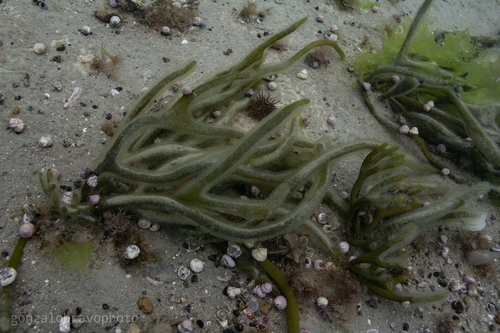
Codium fragile
(Suringar) Hariot
Seaweed sponge weed
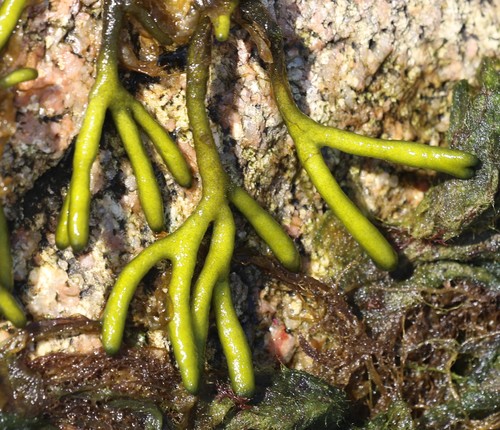
(c) Jackson Frost, some rights reserved (CC BY-NC), uploaded by Jackson Frost
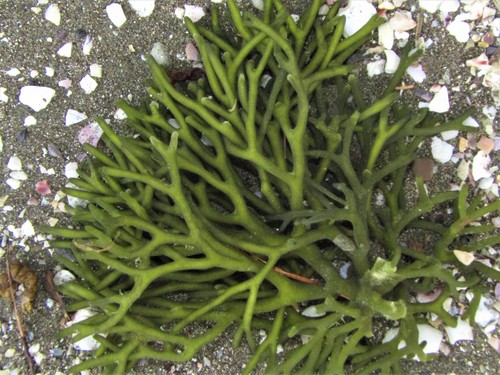
(c) Saryu Mae 前 朝琉, some rights reserved (CC BY), uploaded by Saryu Mae 前 朝琉
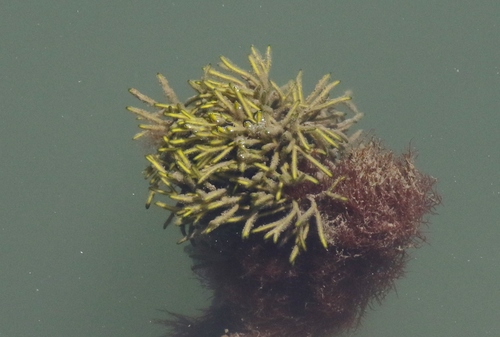
(c) James Bailey, some rights reserved (CC BY-NC), uploaded by James Bailey
What to Eat
Edible parts: Tea, Algae, Seaweed, Frond
The fronds are used in soups and sauces, and can be prepared as tea or eaten as seaweed.
Where to Find It
It is a temperate plant. It occurs on rough coasts below the tide level or in inter-tidal pools.
Alaska, America, Antarctica, Argentina, Asia, Australia, Britain, Canada, Canary Islands, Chile, China, Europe, France, Ireland, Japan, Korea, Mediterranean, Mexico, Namibia, Netherlands, New Zealand, North America, Norway, Philippines, Scandinavia, SE Asia, Southern Africa, Spain, Sri Lanka, Sweden, Tasmania, Turkey, Türkiye,
How to Identify
A green seaweed. It has a soft velvet-like surface. The fronds are round and branch. It is dark green in colour. The fronds can be 30 cm long.
Nutrition Score: 2/100
| Part | Moisture | kJ | kcal | Protein | Vit A | Vit C | Iron | Zinc |
|---|---|---|---|---|---|---|---|---|
| Seaweed dry | — | — | 10 | — | — | — | — | — |
Wikipedia
Source ↗Codium fragile, known commonly as green sea fingers, dead man's fingers, felty fingers, forked felt-alga, stag seaweed, sponge seaweed, green sponge, green fleece, sea staghorn, and oyster thief, is a species of seaweed in the family Codiaceae. It originates in the Pacific Ocean near Japan and has become an invasive species on the coasts of the Northern Atlantic Ocean.
Names & Synonyms
Cheonggak, Dead man's fingers, Miru, Sea velvet, Shui-sung, Shulsong, Tercioelo
References (15)
- Bonney, N., 2012, Edible Wild Native Plants for Southern Australia. p 96
- Breidahl H., 1997, Australian Southern Shores. Lothian. p 57
- Cribb, A.B. & J.W., 1976, Wild Food in Australia, Fontana. p 196
- Crowe, A., 1997, A Field Guide to the Native Edible Plants of New Zealand. Penguin. p 141
- Fuhrer, B.A. et al, 1981, Seaweeds of Australia. Reed. p 102
- Fujiwara-Arasaki, T. et al, 1984, The protein value in human nutrition of edible marine algae in Japan. Hydrobiologia 116/117, 513-516
- Irving, M., 2009, The Forager Handbook, A Guide to the Edible Plants of Britain. Ebury Press p 367
- Kiple, K.F. & Ornelas, K.C., (eds), 2000, The Cambridge World History of Food. CUP p 232, 234
- Low, T., 1992, Bush Tucker. Australia’s Wild Food Harvest. Angus & Robertson. p 35
- Pereira, L., 2011, A Review of the Nutrient Composition of Selected Edible Seaweeds. In Seaweed. Pomin V. H., (Ed.) Nova Science Publishers, Inc
- Song, M., et al, 2013, Traditional knowledge of wild edible plants in Jeju Island, Korea. Indian Journal of Traditional Knowledge. 12(2) pp 177-194
- Surey-Gent, S. & Morris G., 1987, Seaweed. A User's Guide. Whirret Books. London. p 22
- Tseng, C.K., 1983, Common seaweeds of China. Beijing.
- Xia, B., and Abbott, I.A., 1987, Edible seaweeds of China and their place in the Chinese diet. Economic Botany 41:341-53
- Zemke-White, W. L. & Ohno, M., 1999, World seaweed utilisation: An end-of-century summary. Journal of Applied Phycology 11: 369-376