Cola nitida
(Vent.) Schott et Endl.
Ghanja Kola, Bitter Cola
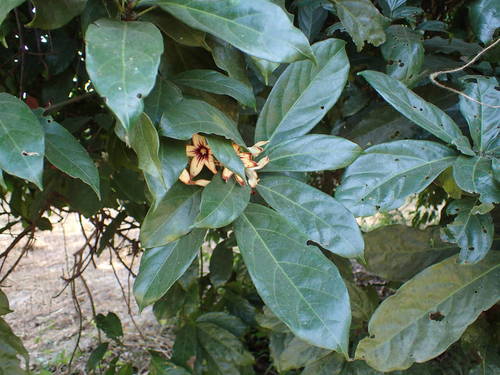
(c) Sylvain Piry, some rights reserved (CC BY-NC), uploaded by Sylvain Piry
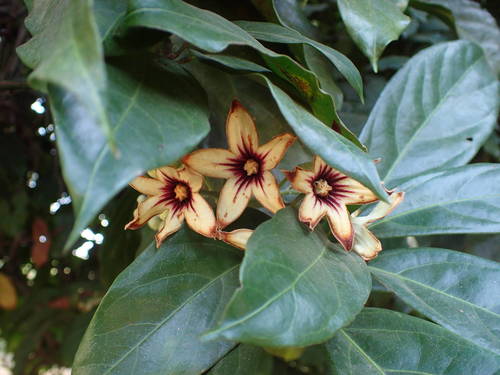
(c) Sylvain Piry, some rights reserved (CC BY-NC)
What to Eat
The aromatic seeds are especially rich in caffeine, with some seeds containing up to 3.5% caffeine, and act as a stimulant. They can be chewed or ground into a powder and made into a drink to provide energy, increase alertness, retard hunger and fatigue, aid digestion and increase stamina. Chewing the seeds also modifies taste perception so that any food or drink consumed immediately afterwards seems sweet. An extract prepared from the dried kernels is used to flavour carbonated drinks, ice cream, candy and baked goods.
Where to Find It
Western Tropical Africa - Sierra Leone, Côte d'Ivoire eastward to Ghana.
Lowland forest, usually at elevations up to 300 metres, but also found up to 800 metres.
How to Identify
Evergreen tree growing to 20m in height and width at a slow rate. Hardy to UK zone 10. Accommodates light sandy, medium loamy, and heavy clay soils with good drainage; tolerates very acidic and very alkaline conditions. Grows in semi-shade or full sun, adapting to dry or moist soil with good drought tolerance once established.
Nutrition Score: 49/100
| Part | Moisture | kJ | kcal | Protein | Vit A | Vit C | Iron | Zinc |
|---|---|---|---|---|---|---|---|---|
| Nuts dried | 11.5 | 1467 | 351 | 5.8 | — | — | 6 | — |
| Nuts | 62.9 | 619 | 148 | 2.2 | — | — | 2 | — |
How to Grow
Malvaceae
Propagation: The seeds are thought to require a period of dormancy for effective germination. Pre-soaking for 24 hours can improve germination rates. Sow seeds individually in containers — germination is generally slow, taking 2–3 months, though sowing at 30°C has achieved germination within 10–18 days. Parting the cotyledons before sowing has produced higher germination levels, likely by removing a mechanical constraint. Seedlings can be planted out after approximately 12 months. Seeds are sensitive to drying and low temperatures and should not be dried below approximately 30% moisture content. When wrapped in banana leaves at room temperature, seeds can be stored for a year or more without loss of viability. Propagation is also possible by cuttings of mature wood.
Medicinal Uses
The seeds are an astringent, bitter-sweet, antidepressant herb with a stimulant effect, particularly on the heart. Powdered seeds are taken internally in tonics for exhaustion, low energy and poor appetite, and are also used in treating diarrhoea. The following applies equally to Cola acuminata, as the seeds of both species are used interchangeably. Cola nuts contain up to 2.5% caffeine along with theobromine, tannins, phlobaphene and an anthocyanin. They stimulate the nervous system when chewed and are considered a digestive tonic, diuretic, astringent and antidepressant, counteracting overstrain and depression and improving both physical and mental state. The primary active principle is caffeine, with theobromine and kolatine as additional active compounds. Due to its astringent properties, cola is used as a non-addictive stimulant in the treatment of diarrhoea and dysentery, and to prevent vomiting in high fever. It has been used in treating headaches and migraine. In combination with coca leaf (Erythroxylum coca) it has been used to produce a stimulant drug sold as 'Forced March' tablets for explorers and military expeditions. Crushed nuts boiled with the leaves of Morinda lucida are taken internally to treat piles. Nuts ground to a fine paste with the leaves of Scoparia dulce, dissolved in a little water, are given in a few drops orally to babies for headache. Seeds are harvested when fully ripe and dried in the sun. An infusion of the bark with ginger and a little pepper is taken internally to treat stomach ulcers.
Other Uses
Plants are often used as shade trees in cocoa (Theobroma cacao) plantations. The sapwood is pinkish-white and the heartwood dull yellow; the wood is susceptible to borers. It is suitable for furniture, house and boat building, coach-work, plates, domestic utensils, gun stocks, joinery and carvings. The wood is also a good fuel source.
Wikipedia
Source ↗Cola nitida is a species of plant belonging to the family Malvaceae. It is a tree native to the rainforests of tropical West Africa. Common names include kola nut, cola, kola and bitter kola. The seeds contain caffeine and are chewed as a stimulant and used in the manufacture of soft drinks. The nuts and other parts of the tree have many uses of a ceremonial nature and in traditional medicine. The timber has multiple uses.
Production
A tree. It grows up to 8-12 m high. The trunk does not have branches for a few metres. There are buttresses to 1 m high. The bark is grey with cracks along it. The small branches are smooth. The leaves are not confined to the tips of branches. The leaves are simple and 9-32 cm long by 3.5-13 cm wide. They are leathery and dark green. The leaf stalk is 1-10 cm long. It is swollen at the top. The flowers are in short, irregular, branches clusters. The flowers are joined for 1/3 of their length forming a cup. The female flowers are 5 cm across and the male flowers 2 cm. They are white or cream with red marks inside. The fruit are made up of 5 cells which curve back. They are green and shiny. The fruit are 14 cm long by 7.5 cm wide. There are about 10 seeds. These are covered with a white skin. The seeds have purple seed leaves. When the seed coat is removed the seed splits into two.
Names & Synonyms
Ajauru, Bakuru, Buur, Cola, Coleira, Colo-fuque, Curo-djo-o, Curo, Essore, Evbe, Goeh, Goro, Kola, Leuh, Mancuur, N'kola, Obi-akechi, Obi-gbanja, Oji igbo, Opo, Pohon kola nitida, Pohon kola pahit, Uncurame
References (51)
- Ambasta, S.P. (Ed.), 2000, The Useful Plants of India. CSIR India. p 136
- Aniama, S. O., et al, 2016, Ethnobotanical documentaton of some plants among Igala people of Kogi State (Nigeria). The International Journal Of Engineering And Science (IJES). 5(4) pp 33-42
- Assogbadjo, A. E. et al, 2013, Specific Richness and Cultural Importance of Wild Edible Trees in Benin. Acta Hort. 979, ISHS 2013
- Atato, A., et al, 2010, Diversity of Edible Wild Fruit Tree Species of Togo. Global Science Books.
- Bernholt, H. et al, 2009, Plant species richness and diversity in urban and peri-urban gardens of Niamey, Niger. Agroforestry Systems 77:159-179
- Bremness, L., 1994, Herbs. Collins Eyewitness Handbooks. Harper Collins. p 50
- Brouk, B., 1975, Plants Consumed by Man. Academic Press, London. p 348, 377
- Brown, D., 2002, The Royal Horticultural Society encyclopedia of Herbs and their uses. DK Books. p 175
- Burkill, H. M., 1985, The useful plants of west tropical Africa, Vol. 5. Kew.
- Burkill, I.H., 1966, A Dictionary of the Economic Products of the Malay Peninsula. Ministry of Agriculture and Cooperatives, Kuala Lumpur, Malaysia. Vol 1 (A-H) p 641
- Catarino, L., et al, 2016, Ecological data in support of an analysis of Guinea-Bissau's medicinal flora. Data in Brief 7 (2016):1078-1097
- Cobley, L.S. (rev. Steele, W.M.) 2nd Ed., 1976, An Introduction to the Botany of Tropical Crops. Longmans. p 216
- Codjia, J. T. C., et al, 2003, Diversity and local valorisation of vegetal edible products in Benin. Cahiers Agricultures 12:1-12
- Dalziel, J. M., 1937, The Useful plants of west tropical Africa. Crown Agents for the Colonies London.
- Dibong, S. D., et al, 2011, Inventory and Biodiversity of species edible wild fruits sold in the markets of Douala, Cameroon. International Journal of Applied Biology and Pharmaceutical Technology. 2(3).
- Diop, A. l., et al, 2021, Cultural importance of wild edible plants in three sympatric communities: Agni, Akyé and Gwa in the Department of Alépé (Southeast of Côte d’Ivoire). Ethnobotany Research and Applications 22:35. p 6
- Eijnatten van, C.L.M., 1979, Kola, in Simmonds, N.W., (ed), Crop Plant Evolution. Longmans. London. p 284
- Etherington, K., & Imwold, D., (Eds), 2001, Botanica's Trees & Shrubs. The illustrated A-Z of over 8500 trees and shrubs. Random House, Australia. p 220
- Facciola, S., 1998, Cornucopia 2: a Source Book of Edible Plants. Kampong Publications, p 239
- Grivetti, L. E., 1980, Agricultural development: present and potential role of edible wild plants. Part 2: Sub-Saharan Africa, Report to the Department of State Agency for International Development. p 30, 33
- Hawthorne, W.& Marshall, C., 2013, Nimba Western Area Iron Ore Concentrator Mining Project Environmental and Social Impact Assessment. AcelorMittel Liberia. p 469
- Heywood, V.H., Brummitt, R.K., Culham, A., and Seberg, O., 2007, Flowering Plant Families of the World. Royal Botanical Gardens, Kew. p 311
- Hwang, L. C., et al, 2020, Traditional Botanical Uses of Non-Timber Forest Products (NTFP) in Seven Counties in Liberia. ACS Symposium Series; American Chemical Society: Washington, DC, 2020.
- Jardin, C., 1970, List of Foods Used In Africa, FAO Nutrition Information Document Series No 2.p 33
- Keay, R.W.J., 1989, Trees of Nigeria. Clarendon Press, Oxford. p 136
- Kiple, K.F. & Ornelas, K.C., (eds), 2000, The Cambridge World History of Food. CUP p 1797
- Kuhnlein, H. V., et al, 2009, Indigenous Peoples' food systems. FAO Rome p 260
- liberianfaunaflora.org Plant Atlas
- Manvell, A., 2011, Use of Non-Timber Forest Products around Sapo National Park, Liberia (Report B) p 51
- Melet. bot. 33. 1832
- Menninger, E.A., 1977, Edible Nuts of the World. Horticultural Books. Florida p 40
- Moutsambote, J., 1996, Vegetation forestiere et plantes alimentaires de la region de la Sangha. Chp. 11 of Bien Manger et Bien Vivre. ORSTOM p 119
- Nkeoua, G. & Boundzanga, G. C., 1999, Donnees sur les produits forestieres non ligneux en Republique du Congo. FAO. p 22
- Odebunmi, E., Oluwaniyi, O., Awoloa, G., et al., 2009, Proximate and Nutritional Composition of Kola Nut (Cola nitida), Bitter Cola (Garcinia cola) and Alligator Pepper (Afromomum melegueta). African Journal of Biotechnology, 8, 308-309.
- Parham, B. E. V., 1972, Plants of Samoa. New Zealand Department of Scientific and Industrial Research. Information Series. No. 85 p 46
- Peters, C. R., O'Brien, E. M., and Drummond, R.B., 1992, Edible Wild plants of Sub-saharan Africa. Kew. p 188
- Pham-Hoang Ho, 1999, An Illustrated Flora of Vietnam. Nha Xuat Ban Tre. p 511
- PROSEA (Plant Resources of South East Asia) handbook, Volume 16, 2000, Stimulants.
- Purseglove, J.W., 1968, Tropical Crops Dicotyledons, Longmans. p 566
- Russell, T.A., 1955, Tropical Agriculture 32
- Savill, P. S. & Fox, J. E. D., Trees of Sierra Leone. p 252
- Small, E., 2009, Top 100 Food Plants. The world's most important culinary crops. NRC Research Press. p 219
- Sneyd, L. Q., 2013. Wild Food, Prices, Diets and Development: Sustainability and Food Security in Urban Cameroon. Sustainability 2013, 5, 4728-4759
- Sukarya, D. G., (Ed.) 2013, 3,500 Plant Species of the Botanic Gardens of Indonesia. LIPI p 207
- van Wyk, B., 2005, Food Plants of the World. An illustrated guide. Timber press. p 149
- Vickery, M.L. and Vickery, B., 1979, Plant Products of Tropical Africa, Macmillan. p 90
- Vivien, J., & Faure, J.J., 1996, Fruitiers Sauvages d'Afrique. Especes du Cameroun. CTA p 342
- Wickens, G.E., 1995, Edible Nuts. FAO Non-wood forest products. FAO, Rome. p 84, 155
- Wiersema, J. H. & Leon, B., 2013, World Economic Plants. A Standard Reference CRC Press. 2nd Ed. p 190
- World Checklist of Useful Plant Species 2020. Royal Botanic Gardens, Kew
- www.worldagroforestrycentre.org/treedb/