Durio lanceolatus
Mast.
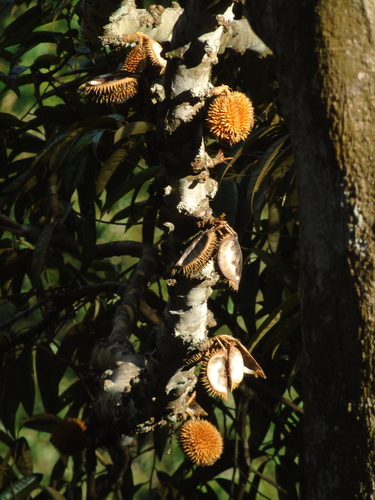
(c) Alponsin, some rights reserved (CC BY-NC-SA), uploaded by Alponsin

(c) Andre Ronaldo, some rights reserved (CC BY-NC)

Wikimedia Commons - Одоардо Беккари
What to Eat
Edible parts: Fruit
Durio lanceolatus is a source of durian timber, used in construction and furniture. The fruit of this species is not considered edible.
Where to Find It
It is a tropical plant. It occurs in Sarawak. It grows on sandy soils.
Asia, Indonesia, Malaysia, SE Asia,
How to Identify
A tree. It grows 50 m tall. The trunk is straight and 80 cm across. It has buttresses 3 m tall. The bark is rough and deeply cracked. The leaves are sword shaped and 6-9 cm long by 1.5-3 cm wide. The lower surface is dull and covered with brown scales. The flowers are 3 cm long. There are many flowers in a group. The fruit is a dull yellow and 10 cm across. It usually has 5 valves. There are pyramid shaped spines 6 mm long. The seeds are shiny black. The aril is thin and red to yellow.
Wikipedia
Source ↗Durio lanceolatus is a tree in the family Malvaceae. It grows up to 55 metres (180 ft) tall.
Other Information
There is little flesh and it has little taste.
Names & Synonyms
Durian anggang, Durian pelanduk
References (2)
- Chai, P.P.K., 2000, Development of the Lanjak Entimau Wild life sanctuary. Final report. ITTO and Sarawak Forestry. p 19
- Kebler, P. J. A., & Kidiyasa, 1994, Trees of the Balikpapan-Samarinda area of East Kalimantan, Indonesia. The Tropenbos Foundation, Wageningen, The Netherlands. p 61