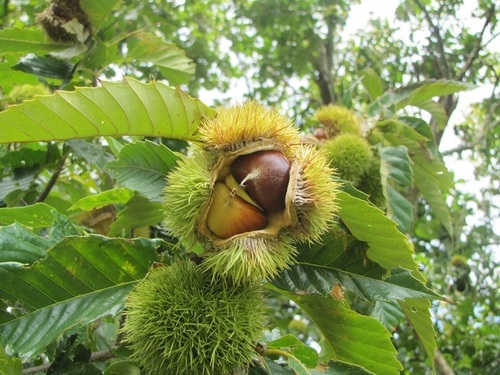
Quercus griffithii
Hook.f. & Thomson ex Miq.
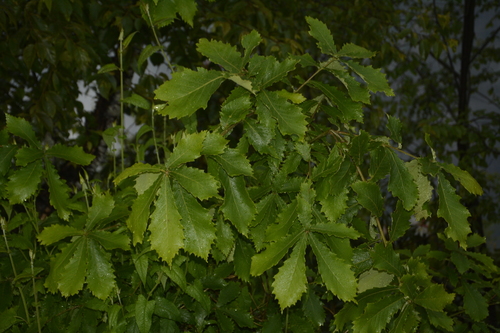
(c) Siddarth Machado, some rights reserved (CC BY)
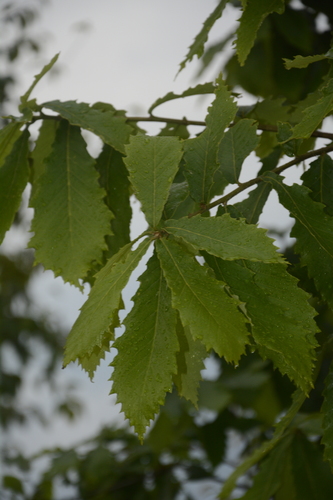
(c) Siddarth Machado, some rights reserved (CC BY)

(c) WWF EH2019 group 1, some rights reserved (CC BY-NC)
What to Eat
Edible parts: Seeds - flour, Nut
The seed flour is mixed with cereal flour and cooked. The nuts are edible.
Where to Find It
It is a temperate plant.
Asia, Bhutan, Himalayas, India, Northeastern India,
How to Identify
A temperate tree in the Fagaceae family.
Wikipedia
Source ↗Quercus griffithii, called paisang, is a species of oak native to the eastern Himalayas, Tibet, south-central and southeast China, Assam, Myanmar, Thailand, Laos, and Vietnam. It is in the subgenus Quercus, section Quercus. Some authorities feel that it could be a synonym of Quercus aliena var. acutiserrata. It is a deciduous tree reaching 25 metres (82 feet) with an oblong crown, typically found from 700 to 2,800 m (2,300 to 9,200 ft) above sea level. It is a locally important fuelwood and fodder species.
Names & Synonyms
Kra, Mon-cha-ra, Pa-sheng
References (4)
- Castillo, C., 2013, The Archaeobotany of Khao Sam Kaeo and Phu Khao Thong: The Agriculture of Late Prehistoric Southern Thailand. Ph. D. thesis University College, London p 380 (As Quercus aliena subsp. griffithii)
- Murtem, G. & Chaudhrey, P., 2016, An ethnobotanical note on wild edible plants of Upper Eastern Himalaya, India. Brazilian Journal of Biological Sciences, 2016, v. 3, no. 5, p. 63-81
- Tsering, J., et al, 2017, Ethnobotanical appraisal on wild edible plants used by the Monpa community of Arunchal Pradesh. Indian Journal of Traditional Knowledge. Vol 16(4), October 2017, pp 626-637
- Yeshi, K. et al, 2017, Taxonomical Identification of Himalayan Edible Medicinal Plants in Bhutan and the Phenolic Contents and Antioxidant Activity of Selected Plants. TBAP 7 (2) 2017 pp 89 - 106
More from Fagaceae