Cyclanthera langaei
Cogn.
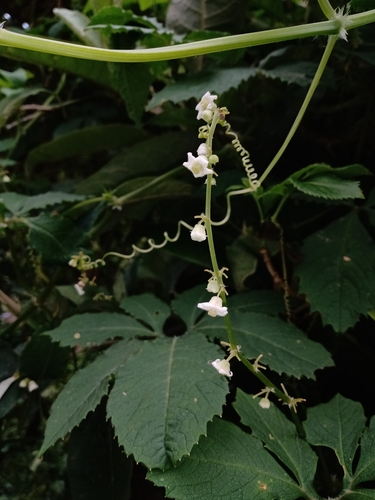
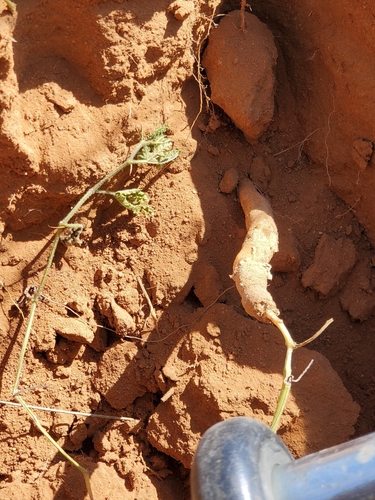
iNaturalist · cc-by-nc
(c) Sarahí Díaz, some rights reserved (CC BY-NC), uploaded by Sarahí Díaz
(c) Sarahí Díaz, some rights reserved (CC BY-NC), uploaded by Sarahí Díaz
What to Eat
Edible parts: Leaves
The young leaves are eaten.
Where to Find It
It is a tropical plant. In Costa Rica plants grow between 1,400-2,500 m above sea level.
Central America, Costa Rica, El Salvador, Guatemala, Honduras, Mexico, Nicaragua, Panama,
Countries: Belize, Costa Rica, Guatemala, Honduras, Mexico, Nicaragua, Panama, El Salvador
How to Identify
A pumpkin family herb. It is a vine. The leaves have 3-5 leaflets and teeth along the edge. The lower leaflets have lobes and are 12 cm long and wide. The end leaflet is not lobed. The tendrils are divided into 2. The male flowers are in groups in the axils of leaves. The female flowers occur singly. The fruit are green and 3 cm long. They open explosively when ripe. The seeds are oval and 9 mm long.
Nutrition Score: 28/100
| Part | Moisture | kJ | kcal | Protein | Vit A | Vit C | Iron | Zinc |
|---|---|---|---|---|---|---|---|---|
| Leaves - dry | 5.8 | — | — | 20.4 | — | — | — | — |
Names & Synonyms
Cincoquelites, Macuilquilitl, Yao-mbo hubo, Yao-mbo maratsi
Cyclanthera langaei subsp. gracillima Pittier
References (4)
- Lira, R. & Caballero, J., 2002, Ethnobotany of the Wild Mexican Cucurbitaceae. Economic Botany 56(4) pp. 380-398
- Mapes, C. & Basurto, F., 2016, Biodiversity and Edible Plants of Mexico. Chapter 5 in R. Lira, et al. (eds.), Ethnobotany of Mexico, Ethnobiology, Springer. p 112
- Pena, F. B., et al, 1998, Los quelites de la Sierra Norte de Puebla, Mexico: Inventory Y Formas de Preparacion. Bol. Soc. Bot. Mexico 62:49-62
- Piedra-Malagón, E. M. et al, 2022, Edible native plants of the Gulf of Mexico Province. Biodiversity Data Journal 10: e80565 p 17