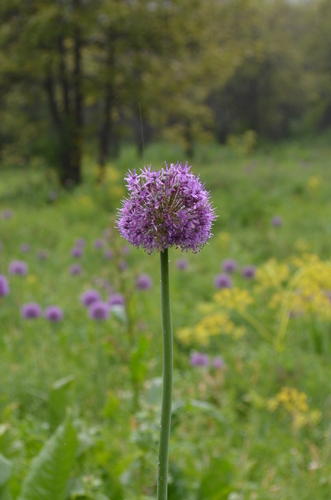
Allium auriculatum
Kunth
Kunth onion
AmaryllidaceaeSpice/Beverage

gbif · cc-by
The New York Botanical Garden
The New York Botanical Garden

gbif · cc0
Conveyor Belt
Conveyor Belt
What to Eat
Edible parts: Spice, Flavouring
It is used as a food flavouring, with both bulbs and leaves as spice.
Where to Find It
It is a temperate plant. It grows on rocky slopes between 3,350-5,480 m above sea level in the Himalayas.
Asia, Himalayas, India, Nepal,
Countries: United Arab Emirates, Afghanistan, Armenia, Azerbaijan, Bangladesh, Bahrain, Brunei, Bhutan, China, Georgia, Indonesia, Israel, India, Iraq, Iran, Jordan, Japan, Kyrgyzstan, Cambodia, North Korea, South Korea, Kuwait, Kazakhstan, Laos, Lebanon, Sri Lanka, Myanmar, Mongolia, Maldives, Malaysia, Nepal, Oman, Philippines, Pakistan, Qatar, Saudi Arabia, Singapore, Syria, Thailand, Tajikistan, Timor-Leste, Turkmenistan, Turkey, Taiwan, Uzbekistan, Vietnam, Yemen
How to Identify
An onion family herb. It grows 12-35 cm tall. The bulbs are cylinder shaped and 5-8 cm long by 1-1.5 cm wide. There are 3 or 4 leaves arising from the base of the stem. The leaves are narrow ad 12-20 cm long by 0.3-0.5 cm wide. The flowering groups are in a half circle and 1.5-2.5 cm wide.
Production
Flowering and fruiting occurs July to September.
References (4)
- Encyclopedia of Life.
- Pande, K. M., et al, 2015, Identification and Comparison of Volatile Constituents of Himalayan Phytofood; Allium auriculatum Kunth and its Antimicrobial Activity. International Journal of Life Sciences Vol. 4. No. 3. 2015. Pp.168-172
- Wiersema, J. H. & Leon, B., 2013, World Economic Plants. A Standard Reference CRC Press. 2nd Ed. p 33
- World Checklist of Useful Plant Species 2020. Royal Botanic Gardens, Kew