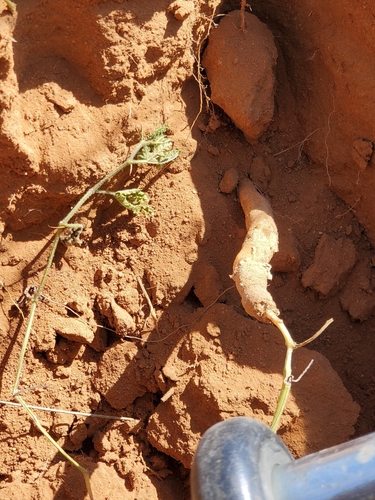
Corallocarpus bainesii
(Hook. f.) Meeuse

(c) nolliecilliers, some rights reserved (CC BY-NC)

(c) Dr. Alexey Yakovlev, some rights reserved (CC BY), uploaded by Dr. Alexey Yakovlev
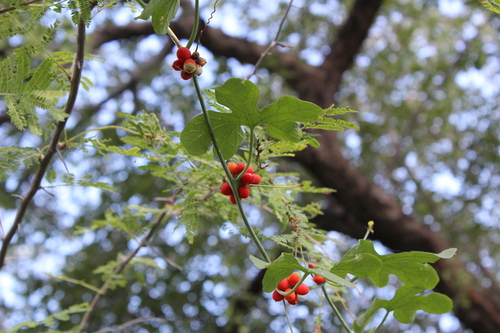
(c) Dewald du Plessis, some rights reserved (CC BY-NC), uploaded by Dewald du Plessis
What to Eat
Edible parts: Leaves, Stems, Fruit, Root, Vegetable
The ripe fruit is eaten raw. The tuberous root can be eaten raw or baked. Young leaves are eaten raw or cooked.
Where to Find It
A tropical plant. It grows in hot arid areas. It grows in areas with a marked dry season. It is rare in Swaziland. It grows in woodland and bushland between 350-1,150 m altitude. It grows in sandy areas. It can grow in arid places.
Africa, Angola, Botswana, Central Africa, Comoros, East Africa, Eswatini, Madagascar, Malawi, Mozambique, Namibia, South Africa, Southern Africa, Swaziland, Tanzania, Zambia, Zimbabwe,
How to Identify
A pumpkin family herb. It is a creeper. Older stems have brown bark. The leaves are simple and alternate. The leaf stalk is 2-5 cm long. The leaf blade is oval and deeply divided into 5 lobes like fingers on a hand. The leaves are heart shaped at the base. The flowers are in a congested cluster. The male flowers have stalks and female flowers do not. The fruit is small and 8-9 mm long by 6 mm wide. They are in clusters and bright red. They contain about 6 seeds.
Nutrition
| Part | Moisture | kJ | kcal | Protein | Vit A | Vit C | Iron | Zinc |
|---|---|---|---|---|---|---|---|---|
| Fruit | — | — | — | — | 23.6 | — | — | — |
How to Grow
Prefers a position with reasonable sun. Grows best in a well-drained, moderately fertile soil.
Other Information
A minor vegetable of local importance only.
Notes
There are about 10 Corallocarpus species.
Names & Synonyms
Moraanoga
References (24)
- Bosch, C.H., 2004. Corallocarpus bainesii (Hook.f.) A.Meeuse. [Internet] Record from Protabase. Grubben, G.J.H. & Denton, O.A. (Editors). PROTA (Plant Resources of Tropical Africa), Wageningen, Netherlands. < http://database.prota.org/search.htm>. Accessed 15 October 2009.
- Fox, F. W. & Young, M. E. N., 1982, Food from the Veld. Delta Books. p 178
- Grubben, G. J. H. and Denton, O. A. (eds), 2004, Plant Resources of Tropical Africa 2. Vegetables. PROTA, Wageningen, Netherlands. p 215
- Heinz & Maguire, 1974,
- INFOODS:FAO/INFOODS Databases
- Jardin, C., 1970, List of Foods Used In Africa, FAO Nutrition Information Document Series No 2.p 69, 130
- Lee, 1979,
- Leger, S., 1997, A Description of Today's Use of Plants in West Bushmanland (Namibia). German Development Service. PO Box 220035, 14061 Berlin, Germany. http://www.sigridleger.de/book/
- Long, C., 2005, Swaziland's Flora - siSwati names and Uses http://www.sntc.org.sz/flora/
- Maguire, 1978,
- Malan & Owen-Smith, 1974,
- Marshall, 1976, (Also as Corallocarpus sphaerocarpus)
- Martin, F.W. & Ruberte, R.M., 1979, Edible Leaves of the Tropics. Antillian College Press, Mayaguez, Puerto Rico. p 189 (As Corallocarpus sphaerocarpus)
- Matlhare, T., et al, Vegetables in Botswana. p 21 Bioversity website.
- Peters, C. R., O'Brien, E. M., and Drummond, R.B., 1992, Edible Wild plants of Sub-saharan Africa. Kew. p 99 (Also as Corallocarpus sphaerocarpus)
- Royal Botanic Gardens, Kew (1999). Survey of Economic Plants for Arid and Semi-Arid Lands (SEPASAL) database. Published on the Internet; http://www.rbgkew.org.uk/ceb/sepasal/internet [Accessed 15th April 2011]
- Ruiters-Welcome, A. K., 2019, Food plants of southern Africa. Ph.D. thesis. Univ. of Johannesburg p 48
- Silberbauer, 1965, (As Corallocarpus sphaerocarpus)
- Story, 1958, (As Corallocarpus welwitschii) and (As Corallocarpus sphaerocarpus)
- Swaziland's Flora Database http://www.sntc.org.sz/flora
- Tanaka, 1980,
- Wehmeyer, A. S, 1986, Edible Wild Plants of Southern Africa. Data on the Nutrient Contents of over 300 species
- Welcome, A. K. & Van Wyk, B.-E., 2019, An inventory and analysis of the food plants of southern Africa. South African Journal of Botany 122 (2019) 136–179
- World Checklist of Useful Plant Species 2020. Royal Botanic Gardens, Kew