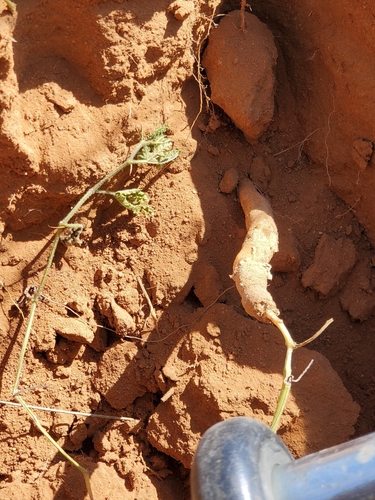
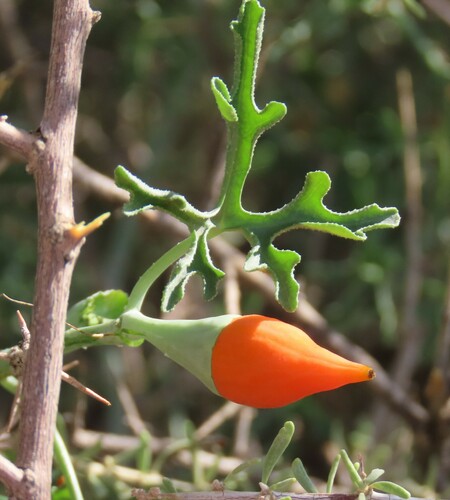
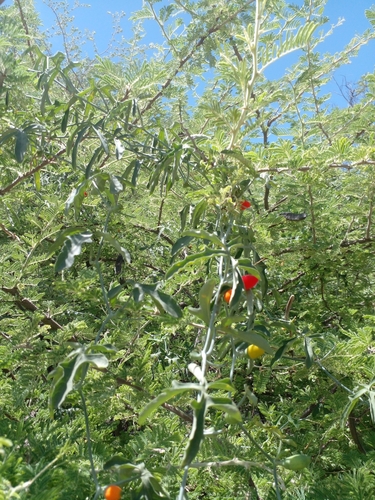
Corallocarpus welwitschii
(Naud.) Hook. f. ex Welw.
iNaturalist · cc0
no rights reserved
no rights reserved
iNaturalist · cc-by-nc
(c) Emilia Nakale, some rights reserved (CC BY-NC)
(c) Emilia Nakale, some rights reserved (CC BY-NC)
What to Eat
Edible parts: Roots, Stems, Leaves, Fruit
The stems are cooked in water or milk; the leaves are eaten raw or cooked in water or milk; the ripe fruit are sweet and eaten raw; the bitter roots are baked in ashes.
Where to Find It
A tropical plant. It grows in hot arid areas with a marked dry season. It grows in sands. It can grow in arid places.
Africa, Angola, Botswana, Central Africa, Congo, Namibia, South Africa, Southern Africa,
Countries: Angola, Burkina Faso, Burundi, Benin, Botswana, Congo (DRC), Central African Republic, Congo (Republic), Cote d'Ivoire, Cameroon, Cape Verde, Djibouti, Algeria, Egypt, Eritrea, Ethiopia, Gabon, Ghana, Gambia, Guinea, Equatorial Guinea, Guinea-Bissau, Kenya, Comoros, Liberia, Lesotho, Libya, Morocco, Madagascar, Mali, Mauritania, Mauritius, Malawi, Mozambique, Namibia, Niger, Nigeria, Rwanda, Seychelles, Sudan, Sierra Leone, Senegal, Somalia, South Sudan, Sao Tome & Principe, Eswatini, Chad, Togo, Tunisia, Tanzania, Uganda, South Africa, Zambia, Zimbabwe
How to Identify
A pumpkin family herb. It lie along the ground or can be a climber. It is 1 m long. It keeps growing from year to year. It has a taproot and puts out annual stems. The fruit are oblong and 2 cm long.
Nutrition Score: 28/100
| Part | Moisture | kJ | kcal | Protein | Vit A | Vit C | Iron | Zinc |
|---|---|---|---|---|---|---|---|---|
| Roots | 77.6 | 90 | 22 | 2.7 | — | 2.1 | 1.3 | 0.6 |
Names & Synonyms
Ohona, Okombanyengo
References (8)
- Bosch, C.H., 2004. Corallocarpus bainesii (Hook.f.) A.Meeuse. [Internet] Record from Protabase. Grubben, G.J.H. & Denton, O.A. (Editors). PROTA (Plant Resources of Tropical Africa), Wageningen, Netherlands. < http://database.prota.org/search.htm>. Accessed 15 October 2009.
- Fox, F. W. & Young, M. E. N., 1982, Food from the Veld. Delta Books. p 178
- Jardin, C., 1970, List of Foods Used In Africa, FAO Nutrition Information Document Series No 2.p 130
- Royal Botanic Gardens, Kew (1999). Survey of Economic Plants for Arid and Semi-Arid Lands (SEPASAL) database. Published on the Internet; http://www.rbgkew.org.uk/ceb/sepasal/internet [Accessed 15th April 2011]
- Ruiters-Welcome, A. K., 2019, Food plants of southern Africa. Ph.D. thesis. Univ. of Johannesburg p 48
- Wehmeyer, A. S, 1986, Edible Wild Plants of Southern Africa. Data on the Nutrient Contents of over 300 species
- Welcome, A. K. & Van Wyk, B.-E., 2019, An inventory and analysis of the food plants of southern Africa. South African Journal of Botany 122 (2019) 136–179
- World Checklist of Useful Plant Species 2020. Royal Botanic Gardens, Kew