Corchorus asplenifolius
Burch.
Wild jute
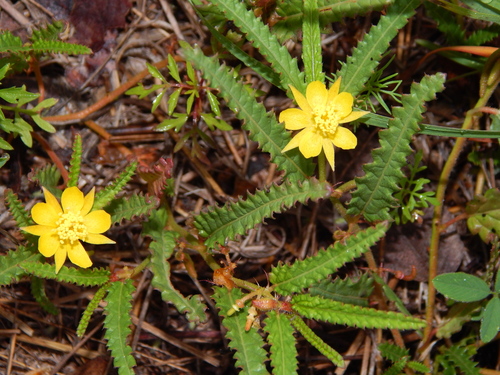
(c) Moira FitzPatrick, some rights reserved (CC BY-NC), uploaded by Moira FitzPatrick

(c) Troos van der Merwe, some rights reserved (CC BY-NC)

(c) Troos van der Merwe, some rights reserved (CC BY-NC)
What to Eat
Edible parts: Leaves, Vegetable
The leaves are stripped from the stem, washed, and boiled with a little potash to create a soft, slimy vegetable. The leaves can also be dried and stored for later use. It is a popular, common, and nutritious leafy vegetable.
Where to Find It
A tropical plant. It is rare in Swaziland. It grows in open woodland and on the edges of seasonal swamps. It grows between 300-1675 m above sea level. It can grow in arid places.
Africa, Botswana, East Africa, Eswatini, Mozambique, Namibia, South Africa, Southern Africa, Swaziland, Zambia, Zimbabwe,
How to Identify
A herb. It keeps growing from year to year. The stems are 50 cm tall and can be hairy. It has a woody rootstock. The leaves are alternate and narrow. There are wide teeth along the edge. The flowers are yellow and have 5 petals. The flowers are in the axils of leaves. The fruit are cylinder shaped capsules. There are many seeds and they are dark brown.
How to Grow
It can re-grow from the woody rootstock.
Medicinal Uses
The roots are dried, then pounded into a powder, which can be rubbed into incisions on the skin near the affected area when treating snake bites.
Other Uses
The ashes obtained from burning the plant have been used to dispel ants.
Other Information
A popular leafy vegetable. It is common and nutritious.
Notes
There are about 100 Corchorus species.
Names & Synonyms
Delelunanzwanowa, Derere, Geelvaringblaartjie, Gusha, Gwisha, Idelele, Igogola, Igusha
References (21)
- Exell, A.W. et al, (Ed), 1963, Flora Zambesiaca Vol 2 Part 1 Crown Agents, London. p 85
- FAO, 1988, Traditional Food Plants, FAO Food and Nutrition Paper 42. FAO Rome p 218
- Fondio, L. & Grubben, G.J.H., 2004. Corchorus olitorius L. [Internet] Record from Protabase. Grubben, G.J.H. & Denton, O.A. (Editors). PROTA (Plant Resources of Tropical Africa), Wageningen, Netherlands. < http://database.prota.org/search.htm>. Accessed 15 October 2009.
- Fox, F. W. & Young, M. E. N., 1982, Food from the Veld. Delta Books. p 350
- Grubben, G. J. H. and Denton, O. A. (eds), 2004, Plant Resources of Tropical Africa 2. Vegetables. PROTA, Wageningen, Netherlands. p 216
- Long, C., 2005, Swaziland's Flora - siSwati names and Uses http://www.sntc.org.sz/flora/
- Magwede, K., van Wyk, B.-E., & van Wyk, A. E., 2019, An inventory of Vhavenḓa useful plants. South African Journal of Botany 122 (2019) 57–89
- Maroyi, A., 2011, The Gathering and Consumption of Wild Edible Plants in Nhema Communal Area, Midlands Province, Zimbabwe. Ecology of Food and Nutrition 50:6, 506-525
- Maroyi, A., 2013, Use of weeds as traditional vegetables in Shurugwi District, Zimbabwe. Journal of Ethnobiology and Ethnomedicine 9:60
- Peters, C. R., O'Brien, E. M., and Drummond, R.B., 1992, Edible Wild plants of Sub-saharan Africa. Kew. p 190
- Pickering, H., & Roe, E., 2009, Wild Flowers of the Victoria Falls Area. Helen Pickering, London. p 109
- Royal Botanic Gardens, Kew (1999). Survey of Economic Plants for Arid and Semi-Arid Lands (SEPASAL) database. Published on the Internet; http://www.rbgkew.org.uk/ceb/sepasal/internet [Accessed 11th June 2011]
- Ruiters-Welcome, A. K., 2019, Food plants of southern Africa. Ph.D. thesis. Univ. of Johannesburg p 75
- Swaziland's Flora Database http://www.sntc.org.sz/flora
- Tredgold, M.H., 1986, Food Plants of Zimbabwe. Mambo Press. p 43
- van Wyk, B., 2005, Food Plants of the World. An illustrated guide. Timber press. p 151
- van Wyk, Be., & Gericke, N., 2007, People's plants. A Guide to Useful Plants of Southern Africa. Briza. p 68
- Welcome, A. K. & Van Wyk, B.-E., 2019, An inventory and analysis of the food plants of southern Africa. South African Journal of Botany 122 (2019) 136–179
- Wild, 1975,
- World Checklist of Useful Plant Species 2020. Royal Botanic Gardens, Kew
- www.zimbabweflora.co.zw 2011