Corchorus capsularis
L.
White Jute
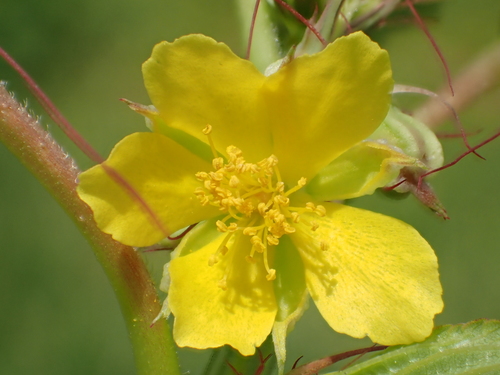
no rights reserved, uploaded by 葉子
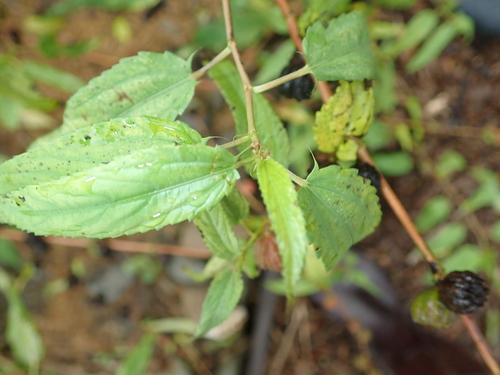
(c) 黃淑真, some rights reserved (CC BY-NC)

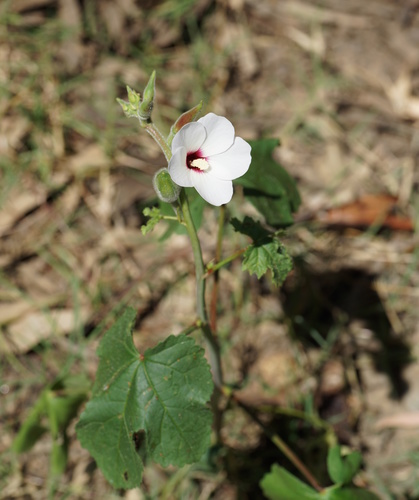
(c) botswanabugs, some rights reserved (CC BY-NC), uploaded by botswanabugs
What to Eat
Edible parts: Leaves, Seeds, Leaves - tea
Young leaves can be added raw to salads, while older leaves are cooked as a pot-herb. The leaves are high in protein, and when dried can be used as a thickener in soups. A tea is made from the dried leaves. Immature fruits are added to salads or used as a pot-herb.
Where to Find It
A tropical plant. In Nepal it grows to about 1200 m altitude. It grows in wetlands. In Sichuan and Yunnan.
Africa, Andamans, Asia, Australia, Bangladesh, China, Cuba, Egypt, Ethiopia, Himalayas, India, Indochina, Indonesia, Japan, Korea, Laos, Malaysia, Myanmar, Nepal, North Africa, North America, Northeastern India, Pakistan, Philippines, SE Asia, Sri Lanka, Taiwan, Thailand, USA, Vietnam, West Indies,
How to Identify
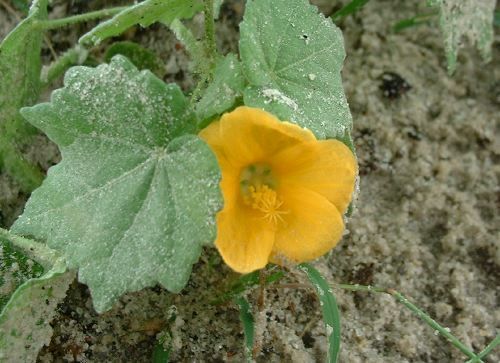
A shrub. It grows 1-2 m high. The leaves are alternate. The leaves are oval but long. They have teeth along the edge. Leaves are about 5-10 cm long by 1.5-3 cm wide. The leaf stalk is 1-4 cm long. Flowers are in the axils of leaves. Flowers are small and yellow. The fruit are round capsules. They have 10 ribs. The seed are 1.2 cm long by 1 cm wide. The seeds are angular.
Nutrition Score: 30/100
| Part | Moisture | kJ | kcal | Protein | Vit A | Vit C | Iron | Zinc |
|---|---|---|---|---|---|---|---|---|
| Leaves | — | — | — | 100 | — | — | — | — |
How to Grow
Prefers a very fertile soil and a hot humid climate. Tolerates very wet conditions according to one report whilst another says that it does not tolerate waterlogged soils. Tolerates a pH in the range 5.1 to 6.8. Jute is sometimes cultivated for the fibre in its stem and also for its edible leaves. It makes an excellent spinach substitute in areas with hot summers. This species is not hardy in Britain but it can be grown as a half-hardy annual here, though it grows much better in areas that are warmer than typical summers in this country. Some reports say that this plant is an annual whilst one says that it is perennial. Since the plant is not hardy in Britain we can only grow it as an annual. This species is very closely related to C. olitorius.
Propagation: Sow seed in spring in a greenhouse. Prick seedlings into individual pots when large enough to handle and plant out in late spring after the last expected frosts. In areas with hot summers, seed can be sown directly in situ in mid-spring.
Medicinal Uses
The leaves are appetizer, carminative, demulcent, laxative, stimulant and stomachic. An infusion treats dysentery, fevers, dyspepsia and liver disorders. A decoction of the roots and unripe fruits is used for dysentery. The seeds contain a substance with a similar action to digitalin from Digitalis species, though less intense in its effect on the heart.
Other Uses
The stems yield jute fibre, though this species tends to branch, which makes extraction more difficult; planting closely together reduces branching. The fibre is somewhat coarse and used mainly for sackcloth. When used for papermaking, the fibres are cooked for 2 hours with lye and ball milled for 4½ hours, producing a grey or buff paper. The very light, soft wood is used to make sulphur matches.
Wikipedia
Source ↗Corchorus capsularis (also known as patsun), commonly known as white jute, is a shrub species in the family Malvaceae. It is one of the sources of jute fibre, considered to be of finer quality than fibre from Corchorus olitorius, the main source of jute. The leaves are used as a foodstuff and the leaves, unripe fruit and the roots are used in traditional medicine.
Other Information
It is sold in markets. It is cultivated.
Notes
There are about 100 Corchorus species. It is high in proVitamin A.
Names & Synonyms
Ananba, Awachuwaey, Bagi pat, Chench arxa, Chinalitapat, Cho-pee-law, Chunch, Day dai, Deshi Paat, Desipat, Fotokani, Gon-shaw, Jelita, Jut, Kalasaka, Kaskomran, Ma ye, Morapat, Nalita, Narcha, Pat, Patshak, Patt, Patuwa, Paw kachao, Pilaw, Pilaw-yin, Pokok betong, Sada pat, Titamara, Titapat
References (44)
- Ambasta, S.P. (Ed.), 2000, The Useful Plants of India. CSIR India. p 140
- Ara, R. I. T., 2015, Leafy Vegetables in Bangladesh. Photon eBooks. p 126
- Arora, R. K., 2014, Diversity in Underutilized Plant Species - An Asia-Pacific Perspective. Bioversity International. p 39
- Awas, T., 1997, A Study on the Ecology and Ethnobotany of Non-cultivated Food Plants and Wild Relatives of Cultivated crops in Gambella Region, Southwestern Ethiopia. Addis Ababa University. p 69
- Azam, F. M. S., et al, 2014, Are Famine Food Plants Also Ethnomedicinal Plants? An Ethnomedicinal Appraisal of Famine Food Plants of Two Districts of Bangladesh. Evidence-Based Complementary and Alternative Medicine Volume 2014, Article ID 741712, 28 pages
- Bandyopadhyay, S. et al, 2009, Wild edible plants of Koch Bihar district, West Bengal. Natural Products Radiance 8(1) 64-72
- Burkill, I.H., 1966, A Dictionary of the Economic Products of the Malay Peninsula. Ministry of Agriculture and Cooperatives, Kuala Lumpur, Malaysia. Vol 1 (A-H) p 666
- Chowdhury, M. & Mukherjee, R., 2012, Wild Edible Plants Consumed by Local Communities of Maldah of West Bengal, India. Indian J.Sci.Res.3(2) : 163-170
- Dey, A. & Mukhererjee, A., 2015, Living and Survival Amidst Hunger: Wild Edible Botanicals as a Prime Forest Productivity in the Rural Purulia District, West Bengal, India from Colonial to Present. Research Journal of Forestry 9(3): 71-86
- Facciola, S., 1998, Cornucopia 2: a Source Book of Edible Plants. Kampong Publications, p 241
- FAO, 1988, Traditional Food Plants, FAO Food and Nutrition Paper 42. FAO Rome p 218
- Flora of Pakistan. www.eFloras.org
- Hedrick, U.P., 1919, (Ed.), Sturtevant's edible plants of the world. p 215
- Hossain, U. & Rahman, A., 2018, Study and quantitative analysis of wild vegetable floral diversity available in Barisal district, Bangladesh. Asian J. Med. Biol. Res. 2018, 4 (4), 362-371
- Jacquat, C., 1990, Plants from the Markets of Thailand. D.K. Book House p 69
- Kiran, K. C., et al, 2019, Diversity and Seasonal Availability of Potential Wild Edible Plants from Vidarbha Region of Maharashtra State, India. Int.J.Curr.Microbiol.App.Sci (2019) 8(2): 1434-1446
- Lazarides, M. & Hince, B., 1993, Handbook of Economic Plants of Australia, CSIRO. p 64
- Li, D. et al, 2017, Ethnobotanical survey of herbal tea plants from the traditional markets in Chaoshan, China. Journal of Ethnopharmacology. 205 (2017) 195-206
- Manandhar, N.P., 2002, Plants and People of Nepal. Timber Press. Portland, Oregon. p 169
- Martin, F.W. & Ruberte, R.M., 1979, Edible Leaves of the Tropics. Antillian College Press, Mayaguez, Puerto Rico. p 221
- Maikhuri, R, K, and Gangwar, A. K., 1993, Ethnobiological Notes on the Khasi and Garo Tribes of Meghalaya, Northeast India, Economic Botany, Vol. 47, No. 4, pp. 345-357
- Marandi, R. R. & Britto, S. J., 2015, Medicinal Properties of Edible Weeds of Crop Fields and Wild plants Eaten by Oraon Tribals of Latehar District, Jharkhand. International Journal of Life Science and Pharma Research. Vo. 5. (2) April 2015
- Miguel, E., et al, 1989, A checklist of the cultivated plants of Cuba. Kulturpflanze 37. 1989, 211-357
- Mishra, N., et al, 2016, Indigenous knowledge in utilization of wetland plants in Bhadrak district, Odisha, India. Indian Journal of Natural Products and Resources. Vol. 7(1) pp. 82-89
- Paczkowska, G . & Chapman, A.R., 2000, The Western Australian Flora. A Descriptive Catalogue. Western Australian Herbarium. p 560
- Pham-Hoang Ho, 1999, An Illustrated Flora of Vietnam. Nha Xuat Ban Tre. p 479
- Plants for a Future database, The Field, Penpol, Lostwithiel, Cornwall, PL22 0NG, UK. http://www.scs.leeds.ac.uk/pfaf/
- Purseglove, J.W., 1968, Tropical Crops Dicotyledons, Longmans. p 613
- Rashid, H. E., 1977, Geography of Bangladesh. Westview. p 310, 281
- Rodriguez-Amaya, D. B., 1999, Carotenoides y Prepracion de Alimentos. University Estadual de Campinas, Brasil, Ph.D. thesis. p 22
- Saikia, M., 2015, Wild edible vegetables consumed by Assamese people of Dhemaji District of Assam, NE India and their medicinal values. Archives of Applied Science Research, 2015, 7 (5):102-109
- Sang, D. T., & Mizoue, K. O. N., 2012, Use of Edible Forest Plants among Indigenous Ethnic Minorities in Cat Tien Biosphere Reserve, Vietnam. Asian Journal of Biodiversity Vol. 3 (1), p 23-49
- Sawian, J. T., et al, 2007, Wild edible plants of Meghalaya, North-east India. Natural Product Radiance Vol. 6(5): p 415
- Setiya, A. V., et al, 2016, Exploration and documentation of some wild edible plants used by the aboriginals from Gadchiroli District (M.S.) India. International Advanced Research Journal in Science, Engineering and Technology. 3(7)
- Shah, S. K., 2014, Dietary contribution of underutilized minor crops and indigenous plants collected from uncultivated lands and forests in Nepal. in Promotion of Underutilized Indigenous Food Resources for Food Security and Nutrition in Asia and Pacific. FAO. Bangkok p 64
- Singh, D.P., 1979, Jute, in Simmonds, N.W., (ed), Crop Plant Evolution. Longmans. London. p 290
- Singh, P.K., Singh, N.I., and Singh, L.J., 1988, Ethnobotanical Studies on Wild Edible Plants in the Markets of Manipur - 2. J. Econ. Tax. Bot. Vol. 12 No. 1 pp 113-119
- Smith, K., 1998. Growing Uncommon Fruits and Vegetables. New Holland. p 8
- Sp. pl. 1:529. 1753
- Tanaka,
- Wiersema, J. H. & Leon, B., 2013, World Economic Plants. A Standard Reference CRC Press. 2nd Ed. p 198
- Williams, C.N., Chew, W.Y., and Rajartnam, J.A., 1989, Tree and Field Crops of the Wetter Regions of the Tropics. Longman, p 84
- World Checklist of Useful Plant Species 2020. Royal Botanic Gardens, Kew
- Zeven, A. C. & de West, J. M. J., 1982, Dictionary of cultivated plants and their regions of diversity. Wageningen. p 79