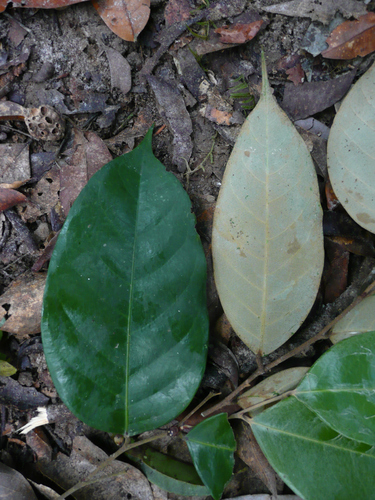
Parinari rodolphii
Huber
Rodolph parinari

Royal Botanic Gardens, Kew

Royal Botanic Gardens, Kew

Arizona State University Vascular Plant Herbarium (ASU-Plants)
What to Eat
Edible parts: Fruit
The fruit are eaten in some places.
Where to Find It
It is a tropical plant. It grows in forests that are not or only occasionally flooded.
Brazil, Colombia, Guianas, South America, Venezuela,
How to Identify
A tree. It grows 40 m tall. The trunk is 45 cm across. It can have buttresses 2 m high. The outer bark is flaky. The young branches have stiff rusty brown hairs. The leaves are alternate and simple. They are narrowly oval and 15 cm long by 4 cm wide. They are densely hairy underneath. The flowers are in dense groups at the ends of branches. These are 6 cm long and have rusty brown hairs. The fruit is narrowly oval and 6 cm long. It is warty and pinkish yellow on the outside. The flesh is starchy, yellow and has a sweet scent.
Other Information
The fruit are eaten in some places.
Names & Synonyms
Arato'y, Buhurada, Burada, Counter, Ereyuru, Farinha-seca, Karapa pori, Merecure, Merecure montanero, Merecurillo, Merecurillo hoja ancha, Napi, Tapowonureng, Wild potato
References (3)
- Grandtner, M. M. & Chevrette, J., 2013, Dictionary of Trees, Volume 2: South America: Nomenclature, Taxonomy and Ecology. Academic Press p 481
- Maas, P.J. M., Non-Timber Forest Products of the North-West District of Guyana Part 2. The 85 most important NTFP species. p 174
- Roa, J. A. G. & Boada, D. S. G., 2018, Fundación para el Fortalecimiento de la Fruticultura y Plantas Alimenticias no Convencionales en Colombia.